Showing posts with label Allen Bramhall. Show all posts
Showing posts with label Allen Bramhall. Show all posts
12.20.2007

6.08.2007
Allen Bramhall, fellow seasoned veteran of the American Muse Stakes (pronounced "mistakes"), says some kind words about me, & leaves his brand new book on my grave. (Hope he doesn't mind me swiping his photo...)

5.15.2007
Allen Bramhall is reading my book in Starbucks, says kind word. New England, May (2007). This is old country. Poets in moss & old manses. Makes me happy.
6.29.2005
I'm grateful to Allen for his encouragement. I would like to encourage him, too, though he probably doesn't need it, even if he thinks he does : Allen seems confirmed in his independent ways & schedule.
6.22.2005
Notes Toward & So On (5)
The image, the image... I bump up against the limits of my own vocabulary. One falls back into imagining some kind of neorealism, some one-to-one correspondence between the poet's picture & the "real thing". But this is definitely not what I'm talking about. It's not simply a perceptual flash, as in Imagism, or a familiar recounting, as in a realist novel or an anecdotal lyric or a memoir. "Symbol", as I mentioned, is perhaps a more appropriate word for what I'm talking about - a poetic whole which resonates with meaning in different directions, because it speaks from and to the experiential knowledge & feeling of its readers or listeners.
Take a look at Allen Bramhall's post of today. On first glance one is struck by the rather jarring dissonance between this kind of writing, and the "project" for poetry I have been describing. It's difficult here to pick out any kind of familiar "objective correlative", or synthesis of logic & impression. Yet obviously Allen is drawing on & pointing toward certain streams of writing, Whitman to the present. & he's engaged in a kind of poetry-making - a particular manner - which is not so concerned with representation as with pure creation : a kind of happy expressionism, which follows words in their sentences where they lead - resulting in continual surprise. However, if you look more carefully at this kind of writing, you recognize that under and around the sort of free jazz improvisation float the shadows & edges of both arguments (statements about how things are) and feelings (the emotions which words & their connotations evoke). The improvisation and the "mix", the "surround", go together, mutually encourage each other. And the whole leads in the direction of a sort of phantom impression or pseudo-argument (A = A) - self-defining, self-defending - an enjoyable end-in-itself.
Think, in this regard, with what Crane did with the Brooklyn Bridge. Despite the fact that he wrote parts of The Bridge from an apartment looking out on the actual bridge itself - an apartment once occupied by Roebling, the bridge's architect - Crane's goal was not to reiterate what was already known, or memorialize an already-existing history. Crane's purpose was symbolic. In the Brooklyn Bridge he had found a correlative for the real subject of his poem, which is too complex to be paraphrased. The bridge is a symbol for a metaphysical unity (a kind of time-transcending Bergsonian vital Beauty) for which poetry - Crane's "single, never-before-spoken Word" - is itself a more encompassing symbol or counterpart : creation's end-in-itself.
The poem of the "resonant symbol" which I am promoting, has less to do with 2-dimensional image-making, than with multidimensional "speaking pictures" : the fusion or synthesis of impressions into a unified complexity. At the root of speaking lies the cognitive (logical) image or impression - a paradoxical synthesis, which is the poem's underlying bone structure, its "argument". (Again, note how the scale of values differs, here, from that postmodern "indeterminacy" we have come to know so well.)
The image, the image... I bump up against the limits of my own vocabulary. One falls back into imagining some kind of neorealism, some one-to-one correspondence between the poet's picture & the "real thing". But this is definitely not what I'm talking about. It's not simply a perceptual flash, as in Imagism, or a familiar recounting, as in a realist novel or an anecdotal lyric or a memoir. "Symbol", as I mentioned, is perhaps a more appropriate word for what I'm talking about - a poetic whole which resonates with meaning in different directions, because it speaks from and to the experiential knowledge & feeling of its readers or listeners.
Take a look at Allen Bramhall's post of today. On first glance one is struck by the rather jarring dissonance between this kind of writing, and the "project" for poetry I have been describing. It's difficult here to pick out any kind of familiar "objective correlative", or synthesis of logic & impression. Yet obviously Allen is drawing on & pointing toward certain streams of writing, Whitman to the present. & he's engaged in a kind of poetry-making - a particular manner - which is not so concerned with representation as with pure creation : a kind of happy expressionism, which follows words in their sentences where they lead - resulting in continual surprise. However, if you look more carefully at this kind of writing, you recognize that under and around the sort of free jazz improvisation float the shadows & edges of both arguments (statements about how things are) and feelings (the emotions which words & their connotations evoke). The improvisation and the "mix", the "surround", go together, mutually encourage each other. And the whole leads in the direction of a sort of phantom impression or pseudo-argument (A = A) - self-defining, self-defending - an enjoyable end-in-itself.
Think, in this regard, with what Crane did with the Brooklyn Bridge. Despite the fact that he wrote parts of The Bridge from an apartment looking out on the actual bridge itself - an apartment once occupied by Roebling, the bridge's architect - Crane's goal was not to reiterate what was already known, or memorialize an already-existing history. Crane's purpose was symbolic. In the Brooklyn Bridge he had found a correlative for the real subject of his poem, which is too complex to be paraphrased. The bridge is a symbol for a metaphysical unity (a kind of time-transcending Bergsonian vital Beauty) for which poetry - Crane's "single, never-before-spoken Word" - is itself a more encompassing symbol or counterpart : creation's end-in-itself.
The poem of the "resonant symbol" which I am promoting, has less to do with 2-dimensional image-making, than with multidimensional "speaking pictures" : the fusion or synthesis of impressions into a unified complexity. At the root of speaking lies the cognitive (logical) image or impression - a paradoxical synthesis, which is the poem's underlying bone structure, its "argument". (Again, note how the scale of values differs, here, from that postmodern "indeterminacy" we have come to know so well.)
3.07.2005
this just in : Ramblin' Bramhall uses word "ducats". May have been reading Yourcenar in his subconscious mind.
12.02.2004
The Tribune in the Woods on prose versus versus. Responding to Laura Carter on lines & line-breaks.
My two cents: a line-break is a break in the sentence flow. If you break the line where there is no natural pause in the sentence, you emphasize the break: you juxtapose the "natural", ordinary flow of a sentence with the artifice of the poem.
This may be a way to heighten the intensity, by creating kind of a special, demarcated space. But "unnatural" breaks, after a while - especially if the actual sentences are not all that interesting - become simply annoying, or emphatically boring.
I usually like to "work with" the line-break. I use it to try to give more music (rhythm) to the sentence. I use odd or "unnatural" line-breaks rarely, & in conjunction with a particular meaning the sentence is conveying. What I like about line-breaks is that in addition to adding rhythm to the sentence with a pause, they also fortify the rhythmic unity of the individual lines. So these 2 things - the unity of the line & the rhythm of the break - work together.
But my aim & my practice is to get to the point where I don't have to think about this stuff. Because I'm really more interested in the overall momentum, and in the coalescence of a larger content or argument as a whole. Make it natural, make it flow. Then the real original content & diction will appear, almost magically, on its own.
This is probably the most conventional approach to these issues. But perhaps there's some advantage to developing a kind of natural, thoughtless practice, one which fits your own thoughtless nature. Natural, anyway, for thoughtless people like me. Painstaking poets will take a more painstaking approach.
p.s. this issue is complicated by the fact that a "natural" line-length does not always correspond with a "natural"-sounding break. This is where rhyme comes in very handy. Rhyme adds a 3rd layer of interest, like from a new direction, to (1) rhythmic unity of line and (2) rhythmic interest of the break. Rhyme is like the mortar used by masons, except you have to imagine a mason who erects some fantastic structure which follows the inclination of the mortar rather than the structure of the bricks.
My two cents: a line-break is a break in the sentence flow. If you break the line where there is no natural pause in the sentence, you emphasize the break: you juxtapose the "natural", ordinary flow of a sentence with the artifice of the poem.
This may be a way to heighten the intensity, by creating kind of a special, demarcated space. But "unnatural" breaks, after a while - especially if the actual sentences are not all that interesting - become simply annoying, or emphatically boring.
I usually like to "work with" the line-break. I use it to try to give more music (rhythm) to the sentence. I use odd or "unnatural" line-breaks rarely, & in conjunction with a particular meaning the sentence is conveying. What I like about line-breaks is that in addition to adding rhythm to the sentence with a pause, they also fortify the rhythmic unity of the individual lines. So these 2 things - the unity of the line & the rhythm of the break - work together.
But my aim & my practice is to get to the point where I don't have to think about this stuff. Because I'm really more interested in the overall momentum, and in the coalescence of a larger content or argument as a whole. Make it natural, make it flow. Then the real original content & diction will appear, almost magically, on its own.
This is probably the most conventional approach to these issues. But perhaps there's some advantage to developing a kind of natural, thoughtless practice, one which fits your own thoughtless nature. Natural, anyway, for thoughtless people like me. Painstaking poets will take a more painstaking approach.
p.s. this issue is complicated by the fact that a "natural" line-length does not always correspond with a "natural"-sounding break. This is where rhyme comes in very handy. Rhyme adds a 3rd layer of interest, like from a new direction, to (1) rhythmic unity of line and (2) rhythmic interest of the break. Rhyme is like the mortar used by masons, except you have to imagine a mason who erects some fantastic structure which follows the inclination of the mortar rather than the structure of the bricks.
10.27.2004
Justice Bramhall writes (in an opinion lodged as part of his "tributary 2004" brief):
"I also wonder about the surety artists have about their own work and what it is 'doing'. as if intent (even as far as one can know one's own intent) translated directly to practice. "
The wonder of it all is what grows unexpectedly out of certain ambitions, intentions (or stubborn allegiances, habits). So in my own explanatory-para-poetics anthill, the labyrinth of meaning is always seen in retrospect. I'm surprised by what coheres.
So if you, expert legal surveyor, go over here to Alephoebooks & re-read the two adjacent panels ("Midnight Knock" & the trip-to-London/sonnet fandango), I think you will agree with me that there is a kind of rhyme linking a manic "Shakespeare episode" in the mid-70s, a wayward rock n'roll adventure of the same period, and a NY-Schoolish/Berrymanish/Shakespearish sonnet-gumbo sequence written over 20 years later. In other words, the focus on Shakespeare doesn't go away, but it gets filtered through the lens of a much later time in life.
Did I plan this then, intentionally? No. Not guilty.
"I also wonder about the surety artists have about their own work and what it is 'doing'. as if intent (even as far as one can know one's own intent) translated directly to practice. "
The wonder of it all is what grows unexpectedly out of certain ambitions, intentions (or stubborn allegiances, habits). So in my own explanatory-para-poetics anthill, the labyrinth of meaning is always seen in retrospect. I'm surprised by what coheres.
So if you, expert legal surveyor, go over here to Alephoebooks & re-read the two adjacent panels ("Midnight Knock" & the trip-to-London/sonnet fandango), I think you will agree with me that there is a kind of rhyme linking a manic "Shakespeare episode" in the mid-70s, a wayward rock n'roll adventure of the same period, and a NY-Schoolish/Berrymanish/Shakespearish sonnet-gumbo sequence written over 20 years later. In other words, the focus on Shakespeare doesn't go away, but it gets filtered through the lens of a much later time in life.
Did I plan this then, intentionally? No. Not guilty.
10.21.2004
THE EXPOSITION OF MARION THE LIBRARIAN (copyrighted. any abuse, misuse, refuse, or booze in relation to the following will be prosecuted to the full extent of the public stocks in the public square of the Duchy of Grand Fenwick.)
A schtick is not a poetics.
This brief declarative sentence appeared, without further explanation, on the Bemsha Swing blog of poet, scholar, translator, jazz drummer, & inhabitant of Kansas, Jonathan Mayhew, yesterday.
This gnomic admonition cries out for interpretation and analysis. As author of the phd. dissertation "Genesis and Pratfall : the Poetics of Schtick in the Infernal Landscapes of Milton's Paradise Lost" (Harvard Univ., 1986), and presently municipal Librarian of River City, Iowa, I feel appropriately situated for such an endeavor.
We have learned, since the advent of historical-material-nosediggin methodologies, to approach text in context. Paradise Lost was not composed in a vacuum: it was orated verbally by one John Milton, specific middle-class London person, to his three specific daughters, Hepzibah, Pepzibah & Zepzibah, on a specific day, in a specific week, in a specific room, of a specific house, in a specific England - about none of which specifics, unfortunately, we have any specific information. Fortunately, however, we know much more about the schtick-poetics contextual nexus in question.
We understand that the issue taken up at Bemsha Swing has nothing to do with the poetics of schtick (the techniques, methodologies, and philosophies of composition of the specific types of tomfoolery, trickery, "routines" and impersonations, folded under the umbrella (the trick umbrella) of "schtick". Rather, Governor Mayhew is voicing a limit-rubric, a critique, a boundary-value, with respect to the philosophy of poetic composition. General Mayhew is asserting that schtick as we know it is an insufficient basis for a true praxis-oriented poetics.
There. We feel better now.
Now I would like to turn to a brief remark made by Lieutenant Mayhew in the Comment Box of a post yesterday at HG Poetics. Here Officer Mayhew states: "Take away Chaplin's pliant cane and hat, and he'd still be Chaplin." This little offhand remark actually drills toward the nub of the ambiguities swirling around schtick-poetics. Just as Chaplin does not exist, in any actual Chaplin mode we know of, without the totality of his performative acts - in fact, without his acts, Chaplin probably goes by a given name different from "Chaplin"! - just as Chaplin-&-his-schtick present a symbiosis of Person-In-Action or an apotheosis-disappearance of Person-Into-Creative-Act : so the Poet, and The-Poet-as-we-Knoet, is indivisible from the performative acts by which he-she embodies creative vocation.
Thus a poetics of Impersonation, of Echo & Mimicry, is none other than the biological imperative, encapsulated in the dance of the Bower-Bird of Tango-Nika, or the chortlings of the Chortle-Bird of Irkutzk; and the boingy schtick of Chaplin is no different from the squiggly phallic-Hermetic Stick of the Lame Oedip-Orpho-Burpic Shaman of the wilds of Northern Cressida, in Thessaly, O Child of Dionysos!!!
Now as Kernel Bramhall pointed out, a poet's (as opposed to a critic's, or a boll weevil's) poetics follows, rather than precedes, the work itself. A poetics is an armature, an adjunct, a trace, an emulsion, an extra walnut. As such, a poetics can indeed fold itself recursively (see my study, Nonlinear Dynamic Systems and Time Travels with Loch Nessie in the Poetry of Robbie Burns) back into the poetry itself, and in so doing, that is, in folding back into itself, folding, as I say, fold upon fold, so to speak, back, itself into, poetry, poetry can, fold, folding, folded, make creative use of poetics; but this granular-recursive aspect should not be understood in any other than a quarky way, that is, as a part, not a whole, of the performative array or implosion known as poetic crystallization. (For more information, fold here and throw yourself into River City! If you've got the moxie to step outside of Grand Fenwick for once in your lazy lives, laddies!)
A schtick is not a poetics.
This brief declarative sentence appeared, without further explanation, on the Bemsha Swing blog of poet, scholar, translator, jazz drummer, & inhabitant of Kansas, Jonathan Mayhew, yesterday.
This gnomic admonition cries out for interpretation and analysis. As author of the phd. dissertation "Genesis and Pratfall : the Poetics of Schtick in the Infernal Landscapes of Milton's Paradise Lost" (Harvard Univ., 1986), and presently municipal Librarian of River City, Iowa, I feel appropriately situated for such an endeavor.
We have learned, since the advent of historical-material-nosediggin methodologies, to approach text in context. Paradise Lost was not composed in a vacuum: it was orated verbally by one John Milton, specific middle-class London person, to his three specific daughters, Hepzibah, Pepzibah & Zepzibah, on a specific day, in a specific week, in a specific room, of a specific house, in a specific England - about none of which specifics, unfortunately, we have any specific information. Fortunately, however, we know much more about the schtick-poetics contextual nexus in question.
We understand that the issue taken up at Bemsha Swing has nothing to do with the poetics of schtick (the techniques, methodologies, and philosophies of composition of the specific types of tomfoolery, trickery, "routines" and impersonations, folded under the umbrella (the trick umbrella) of "schtick". Rather, Governor Mayhew is voicing a limit-rubric, a critique, a boundary-value, with respect to the philosophy of poetic composition. General Mayhew is asserting that schtick as we know it is an insufficient basis for a true praxis-oriented poetics.
There. We feel better now.
Now I would like to turn to a brief remark made by Lieutenant Mayhew in the Comment Box of a post yesterday at HG Poetics. Here Officer Mayhew states: "Take away Chaplin's pliant cane and hat, and he'd still be Chaplin." This little offhand remark actually drills toward the nub of the ambiguities swirling around schtick-poetics. Just as Chaplin does not exist, in any actual Chaplin mode we know of, without the totality of his performative acts - in fact, without his acts, Chaplin probably goes by a given name different from "Chaplin"! - just as Chaplin-&-his-schtick present a symbiosis of Person-In-Action or an apotheosis-disappearance of Person-Into-Creative-Act : so the Poet, and The-Poet-as-we-Knoet, is indivisible from the performative acts by which he-she embodies creative vocation.
Thus a poetics of Impersonation, of Echo & Mimicry, is none other than the biological imperative, encapsulated in the dance of the Bower-Bird of Tango-Nika, or the chortlings of the Chortle-Bird of Irkutzk; and the boingy schtick of Chaplin is no different from the squiggly phallic-Hermetic Stick of the Lame Oedip-Orpho-Burpic Shaman of the wilds of Northern Cressida, in Thessaly, O Child of Dionysos!!!
Now as Kernel Bramhall pointed out, a poet's (as opposed to a critic's, or a boll weevil's) poetics follows, rather than precedes, the work itself. A poetics is an armature, an adjunct, a trace, an emulsion, an extra walnut. As such, a poetics can indeed fold itself recursively (see my study, Nonlinear Dynamic Systems and Time Travels with Loch Nessie in the Poetry of Robbie Burns) back into the poetry itself, and in so doing, that is, in folding back into itself, folding, as I say, fold upon fold, so to speak, back, itself into, poetry, poetry can, fold, folding, folded, make creative use of poetics; but this granular-recursive aspect should not be understood in any other than a quarky way, that is, as a part, not a whole, of the performative array or implosion known as poetic crystallization. (For more information, fold here and throw yourself into River City! If you've got the moxie to step outside of Grand Fenwick for once in your lazy lives, laddies!)
9.28.2004
I'm listening to AB, see. De effin' gee w-hizz jive kums, muh mn, when, oh (y'know), pee-lostopherz quashtion thuh simple trut' of a Tex', (U C). Veeringly Way Say (Until U), X-peshially, Y - "Z".
Now where was I.
Recognizing the special pizzazz of some Language Poetries & Language Poets, their contributions to variety & interest. . . yet I would say it has its downside. It for me is like unto the Special Relationship between Mobster A and Poliktican B, whereby they both agree to discount the value of Representation. The enforced solipsism of Post-structuralism & Deconstruction (words dissipate & dissolve their authorial motivations, yet they are all we have) became both a justification & a compositional tool for poets, a style. A style of singling out & separating individual words from any particular context, "highlighting" the signifier. (Zukofsky was a pioneer, here.) This process simply amplifies what ordinary poetry does in a more limited and integrated way (integrated with other functions of language). In a similar way, advertising singles out & amplifies particular reductive-persuasive functions of speech.
Possibly it's an irony that Language Poetry succeeds as poetry, to the extent that words, language, cannot be completely streamlined - in truly deconstructive fashion, language escapes the best-laid plans of mice & langpos. Because carried to its limit - an unmotivated slather of words without conscious or unconscious design or purpose - the result would be too boring. Langpo is not quite too boring.
& now I know I'm being boring, since I done said it all before.
Now where was I.
Recognizing the special pizzazz of some Language Poetries & Language Poets, their contributions to variety & interest. . . yet I would say it has its downside. It for me is like unto the Special Relationship between Mobster A and Poliktican B, whereby they both agree to discount the value of Representation. The enforced solipsism of Post-structuralism & Deconstruction (words dissipate & dissolve their authorial motivations, yet they are all we have) became both a justification & a compositional tool for poets, a style. A style of singling out & separating individual words from any particular context, "highlighting" the signifier. (Zukofsky was a pioneer, here.) This process simply amplifies what ordinary poetry does in a more limited and integrated way (integrated with other functions of language). In a similar way, advertising singles out & amplifies particular reductive-persuasive functions of speech.
Possibly it's an irony that Language Poetry succeeds as poetry, to the extent that words, language, cannot be completely streamlined - in truly deconstructive fashion, language escapes the best-laid plans of mice & langpos. Because carried to its limit - an unmotivated slather of words without conscious or unconscious design or purpose - the result would be too boring. Langpo is not quite too boring.
& now I know I'm being boring, since I done said it all before.
9.23.2004
speaking so friendly of the big poem arena, Allen Bramhall rightly points to Rachel Blau du Plessis. There are many others missing from my list - hoovers I should know better. How could I leave out Susan Howe's historical collage-researches, for example.
Maybe that's why I had one of my occasional poetry dreams last night. In this one, a young blonde poet named Debbie(! - no relation to actual person that I know of) shows me her work, cut from some magazines like coupons. In fact, a couple of the poems incorporate coupon-phrases.
In this kind of dream which I have now & then, I read actual poems. I see them close up, line by line. "Debbie's" were so clever, witty, tender, brimming with sheer playful joy & verbal verve - I felt humbled & awkward offering my praise. I woke up wondering what remote & now inaccessible brain-region evoked all this.
Maybe that's why I had one of my occasional poetry dreams last night. In this one, a young blonde poet named Debbie(! - no relation to actual person that I know of) shows me her work, cut from some magazines like coupons. In fact, a couple of the poems incorporate coupon-phrases.
In this kind of dream which I have now & then, I read actual poems. I see them close up, line by line. "Debbie's" were so clever, witty, tender, brimming with sheer playful joy & verbal verve - I felt humbled & awkward offering my praise. I woke up wondering what remote & now inaccessible brain-region evoked all this.
9.16.2004
Thank you, Allen. You make my day, today. Generosity. (& Kent, ever alert & compagnevole.)
(On this day in 1999 I started the sequel to Stubborn G.)
(On this day in 1999 I started the sequel to Stubborn G.)
9.15.2004
This just in (Pravda) : Allen Bramhall reading Stubborn Grew
Allen - word of advice from the Author Position. Do not begin to feel that reading it is work, or that you are guilty, inadequate. I Author have ofttimes done my Readers (& Author-Self) a disservice by harping on the deep complexity and High Postoffice-Modern Seriousness-Quality of my Work.
Remember : the Poem was written by a (drunken/sleeping) snail (Dung-Beetle) trying to munch his way into Providence. It should be read in that Spirit as well. It was written for fun, fun, fun and is meant to be fun, fun, fun - a true Leisure Time Activity brought to you by Prof. Leisure Time himself.
I have found that the best way to read my Work is in the Tub, out loud, while your Significant Author pours buckets of warm Water over your head. This tends to bring out the real "Ocean State" flavor (or material status) of the Verse.
Allen - word of advice from the Author Position. Do not begin to feel that reading it is work, or that you are guilty, inadequate. I Author have ofttimes done my Readers (& Author-Self) a disservice by harping on the deep complexity and High Postoffice-Modern Seriousness-Quality of my Work.
Remember : the Poem was written by a (drunken/sleeping) snail (Dung-Beetle) trying to munch his way into Providence. It should be read in that Spirit as well. It was written for fun, fun, fun and is meant to be fun, fun, fun - a true Leisure Time Activity brought to you by Prof. Leisure Time himself.
I have found that the best way to read my Work is in the Tub, out loud, while your Significant Author pours buckets of warm Water over your head. This tends to bring out the real "Ocean State" flavor (or material status) of the Verse.
8.30.2004
Happy to notice Allen's early interest in Robert Benchley. Yes, he could have a big influence on poetry. Robert Benchley was my absolute favorite writer & hero when I was about 12. I wanted to write like him & I tried. (Started an independent school paper just so I could do Benchley-like routines on the weekly happenings around the old prison yard.)
Allen Bramhall seems a little like a solitary miner who's struck a vein, or an old New England water dowser with his birch-twig divining rod, out in the woods. His sentences don't describe anything directly, but you see things; there's nothing programmatic about his "abstraction", instead his poems convey a lot of feeling, without asking the reader to acknowledge anything in particular. He can be ironic, even sardonic, without being sarcastic or edgy in the usual (boring) ways. Much of his humor turns gradually outward and then back at himself. His work is fun to read, but it was good to hear him read: maybe he should get together with Jim Behrle for some audio sessions, & put out some sound blogs.
8.29.2004
I have to get Sarah at the train station in a few minutes, a bit rushed here. But feeling warm & happy about Cambridge reading yesterday, courtesy of the mysterious Jim Behrle. Happy to meet Allen Bramhall & Beth, and hear him read his [afraid to use conventional adjective] poetry, which I enjoyed a great deal.
A fine thing today to see Allen had been reading my poems in Stone (written 30 yrs ago) & liking something he read.
About the photo : it was taken on Houston St, in my high school friend Chris Kraemer's loft looking over at the World Trade Center, in 1975. Chris was a promising photographer in NY, who made a living as a builder (he is an archetypal Finn from MN, whose dad ran a hardware store there). He knew some bigshot artists at the time, Vito Acconci, Susan Acolella(? - don't know who I'm talking about). Also a whacky Russian sculptor named Ernst Niesvestny. When Stone was published, Chris arranged a little party at his studio someplace in Williamsburg. I remember sitting on a huge wooden crucifix sculpture he had laid out on the floor, being toasted with vodka. The title Stone, of course, was an imitation of Mandelstam's first book, Kamen ("Stone") - an acronym of akme ("acmeism"). So this party felt appropriate. Chris married a New Zealand clothing designer so she could get a green card, & they ended up staying together & having kids. He lives out in the Bay Area now. That's his typewriter & cot (I use a Sears Constellation myself). I was living with them for a few months in NY, helping Chris on interior painting jobs etc, before going over to London to try to take Mick Taylor's place in the Rolling Stones.
(p.s. Monday morning : through Denny Moers, a former student of Robert Creeley & studio assistant to Aaron Siskind, I was able to get an actual Siskind photo for the cover of Stone - some sections of Inca wall in Cuzco. The Inca/stone/Mandelstam/Vallejo configuration shows up 25 yrs later in the penultimate sections of Forth of July. Yesterday was the traditional anniversary, by the way, not only of the death of John the Baptist, but of the execution of Atahualpa, the last Inca ruler.)
A fine thing today to see Allen had been reading my poems in Stone (written 30 yrs ago) & liking something he read.
About the photo : it was taken on Houston St, in my high school friend Chris Kraemer's loft looking over at the World Trade Center, in 1975. Chris was a promising photographer in NY, who made a living as a builder (he is an archetypal Finn from MN, whose dad ran a hardware store there). He knew some bigshot artists at the time, Vito Acconci, Susan Acolella(? - don't know who I'm talking about). Also a whacky Russian sculptor named Ernst Niesvestny. When Stone was published, Chris arranged a little party at his studio someplace in Williamsburg. I remember sitting on a huge wooden crucifix sculpture he had laid out on the floor, being toasted with vodka. The title Stone, of course, was an imitation of Mandelstam's first book, Kamen ("Stone") - an acronym of akme ("acmeism"). So this party felt appropriate. Chris married a New Zealand clothing designer so she could get a green card, & they ended up staying together & having kids. He lives out in the Bay Area now. That's his typewriter & cot (I use a Sears Constellation myself). I was living with them for a few months in NY, helping Chris on interior painting jobs etc, before going over to London to try to take Mick Taylor's place in the Rolling Stones.
(p.s. Monday morning : through Denny Moers, a former student of Robert Creeley & studio assistant to Aaron Siskind, I was able to get an actual Siskind photo for the cover of Stone - some sections of Inca wall in Cuzco. The Inca/stone/Mandelstam/Vallejo configuration shows up 25 yrs later in the penultimate sections of Forth of July. Yesterday was the traditional anniversary, by the way, not only of the death of John the Baptist, but of the execution of Atahualpa, the last Inca ruler.)
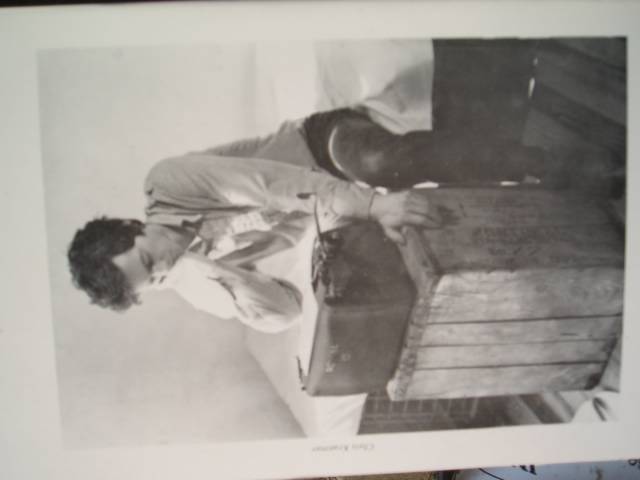
Here's a lopside photo of the photo Allen wrote about. More later (wish I could figure out how to flip this).

8.23.2004
7.19.2004
I've added Allen Bramhall's tributary to my blog links. I've been told we may be giving a reading together next month, up in the Hill-uv-Beans to the north (otherwise known as The HuB). I haven't given a reading in 700 years, to be precise.
Subscribe to:
Posts (Atom)


