Interesting op-ed piece in NY Times today about the value of fiction as opposed to (current favorite) memoirs.
I've tried doing that prose stuff, now & then. Started out writing short stories, in 8th grade or so. My first story was a satire on my school, The Blake School (which nomad Maria Damon visited recently). It featured a naive young knight named Miles Blakesley.
But I seem pretty addicted to poetry. It's the mumbling, I guess. Trouble is I'm scattered, numb from work, oldified, uninspired. Cain't make it cohere nohow, lately.
But I ain't given up, not just yet. Them Goulds is a stubborn bunch of mule-headed form farmers.
Showing posts with label Hen biography. Show all posts
Showing posts with label Hen biography. Show all posts
2.11.2006

1.12.2006
Responding in part to Robert A.'s interesting post on public/private manners & mannerisms:
Here's a passage from an essay that TS Eliot published in The Egoist in 1919 (& never republished):
"This relation is a feeling of profound kinship, or rather a peculiar personal intimacy, with another, probably a dead author. It may overcome us suddenly, on first or after long acquaintance; it is certainly a crisis; and when a young writer is seized with a passion of this sort he may be changed, metamorphosed almost, within a few weeks even, from a bundle of second-hand sentiments into a person...
...We may not be great lovers, but if we had a genuine affair with a real poet of any degree we have acquired a monitor to avert us when we are not in love... We do not imitate, we are changed; and our work is the work of the changed man; we have not borrowed, we have been quickened, and we become bearers of a tradition."
- this is quoted in Langdon Hammer's Hart Crane & Allen Tate, as part of his history of Crane/Tate/Eliot's ambiguous-subliminal erotic psychologies. Crane responded (as a gay man) to this early Eliot; Tate, on the other hand, to the reserved, impersonal, authoritative Eliot of "Tradition and the Individual Talent".
I post this to point to the contrast between this, on the one hand, and the informal, relaxed familiarity of the NY School approach (which RA describes). Poet-friendships, there, are not surrounded by an aura of ambiguity, romance & taboo.
This "demotic" attitude seems connected with the general relaxation (or vulgarization) of sexual mores : the taboos have broken down.
The idea that private name-dropping in poems, etc., impinges on the boundaries of traditional public speech is true in more ways than one.
I think it's possible to send private, personal messages & public messages - separately - in one and the same poem. The overuse of obviously private messages seems kind of slack, in a way. But it may also be a realistic acknowledgement of the limits of a poet's reach & impact. & it reflects, back to us, the quality of our own private lives.
Eliot's passage above, by the way, seems like a script for my own comically-representative experience (I mean Mandelstam's impact, & the "Shakespeare episode"). Shakespeare's ambiguously erotic & narcissistic sonnets literally knocked the wind out of me - & threw me back into the Biblical fold.
Oddly, Eliot here seems sane & healthy to me. He's talking about love, not "eros" or sex (hence his phrase, "we may not be great lovers" - funny). Love may involve passionate erotic energies, but it's not only that. Contemporary mores often simply reduce love to eros.
Here's a passage from an essay that TS Eliot published in The Egoist in 1919 (& never republished):
"This relation is a feeling of profound kinship, or rather a peculiar personal intimacy, with another, probably a dead author. It may overcome us suddenly, on first or after long acquaintance; it is certainly a crisis; and when a young writer is seized with a passion of this sort he may be changed, metamorphosed almost, within a few weeks even, from a bundle of second-hand sentiments into a person...
...We may not be great lovers, but if we had a genuine affair with a real poet of any degree we have acquired a monitor to avert us when we are not in love... We do not imitate, we are changed; and our work is the work of the changed man; we have not borrowed, we have been quickened, and we become bearers of a tradition."
- this is quoted in Langdon Hammer's Hart Crane & Allen Tate, as part of his history of Crane/Tate/Eliot's ambiguous-subliminal erotic psychologies. Crane responded (as a gay man) to this early Eliot; Tate, on the other hand, to the reserved, impersonal, authoritative Eliot of "Tradition and the Individual Talent".
I post this to point to the contrast between this, on the one hand, and the informal, relaxed familiarity of the NY School approach (which RA describes). Poet-friendships, there, are not surrounded by an aura of ambiguity, romance & taboo.
This "demotic" attitude seems connected with the general relaxation (or vulgarization) of sexual mores : the taboos have broken down.
The idea that private name-dropping in poems, etc., impinges on the boundaries of traditional public speech is true in more ways than one.
I think it's possible to send private, personal messages & public messages - separately - in one and the same poem. The overuse of obviously private messages seems kind of slack, in a way. But it may also be a realistic acknowledgement of the limits of a poet's reach & impact. & it reflects, back to us, the quality of our own private lives.
Eliot's passage above, by the way, seems like a script for my own comically-representative experience (I mean Mandelstam's impact, & the "Shakespeare episode"). Shakespeare's ambiguously erotic & narcissistic sonnets literally knocked the wind out of me - & threw me back into the Biblical fold.
Oddly, Eliot here seems sane & healthy to me. He's talking about love, not "eros" or sex (hence his phrase, "we may not be great lovers" - funny). Love may involve passionate erotic energies, but it's not only that. Contemporary mores often simply reduce love to eros.
12.13.2005
Returned late last night from unexpected unplanned trip to Toledo, Ohio. Had to post bail & find a lawyer for someone involved in anti-Nazi march protest. Strange trip. Waited around by myself at Lucas Cty Jail for 3.5 hrs. Watched jailor shift change; feel I know the entire Toledo Police Dept now, along with several recent arrestees.
In Toledo you pay $100./night for the courtesy of incarceration. The Radisson was cheaper.
Toledo reminded me architecturally of Minneapolis (i.e flat; snow; cold), with a little less going on. The homeless shelter (Cherry St. Mission) was literally jammed with skinny men, in for warmth & dinner : packed into both sides of long tables in dining hall. They are doing God's work there.
Getting more samples of my Lulu bks. I must keep tweaking the design slightly; a few minor glitches. Some of you will soon be lucky recipients of test-run pre-first editions...
In Toledo you pay $100./night for the courtesy of incarceration. The Radisson was cheaper.
Toledo reminded me architecturally of Minneapolis (i.e flat; snow; cold), with a little less going on. The homeless shelter (Cherry St. Mission) was literally jammed with skinny men, in for warmth & dinner : packed into both sides of long tables in dining hall. They are doing God's work there.
Getting more samples of my Lulu bks. I must keep tweaking the design slightly; a few minor glitches. Some of you will soon be lucky recipients of test-run pre-first editions...
11.30.2005
Woke up around 2 a.m. last night, was thinking about some comments in the Vico book (by Mazzotta), having to do with memory. Mazzotta writes something about the nature of memory, as the sign of a break or fracture between present & past. Memory registers the separation or distance between them.
This seems fairly obvious, but it got me thinking about my poetry ("memory, mother of the muses"), and about memory and space.
It might have something to do with having lived my adult life half a continent away from where I grew up. My sense of memory is always connected with distance in space as well as time.
I think about Proust's (heroic & mock-heroic) rendering of memory. Not that I'm a Proust expert, but I have the idea that with Proust, the action of memory is a kind of bridging & retrieval, an absorption in a past state, which sort of blossoms on its own.
My own sense of memory's action feels more like a distancing : as if one were closing one's eyes & going up in a balloon, or gaining some kind of bird's eye view of oneself, from far away, in a landscape or vast context (of time/space).
This is all rather vague, & maybe I should try to work up an essay or something. But as these notions were occurring to me last night, I also thought of Jonathan's comment of 11/26 :
"So much of reading poetry--and writing it--is ruminative and fragmented. An anxious, frustrating searching through books and magazines. The attention flags. There is not that unitary 6-hour experience of reading a novel, or the novelist's feeling of writing through a certain portion of the narrative."
I'm not sure what he means by "ruminative" here. But I understand the sense of a kind of jumpy or fragmented response to short poems & etc.
& I'm hoping that my own poetry somewhat works against or counters that kind of experience. I mean that these books & sequences of mine aim for a more sustained impression - of vastness - space & memory.
The first (& one of the only) reviews my poetry has received, was in a Brown U. student newspaper, written by an undergrad about my 1st book, Stone. I don't have it in front of me (this was almost 30 yrs ago), but she started it out with something like : "Henry Gould takes his time. He waits until the poem is ready." What she meant, I think, was that I composed slowly & quietly; the poems are sort of calm, without flash, bells & whistles.
I still like those little comments very much, & I think they relate to what I've tried to do.
[p.s. Vico himself might demur from such an individualistic notion of memory. For him memory & history & anthropology are all combined somehow.]
This seems fairly obvious, but it got me thinking about my poetry ("memory, mother of the muses"), and about memory and space.
It might have something to do with having lived my adult life half a continent away from where I grew up. My sense of memory is always connected with distance in space as well as time.
I think about Proust's (heroic & mock-heroic) rendering of memory. Not that I'm a Proust expert, but I have the idea that with Proust, the action of memory is a kind of bridging & retrieval, an absorption in a past state, which sort of blossoms on its own.
My own sense of memory's action feels more like a distancing : as if one were closing one's eyes & going up in a balloon, or gaining some kind of bird's eye view of oneself, from far away, in a landscape or vast context (of time/space).
This is all rather vague, & maybe I should try to work up an essay or something. But as these notions were occurring to me last night, I also thought of Jonathan's comment of 11/26 :
"So much of reading poetry--and writing it--is ruminative and fragmented. An anxious, frustrating searching through books and magazines. The attention flags. There is not that unitary 6-hour experience of reading a novel, or the novelist's feeling of writing through a certain portion of the narrative."
I'm not sure what he means by "ruminative" here. But I understand the sense of a kind of jumpy or fragmented response to short poems & etc.
& I'm hoping that my own poetry somewhat works against or counters that kind of experience. I mean that these books & sequences of mine aim for a more sustained impression - of vastness - space & memory.
The first (& one of the only) reviews my poetry has received, was in a Brown U. student newspaper, written by an undergrad about my 1st book, Stone. I don't have it in front of me (this was almost 30 yrs ago), but she started it out with something like : "Henry Gould takes his time. He waits until the poem is ready." What she meant, I think, was that I composed slowly & quietly; the poems are sort of calm, without flash, bells & whistles.
I still like those little comments very much, & I think they relate to what I've tried to do.
[p.s. Vico himself might demur from such an individualistic notion of memory. For him memory & history & anthropology are all combined somehow.]
11.14.2005
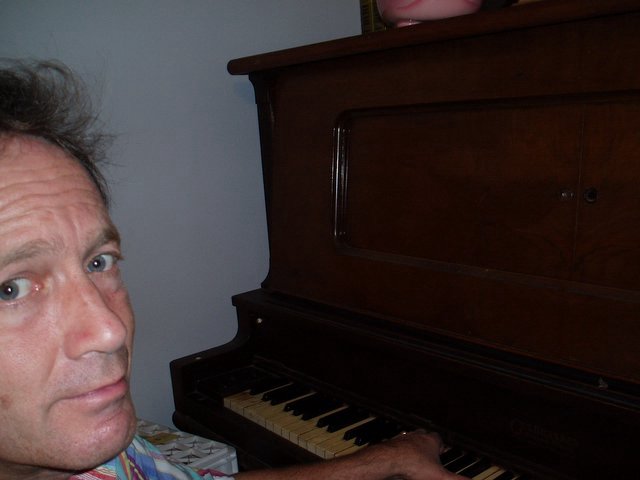
The house sported an old saloon-style (nail-hammer) piano, very dirty but amazingly in tune. Late at night, after the others had gone back to Baton Rouge & I was there by myself, I played the famous song "Can It Be"



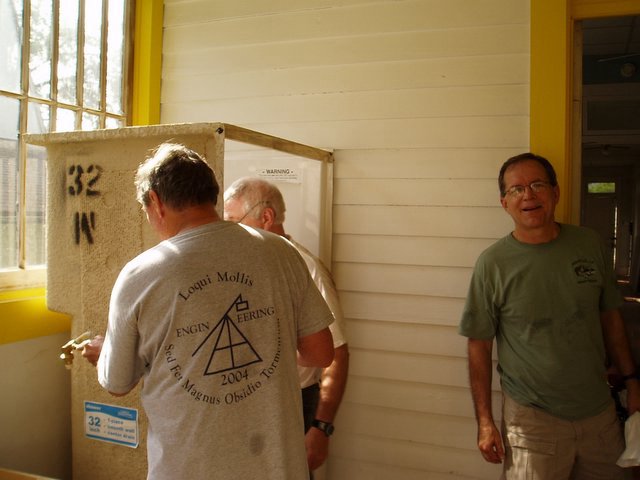
Bill & Micky, my heroes. Carpentry, plumbing, gas & electric, spiritual renewal : they can do it all. They brought so many tools that you could barely see the floor. We spent most of the week in the crawl space under the house. Before climbing under, Bill would yell : "Go on, snakes!" (water moccasins). But the only animals I saw all week were two cats.



11.02.2005
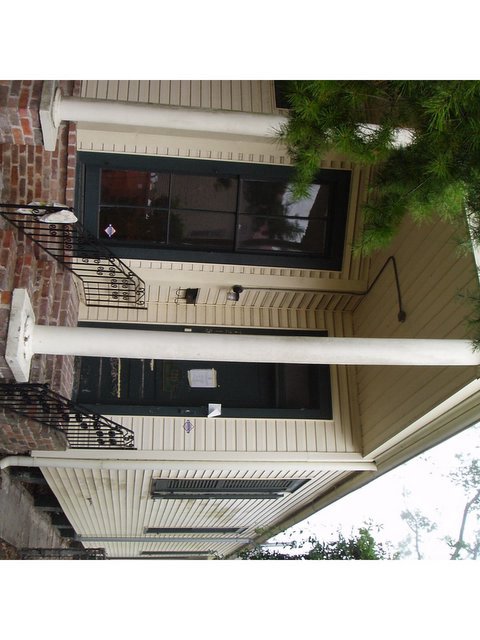
Have been gleaning a little more intelligence about my trip to N'Awlins, day after tomorrow. The house I'll be helping rehab is near Tulane U. It's off by itself. It has cracked doors, windows & floors. That's about the extent of my knowledge at this point. Hoping to learn more before I hit the road.
The Triptik I got from AAA has a little note : "I-10 and I-610 through New Orleans metro area are open, but only local residents with proper identification are allowed to exit." Sounds like they REALLY value their volunteers. If you don't hear from me after the 15th, I may be a Prisoner of Big Easy.
The Triptik I got from AAA has a little note : "I-10 and I-610 through New Orleans metro area are open, but only local residents with proper identification are allowed to exit." Sounds like they REALLY value their volunteers. If you don't hear from me after the 15th, I may be a Prisoner of Big Easy.
1.09.2004
7.15.2003
Subscribe to:
Posts (Atom)


