Having just heard this very morning about a conference at Columbia (Rethinking Poetics), I might possibly be able to attend some of it (be passing through NYC tomorrow). But just in case I can't, & because it's a quiet day here at ye olde library in ye olde Providence, I thought (& re-thought) I would do a little top-o'-th'-heading about Poetics right here, right now. A diary entry, of where we stand at the moment, lacunae & befoggeries & etc. inclusive.
As that Henry who tried valiantly to join the Rolling Stones, back in yon mythical 1970s.... & the poet Henry whose Major Cat Opusses have been for the most part ignored & dismissed by his fellows & peer cats... squirreled away & corner'd as yet he is in the fastnesses of the Rock (Rockefeller Library)... you might say Henry am the Stone the Builders Reject'd, poetickally speaking....
But all that aside... I can say my ponderous thinking rumbles & leans more & more toward an overwhelming apprehension of Personhood - of full human consciousness & sensibility & heart & soul - as the inalienable ground of Reality. Forgive me friends & fellow travelers if 1) this sounds like me repeating myself, and 2) this sounds like a truism.... all I can say is that it becomes more & more my frame of reference with relation to the purposes of Poetry (& thus my poetics). I think of this Personhood as including God - & by that I mean one of the consequences is that this Personhood within which we live & move & have our being is both individually subjective, unique, distinct, and shared, universal, objective... & I understand this is not something easily packaged & explained by logic, nevertheless I affirm it...
Can such a worldview prevail without constraining & hampering our human progress, our science & knowledge, & the objectivity thereof? I believe it can so prevail : in that the Reason which we share as a human birthright need not confuse Religious or Philosophical explanations for Scientific problems, nor will Science necessarily explain away Religion... (herein I do not wish to expound the arguments in favor of this assertion, & yet I hold it to be true...)
& here the special avenue for Poetry opens up... for Poetry is characteristically & forcefully representative of Reality as lived, as experienced... as human Drama : so that our special avenue takes a winding Turn about itself, it curves. By this I mean that Poetry is especially concordant - as dramatic personal expression - with the dramatic personal nature of history & experience in toto. This sounds, I know, like a tautology : but if you think of language as a kind of expressive limb or tool, adapted to its circumstances the way the shape of a boat is adapted to the watery element, then we can say that poetry is language adapted to the dramatic dimension of reality.
But we loiter here yet in a realm of generalities. How does all this apply (if it does) to HG's poetry, & the "poetics" of its making?
Personal.... dramatic. But I have a sense - reinforced of late by re-readings in the work & biography of John Berryman - that art & poetry are not really very dramatic as long as they remain detached from, or in denial of, their entanglements with the larger flow of world-time : of History (with regard to humanity generally) & of Memory (with regard to one's own life with & among others), & of the place where History & Memory conjoin... & of the ways we interpret - & by interpreting, shape - these things together. I, Henry, can't say what my own poetry will mean to others - only that it is those others, not Henry, who will respond to it & shape its meaning - for them, & for the future. This is not to deny my own paramount responsibility for shaping art according to my own best lights (such I would never want to deny, anyway!). It's only to say that it is in recognizing the shared nature of our time & history, that we discover the actual meaning(s) or themes of that work we are trying to accomplish. We leave a track, we make a mark... which perhaps participates in the free growth of understanding... of humankind's self-understanding... isn't this what cultural & artistic labor is about?
On the other hand, such labors will never be of much use to anyone if they don't exude a scent of original free play : if they are not of value in & of themselves, as themselves. Because this inherent value rhymes with & affirms the inherent value of all things & experience, of the universe itself. This is the artist's bond, the octave harmony, with reality as original Creation, the Dream out of Nothing...
Perhaps the crux of all this, the most interesting thing to me, is that matrix where the inexorable movement of time & History are fused with creation and free play. I see this symbolized in the ancient practices of Sabbath & Jubilee & Thanksgiving. I see this as the deepest root of the cosmopolitan global civilization - that peace on earth, that normative & ethical world civic society - the great goal toward which all the manifold labors of humanity on earth - all the terrific struggles & sacrifices - are pointing. The poet is the Maker : mixing & combining materials : & what are these materials? The matters of memory and conscience. The fond memories & memories of pain & loss, the crux of guilt & remorse, & the slow, slow soul-growth, out of self-bound greedy delusions & distractions, toward ripeness, maturity, true freedom... all these personal & dramatic testimonies (the substance of poems) which give shape to our apprehension & moral valuation of what is happening right Now - our contemporary world, the world for which we bear responsibility. In this articulation the poet holds forth self-judgement & the judgement of times & nations - held to the benchmark of that coming Jubilee.
More & more I recognize this world civilization as an expression of the human universals - borne out by & stretching beyond the concrete experience of every different nation & tribe on earth. This is why I assent, for example to Tocqueville's notion of the coming of Democracy upon the world as a sign of divine Providence : it entails the self-recognition of Everyman, of the Biblical "Son of Man" - that World-Person, that humanity, of which each of us (male & female, Jew & Greek, black & white etc. etc.) has a share in the full dignity thereof. We are living it already. There is no dividing wall, except that of the personal soul & conscience, for which in its choices & actions we bear sole responsibility; & all those choices & actions are carried out in the light of common sense, of shared universal reason & truth, & in the bond of responsibility we have, in our weakness, with the weaknesses of one another. "The high shall be brought low, & the low shall be lifted up, & all shall be made a level plain." That's the prophecy.
Now poetry can be seen in this light as the dramatic expression of the essential drama of the earth, as history unfolds - a drama which no other form of discourse can adequately model or perform. & maybe this is part of the dignity of poetry, & why cultures look to it to say what verges on the inexpressible : so that we may know it, & have it, & recognize it, & admit to it, & live it, & share it, & celebrate it. "The Word is bread & suffering", wrote Mandelstam. Or Stevens : “The whole race is a poet that writes down / The eccentric propositions of its fate.”
6.11.2010

6.09.2010

I think this photo was taken around 1975, in NYC, in Chris Kraemer's & Susan Soto's loft on Houston St. (the WTC outside their window)... where I stayed for several weeks (months?) before going over to London (to try to join the Rolling Stones.... !). Chris was taking photographs all over the place with his big old-fashioned b&w glass negatives... buildings, bridges, lots of portraits.... & doing carpentry & cabinet-making (with which I tried to assist a little & earn my keep)... Susan then an up-&-coming fashion designer, the loft always a beehive. (Chris & I went to high school together back in MN.)
Democracy in America
This New Yorker article by James Wood got me reading Tocqueville's Democracy in America, one of da many books I was sposed to read, way back... been on my shelf for about 30 yrs...
& it's inspiring many deep thoughts which I canna articulate at this time.... you gotta believe me... I'd like to be blogging more actively again, but many things both inward & outward push against it these days...
Pondering Tocqueville's "providential" sense of the advent of the mighty power of democracy, & in its American incarnation (& I use that word advisedly in this context). T's view stems in part from his understanding of Christianity : ie. in God's eyes all human beings a'being equal, with inalienable dignity & rights as genuine (though sinful) children of, made in the image of, same. & this spiritual (theological) equality T. sees as borne out in history by the destruction (by the power of Equality) of artificial distinctions of class & inherited social privilege, and the assumption (everyone's inherent right), by a great variety of means, of the skills, knowledge, & determination necessary for liberty. The establishment of township democracy in New England villages, based not so much on material self-interest as on a radically egalitarian set of beliefs about spiritual & civil authority (cf. Pilgrims, Puritans, Roger Williams, etc.) - all this T. understands as offering evidence of the divine shaping of human history (divine providence).
One has to try to get "inside" this theological perspective, where we are witnesses (in time) to God's "overthrowing Kings & Powers" (Rog. Wms.) on behalf of "the Son of Man". Of course such n'all had more obvious bite back when democracy was still rivaled by monarchy & other forms of autocracy, back then.... (or is it really only back then)? (I think of Melville's famous apostrophe in Moby Dick - "O Democracy!" - when he describes God grabbing old backwoods Andrew Jackson out of nowhere and throwing him on a horse to lead the new nation...)
More to come, maybe.... am just getting into first chapters. Relishing T's introduction, with its geographical sweep (North America made of 2 massive planes, one shifting toward the Arctic, the other in the vast bowl of the middle, between the 2 mountain ranges.... with the tipping point at the source of the Mississippi (originally called the "St. Louis" by French explorers), up there in Itasca, MN... I stepped over that particular brook, when I was 10 or so...)
*
p.s. (later) I know all kinds of intellectual dangers lurk in this direction (I mean reading theological signs in history). Such as national chauvinism, American exceptionalism... not to mention the legion of devils in the details (of practical politics).
Details like : Wall Street thieves bloated on the dough of the people; politicians conniving to throw more of it to rich & powerful & greedy special interests (be they industrialists, Masters of War, lobbyists, union bureaucrats, &, lest we forget, themselves); professional demagogues, media moguls & cynical factionalists, making a quick buck serving a coating of propaganda over real injustices & suffering; fat complacent satisfied American vulgarians, supremely content just as long as they get quite a bit more than their fair share; all the vain drones of political self-righteousness, suffocating the American earth beneath the bad breath of their yammering shibboleths & self-flattering cliches... we could all go on.... O Democracy! O Populism!
For the time being I'll just claim my valid & registered poetic license. The poetry of a culture is analogous to the memory & sensibility of an individual person. In an Augustinian sense (I guess), Time itself is a function of human memory & its intellectual/interpretive sensibility. We live in a fleeting Now; the past no longer exists, except on board the good ship Memory (Mandelstam's "funeral barge") & its truthful recall; & the future we make depends on the substantiality (or not) of that truthfulness.
At least this is one way to look at it. Then again, I'm not completely ruling out angels & time travel, either (cf. certified poetic license again). The muse of memorious poetry plays with her inheritance like a child with a toy boat (cf. Heraclitus).
& it's inspiring many deep thoughts which I canna articulate at this time.... you gotta believe me... I'd like to be blogging more actively again, but many things both inward & outward push against it these days...
Pondering Tocqueville's "providential" sense of the advent of the mighty power of democracy, & in its American incarnation (& I use that word advisedly in this context). T's view stems in part from his understanding of Christianity : ie. in God's eyes all human beings a'being equal, with inalienable dignity & rights as genuine (though sinful) children of, made in the image of, same. & this spiritual (theological) equality T. sees as borne out in history by the destruction (by the power of Equality) of artificial distinctions of class & inherited social privilege, and the assumption (everyone's inherent right), by a great variety of means, of the skills, knowledge, & determination necessary for liberty. The establishment of township democracy in New England villages, based not so much on material self-interest as on a radically egalitarian set of beliefs about spiritual & civil authority (cf. Pilgrims, Puritans, Roger Williams, etc.) - all this T. understands as offering evidence of the divine shaping of human history (divine providence).
One has to try to get "inside" this theological perspective, where we are witnesses (in time) to God's "overthrowing Kings & Powers" (Rog. Wms.) on behalf of "the Son of Man". Of course such n'all had more obvious bite back when democracy was still rivaled by monarchy & other forms of autocracy, back then.... (or is it really only back then)? (I think of Melville's famous apostrophe in Moby Dick - "O Democracy!" - when he describes God grabbing old backwoods Andrew Jackson out of nowhere and throwing him on a horse to lead the new nation...)
More to come, maybe.... am just getting into first chapters. Relishing T's introduction, with its geographical sweep (North America made of 2 massive planes, one shifting toward the Arctic, the other in the vast bowl of the middle, between the 2 mountain ranges.... with the tipping point at the source of the Mississippi (originally called the "St. Louis" by French explorers), up there in Itasca, MN... I stepped over that particular brook, when I was 10 or so...)
*
p.s. (later) I know all kinds of intellectual dangers lurk in this direction (I mean reading theological signs in history). Such as national chauvinism, American exceptionalism... not to mention the legion of devils in the details (of practical politics).
Details like : Wall Street thieves bloated on the dough of the people; politicians conniving to throw more of it to rich & powerful & greedy special interests (be they industrialists, Masters of War, lobbyists, union bureaucrats, &, lest we forget, themselves); professional demagogues, media moguls & cynical factionalists, making a quick buck serving a coating of propaganda over real injustices & suffering; fat complacent satisfied American vulgarians, supremely content just as long as they get quite a bit more than their fair share; all the vain drones of political self-righteousness, suffocating the American earth beneath the bad breath of their yammering shibboleths & self-flattering cliches... we could all go on.... O Democracy! O Populism!
For the time being I'll just claim my valid & registered poetic license. The poetry of a culture is analogous to the memory & sensibility of an individual person. In an Augustinian sense (I guess), Time itself is a function of human memory & its intellectual/interpretive sensibility. We live in a fleeting Now; the past no longer exists, except on board the good ship Memory (Mandelstam's "funeral barge") & its truthful recall; & the future we make depends on the substantiality (or not) of that truthfulness.
At least this is one way to look at it. Then again, I'm not completely ruling out angels & time travel, either (cf. certified poetic license again). The muse of memorious poetry plays with her inheritance like a child with a toy boat (cf. Heraclitus).
6.08.2010
Po-rendipity
It happens. I'm working on a poem. Like a lot of them lately, this one involves illness & recovery, death & rebirth. There's a bit about someone in a hospital - I mention "Room 132". (I'm thinking of Beethoven's late quartet, opus #132, the hymn of thanksgiving for his recovery from illness - among other things.) I finish the poem, & I'm so happy with it I send it off to a magazine. I pick up Berryman's Dream Songs, which I've been reading lately - flip by chance to Part III, which comes immediately after the "opus posthumous" section, & in which "Henry" comes back from the dead. There's a title on the 1st poem : "Room 231".
HG on GG
Reading Gabriel Gudding - first appeared in Critical Flame - has been published jointly by Jacket magazine.
6.07.2010
Henry & Berryman, Berryman & Henry H.
Silence reigns at HG Poetics. Wuz happening?
Still working on long poem, Lanthanum. Rather than posting to the web, I'm sending it out in pieces to magazines.
Finally actually finished excellent Paul Mariani bio of John Berryman (Dream Song). (Must have started reading this about 20 yrs ago.) & have been delving into Berryman's work more closely.
He seems so different from me (his personality) in almost every way. Where he is tortured, I am calm. Terrible childhood, happy childhood. When he is fiery & mercurial, I'm subdued & detached. (He is "bored Henry" - I'm just... boring.) Different brands of negative capability, maybe. Where he struggles & works hard, I am complacent, lazy (everything comes easily, & always has). Well.... & he's famous, & I'm.... - might be a relation there.*
I note a few odd parallels & connections, however. Minneapolis. He lived at 33 Arthur Ave. in his last years, just a few blocks from where my parents have lived, early & late (I grew up on Arthur Street, myself). He jumped off the Washington Bridge on my grandfather's birthday, a few blocks from his house. Toward the end of his career (& life), he experienced charismatic religious experiences. This happened to me at the outset of my poetry "career." He taught at Brown briefly, a couple years before I arrived. & Edwin Honig assigned me the task of organizing the memorial reading there in his honor (1972).
& then there's the Huffy Henry factor...
*though some people might disagree with this self-assessment. My wife, for instance, would probably call me a nervous melancholic obsessive scribbler.
Still working on long poem, Lanthanum. Rather than posting to the web, I'm sending it out in pieces to magazines.
Finally actually finished excellent Paul Mariani bio of John Berryman (Dream Song). (Must have started reading this about 20 yrs ago.) & have been delving into Berryman's work more closely.
He seems so different from me (his personality) in almost every way. Where he is tortured, I am calm. Terrible childhood, happy childhood. When he is fiery & mercurial, I'm subdued & detached. (He is "bored Henry" - I'm just... boring.) Different brands of negative capability, maybe. Where he struggles & works hard, I am complacent, lazy (everything comes easily, & always has). Well.... & he's famous, & I'm.... - might be a relation there.*
I note a few odd parallels & connections, however. Minneapolis. He lived at 33 Arthur Ave. in his last years, just a few blocks from where my parents have lived, early & late (I grew up on Arthur Street, myself). He jumped off the Washington Bridge on my grandfather's birthday, a few blocks from his house. Toward the end of his career (& life), he experienced charismatic religious experiences. This happened to me at the outset of my poetry "career." He taught at Brown briefly, a couple years before I arrived. & Edwin Honig assigned me the task of organizing the memorial reading there in his honor (1972).
& then there's the Huffy Henry factor...
*though some people might disagree with this self-assessment. My wife, for instance, would probably call me a nervous melancholic obsessive scribbler.
5.07.2010
Note to Flarf, Conceptualism & All (from Kenneth Burke)

"Do not get me wrong. I am pleading for no 'retreat' to anything. No literary Buchmanism, no off-by-itself, no back-to. Let our enlistments remain as they are. I am asking simply that the temper of our enlistment undergo a change of emphasis. That the norm of our tone cease to be the insulting tone that 'talks down' to people. Nor would it be a presumptuous tone, that laid claim to uplift them. But rather a tone that would plead with us all, with the writer-to and well as the written-to. In it there must also be disdain, for those who have been giving the final insult to democracy, as they contrive to suggest that one almost has a moral obligation to write trivially and superficially, as though one could only show a proper love for mankind by plying the citizenry with flimsy items, 'to be used once and thrown away.'"
- Kenneth Burke, "Semantic and Poetic Meaning", from The Philosophy of Literary Form (1941)
5.06.2010
5.04.2010
I have to feel relatively calm, confident & relaxed to write poetry. I have to be composed in order to compose. So my ability to write depends on a certain feeling of equilibrium. On the other hand, I never feel quite happy or calm or equable unless I'm working on a poem.
This is a serious catch-22. Classic neurosis/obsession, I guess. Married to it. Some people write because they have to. I understand Whitman's "life poem" project.
This is a serious catch-22. Classic neurosis/obsession, I guess. Married to it. Some people write because they have to. I understand Whitman's "life poem" project.
5.03.2010
Have started integrating my books into the Google "Partner" program. Makes them easier to find, search, & preview. Five books are ready, 5 more on the way. The links are here.
4.26.2010
4.23.2010
Restoration Day (the harmony is there)

It's Friday, it's Shakespeare's birthday... Henry will talk some more about poetry...
Henry has been let us say struggling with poetry & with being a poet nigh on 40 years now. I started being a poet in earnest just 40 years ago, in 1970 - when I came to Rhode Island & the East from Minnesota, for school (though I started writing it before, in the 60s... composing my first poem in 1959 - my father scribbled it down on a key card as he went out the door to work).
& a struggle it has been... for recognition, for validation, for publication, for fending off failure & shame & fear & oblivion... but mostly a struggle to write well, to keep at it, to find a way to keep making poetry... when the pressures & temptations & distractions of life are sometimes all against it...
& why? It's a calling. I find a certain superficiality, a thinness, a lightweight quality to much of the current talk about poetry in US circles... a forced & slightly fevered tone that comes mostly from the anxiety of trying to make poetry a career... that's one of the factors, anyway. Another might be the typically-American obsession with technique, technology, gimmickry : the poem is treated as a cool gizmo rather than an utterance emerging from the real stress of human experience, of life & death, of time & history. The "realism" of poetry is not some kind of photographic or documentary replication (another technique) : it's the product of the poet's confrontation with the trials & sufferings & perplexities & joys & marvels of actual life, in the struggle to answer the call of the poetic vocation itself - to fulfill the claim of that calling. The Greeks named memory the "mother of the Muses" - & what is memory, if not the reflection of the conscience - on life lived, choices made, crimes & sins committed, love & charity given & received, punishment, ignorance, foolishness, mistakes, wisdom, & grace? The inward field of the human drama - in this "vale of soul-making," as Keats put it. This is partly what I think Wallace Stevens meant when he wrote about the "conscience" of the "faithful poet" - the poet faithful to conscience & memory & the truths they bear. Every true poem is an accounting, part of someone's last will and testament. This is one of those affective dimensions which a literary world trimmed to the latest gizmo-circus spectacle simply cannot see.
& there are other dimensions missed, too - aspects of poetry seen from a more impersonal or philosophical (aesthetic) perspective. I understand poetry most basically as song. By "song" here I'm referring to harmony, in its essential (not simply musical) sense. A poem, as a work of verbal art, is an entity in harmony with itself. In other words, it is a thing of beauty : it displays an integrity & wholeness & proportion & brilliant originality (Aquinas' & Joyce's requirements, basically). As a thing of harmony, it resonates : in the poem, language reverberates, stands free, returns upon itself in generative reflection & depths of meaning. This is the magnetism of the work of art in general : we are drawn to its resonance, as something with inner integrity & life, as something with inherent value.
But is poetry, then, an end in itself? Is it art for its own sake? Not in my view. The poet's vocation - the vocation to "sing"- stems from an inward (often-unconscious) faith in the ultimate harmony of life itself. How is this possible? Is poetry, then, essentially a throwback to pre-Enlightenment civilization? Is not the Modern era defined by the term disenchantment? Is there not a fundamental chasm between modern and medieval consciousness?
If there is such a chasm, then poetry spans it. Because neither atheism nor religious faith can be proven, we are faced with a pragmatic choice : we must think, that is, inductively - gather up our inferences, order our incomplete knowledge, and live by means of a "working theory," an hypothesis. This gets to the crux of my understanding of poetry's highest purpose and the poet's ultimate vocation. Poetry's song is - at its most basic and its most exalted - primarily a song of thanksgiving. A celebration of the ultimate (unknowable, but sensed) harmony of reality. And (for me) this harmony is ultimately Personal : human & divine. Reality is Creation : God is Personal : and the God who created all from nothing will also save that creation, and us along with it - in fact, has already done so. This is the ur-drama, the play-within-the-plays, of the history of the earth (theologian Hans Küng has described all this better than I can, in his great book Eternal Life?). To the sceptic this will sound like typical neo-medieval mystification; but, as anyone who has followed the theism/atheism debates over the last decade will know, there are many intelligent people today, with impeccable intellectual credentials in various professional fields, who are also theists. To repeat, neither side can prove its case : but what I am arguing is that the harmony of poetry bears witness to a greater harmony at the silent, hidden heart of reality itself. It is the imagination of an inexpressible dimension (a dimension, as Küng suggests, that humanity must go through death to find - the way of the Cross, and of Everyman).
The objections to all this are already clear. Henry, you do a disservice to the autonomy and variety of art and poetry (not to mention of life) by yoking it to a theological rationalization. You narrow poetry down, you squeeze the life out of it : poetry is more than pious vision. This is another unending, irresolvable debate. I respond : yes, poetry is various, secular, impertinent, impious, impish, unpredictable, free. But I also say this : harmony is the heart and soul of poetry; and harmony is something inherent within life itself, within reality as a whole. My own explanation for the presence of this harmony is theological : there may be other, and differing, explanations for it : but I, as poet, assert that the harmony is there - and that is why I sing.
This, in my view, is the essential difference between poetry and prose : you can have prose without art, but not poetry. For a long time, the modern, post-Enlightenment temper has reflected disenchantment; and as a result, we have had a flood of dense, reductive prose "explanations" for life's phenomena. But what if the ultimate truth is harmonious, is harmony? This is what the Romantic poets asserted (Coleridge, Blake) - this was at the heart of their protest. I am not a Romantic, but something a little older (let's say, a Christian humanist) : put me with Donne, and Milton, and Herbert, and Andrew Marvell. This is the true Restoration (check out the photo of young Henry, in NYC, ca. 1975, at his Royal typewriter). I was born on Restoration Day, by the way - May 29th; also Rhode Island Statehood Day, and the date on which my gr-gr-...grandfather Zaccheus Gould established the town of Topsfield, Massachusetts (1637 or so). Poetry has been a long struggle, for me - but I will top the field. I live by the River Okeanos; Rhode Island is the Ocean State. My poetry is not so well known, yet - but it's out there; its endless surf of abba-soundwaves will penetrate the atmosphere, someday.
* p.s. I suppose I said almost all of this more effectively in this earlier post (The scrambled oeuvre of Henry Gould).
4.21.2010
4.16.2010
A Dissociated Writing Program (or, the Quiddity of Things)
1
April 2010 ushers in the conjunction of National Poetry Month with the vast and bulbous Associated Writing Programs (AWP) Conference (in Denver this year), and so, under the lights of such stars, we non-attenders and outsiders are tempted to assess the national state of the art. But the first question is, is there such a “national state”? Should we call it “America” or “the United States,” or neither? I’m going to use “America” and “American” here for the sake of convenience. But simply deploying a name is not enough : you have to prove the name corresponds to something in nature. Presently we Americans are enduring a time of extraordinary divisions, partisan disputations, multiple balkanizations, political and economic stress, upheavals and dislocations, war and terrorism, (man-made) ecological threats, poverty, uncertainty, change and anxiety; is it possible even to speak of a single American nation and culture anymore?
I’m not going to try to answer that question directly. My interest here is in the character of poetry, especially American poetry, now – another vast and diffuse and elusive phenomenon; it seems the only proper way to begin talking about that subject is to try to describe the limits of one’s own perspective and method of approach. My method and perspective in this essay are going to be deliberately eccentric. I’m going to look at our subject through the lens of a single critical concept, which was articulated just 100 years ago by a Russian poet in St. Petersburg, a founding member of the fleeting Russian literary movement called “Acmeism” – Nikolai Gumilev. The concept or hermeneutic tool was something he called “chasteness.” Gumilev identified chasteness with a general sense of the integrity of individual, actual things in the world. The concept has religious, Biblical roots (the earth and universe are a creation, which God “saw was good” : the divine is present through God’s “incarnation”), but it is primarily (in Gumilev’s hands) a philosophical idea, with cultural and artistic consequences. Chasteness is akin to Joyce’s aesthetic of the “epiphany” : the artist’s sense to recognize, and to express, the brilliant, distinct particularity of individual things – their quiddity.
The philosophical roots of Gumilev’s notion are clearly planted in Aristotle. Aristotle’s intellectual modesty – that is, the essential humility of the scientific investigator, empirical, inductive – allowed for the substantiality of distinct things, for the “concrete universals” of poetic representation. In Aristotle’s Poetics, the integral wholeness of dramatic plot (beginning, middle, end) undergirds the unique architectonic of each work of poetic art, which in turn mirrors the chaste and distinct integrity of the matter which it represents.
It is indeed the architectonic dimension of Gumilev’s Aristotelian approach which seems particularly interesting and potentially fruitful. Like an Escher drawing, or a series of mutually-supporting vaults, this notion of chaste integrity bridges the distance between the distinct integrity of the poem, and the normative qualities of human experience, the ethos, which it expresses, guards and celebrates. It is an exercise in equilibrium. And there was (and is) a democratic or egalitarian aspect to this projected ethos, since, as Gumilev put it, chasteness represents the inherent dignity of each person and thing, as it is : that is, its right to be itself. (As Mandelstam wittily put it, Acmeism celebrated the “beautiful Law of Identity : A = A.”)
2
So then – how do we apply this imported Russian aesthetic concept to contemporary American conditions? As noted above, we inhabit a time of particular storm and stress, of ideological polemic and conflict, of multiple challenges to any claim to authority or consensus. But the Gumilevian/Aristotelian idea of chasteness/integrity, when used as a lens, brings surprising things to light. First of all, it can possibly justify our concern for a specifically American poetry, in that, by the law of “epiphany” and chaste integrity, every culture has a unique history – a particular set of circumstances, characteristics, traditions, choices, events, which go into defining its quiddity. To base one’s approach on such a quasi-scientific, disinterested method is to push back against both ends of the current spectrum of polemics : that is, one the one hand, against neo-classical formalists and traditionalists, who center the norms of poetry in English, and the richness of culture per se, in the great works of past times and places; and on the other hand, against the anti-historical and anti-traditional relativism of the postmodern “permanent revolutionaries.” Our poetry, in such “chaste” light, will be seen as inevitably the expression of a distinct culture and nation (which will also, of course, inevitably include its own set of borrowings, hybridities, endurances, etc.).
Such might be viewed as a statement of the obvious; but then, lost in our byzantine labyrinth of literary jargon, polemics, and the Emperor’s ever-new clothes, sometimes the obvious becomes the necessary. Moreover, Gumilev’s concept rhymes to a striking degree with something very characteristic of American poetry : the sharp-eyed, down-to-earth affection for, and attention to, things-in-themselves. Robert Frost rendered this strain (out of Emerson, Whitman, Dickinson) memorably and perhaps best : “The fact is the sweetest dream that labor knows.” In his introductory essay to the very popular (and still in print!) mid-20th century anthology, the Mentor Book of Major American Poets(1), Edwin Honig focused on the fond attention to particulars – the confluence of humble, everyday reality and poetic metaphor, in imagery – as the defining characteristic of American poetry (beginning with the Puritan poet Edward Taylor, and growing stronger from there). Imagistic realism, by itself, is an insufficient measure of American poetry (or any poetry) as a whole (in the same way that the Imagist movement of the early 20th-century had inherent limitations); however, when subsumed within the more general concept of integrity (as presented by Gumilev, Aristotle, Joyce), the architectonics of a national literature begin to become visible again (in outline or sketch) through the polemical mist.
In a recent study of Eliot, Pound, Stevens, and Williams(2), Harold Kaplan projects a similar sense of American poetry as integral and distinct, by contrasting Eliot’s and Pound’s attachment to traditional European cultural authority, with Stevens’ and Williams’ bent toward democratic humanism. Without referencing the Acmeists, Kaplan describes how Stevens’ notion of human “nobility” was part of an effort to define the social purposes of poetry in relation to more general ethical norms – that is, grounded in a similar “chaste integrity” of persons and things. (Interestingly, in an appendix, Kaplan underlines an affinity between the argument of his book, and a study by Michael Eskin, on the ethos and poetics of Emanuel Levinas, Paul Celan, and… Osip Mandelstam(3)). The integrity of both things and poems, according to Kaplan (and Levinas), is underwritten by the fundamental integrity of persons : and this ontology has consequences for theories of literature – for the status of reading, writing, language and meaning. Kaplan outlines a philosophical realism, grounded not in systemic abstraction, but in a sense of reality that begins, ends, and centers in consciousness – the reflective, affective, ethical, and expressive consciousness of the human person. Again, this affirmation of the distinct personhood of authors and readers is in harmony with what we have called the American (and Acmeist, and Joycean) affirmation of the chaste integrity of things-in-themselves – things, including art works.
Things, including poems. Rather than carry these proposals further into the realm of polemic, here I only want to suggest that such polemic might prove necessary, eventually. By this I mean that the more deliberately one defines the characteristics of an American literature, the more inevitably will disagreements follow – since we inhabit a contentious democratic culture, subject to change, growth and decline. Furthermore, as a critical perspective is articulated, its application to actual works (by both critics and poets) becomes more self-conscious and differentiated. The more it becomes possible to see the outlines of a particular poetic phenomenon, the more one begins to distinguish between the inherently aesthetic and the ideologically (or otherwise) tendentious. What I believe Gumilev’s Russian Acmeism(4) and Kaplan’s American humanism offer us are the beginnings of a “way of seeing” our own poetry – as independent art, grounded in imaginative freedom, in the substantial dignity of persons, and in the quiddity of things.
1) Mentor Book of Major American Poets, ed. by Oscar Williams and Edwin Honig (NY : Signet, 1962)
2) Kaplan, Harold. Poetry, politics, and culture : argument in the work of Eliot, Pound, Stevens and Williams (Brunswick, NJ : Transaction, 2007).
3) Eskin, Michael. Ethics and dialogue : in the works of Levinas, Bakhtin, Mandel’shtam, and Celan (NY : Oxford Univ. Press, 2001)
4) For an invaluable study of Acmeism and the poetics of Gumilev and Mandelstam, see : Justin Doherty, The Acmeist movement in Russian poetry : culture and the word (Oxford Univ. Press, 1995)
April 2010 ushers in the conjunction of National Poetry Month with the vast and bulbous Associated Writing Programs (AWP) Conference (in Denver this year), and so, under the lights of such stars, we non-attenders and outsiders are tempted to assess the national state of the art. But the first question is, is there such a “national state”? Should we call it “America” or “the United States,” or neither? I’m going to use “America” and “American” here for the sake of convenience. But simply deploying a name is not enough : you have to prove the name corresponds to something in nature. Presently we Americans are enduring a time of extraordinary divisions, partisan disputations, multiple balkanizations, political and economic stress, upheavals and dislocations, war and terrorism, (man-made) ecological threats, poverty, uncertainty, change and anxiety; is it possible even to speak of a single American nation and culture anymore?
I’m not going to try to answer that question directly. My interest here is in the character of poetry, especially American poetry, now – another vast and diffuse and elusive phenomenon; it seems the only proper way to begin talking about that subject is to try to describe the limits of one’s own perspective and method of approach. My method and perspective in this essay are going to be deliberately eccentric. I’m going to look at our subject through the lens of a single critical concept, which was articulated just 100 years ago by a Russian poet in St. Petersburg, a founding member of the fleeting Russian literary movement called “Acmeism” – Nikolai Gumilev. The concept or hermeneutic tool was something he called “chasteness.” Gumilev identified chasteness with a general sense of the integrity of individual, actual things in the world. The concept has religious, Biblical roots (the earth and universe are a creation, which God “saw was good” : the divine is present through God’s “incarnation”), but it is primarily (in Gumilev’s hands) a philosophical idea, with cultural and artistic consequences. Chasteness is akin to Joyce’s aesthetic of the “epiphany” : the artist’s sense to recognize, and to express, the brilliant, distinct particularity of individual things – their quiddity.
The philosophical roots of Gumilev’s notion are clearly planted in Aristotle. Aristotle’s intellectual modesty – that is, the essential humility of the scientific investigator, empirical, inductive – allowed for the substantiality of distinct things, for the “concrete universals” of poetic representation. In Aristotle’s Poetics, the integral wholeness of dramatic plot (beginning, middle, end) undergirds the unique architectonic of each work of poetic art, which in turn mirrors the chaste and distinct integrity of the matter which it represents.
It is indeed the architectonic dimension of Gumilev’s Aristotelian approach which seems particularly interesting and potentially fruitful. Like an Escher drawing, or a series of mutually-supporting vaults, this notion of chaste integrity bridges the distance between the distinct integrity of the poem, and the normative qualities of human experience, the ethos, which it expresses, guards and celebrates. It is an exercise in equilibrium. And there was (and is) a democratic or egalitarian aspect to this projected ethos, since, as Gumilev put it, chasteness represents the inherent dignity of each person and thing, as it is : that is, its right to be itself. (As Mandelstam wittily put it, Acmeism celebrated the “beautiful Law of Identity : A = A.”)
2
So then – how do we apply this imported Russian aesthetic concept to contemporary American conditions? As noted above, we inhabit a time of particular storm and stress, of ideological polemic and conflict, of multiple challenges to any claim to authority or consensus. But the Gumilevian/Aristotelian idea of chasteness/integrity, when used as a lens, brings surprising things to light. First of all, it can possibly justify our concern for a specifically American poetry, in that, by the law of “epiphany” and chaste integrity, every culture has a unique history – a particular set of circumstances, characteristics, traditions, choices, events, which go into defining its quiddity. To base one’s approach on such a quasi-scientific, disinterested method is to push back against both ends of the current spectrum of polemics : that is, one the one hand, against neo-classical formalists and traditionalists, who center the norms of poetry in English, and the richness of culture per se, in the great works of past times and places; and on the other hand, against the anti-historical and anti-traditional relativism of the postmodern “permanent revolutionaries.” Our poetry, in such “chaste” light, will be seen as inevitably the expression of a distinct culture and nation (which will also, of course, inevitably include its own set of borrowings, hybridities, endurances, etc.).
Such might be viewed as a statement of the obvious; but then, lost in our byzantine labyrinth of literary jargon, polemics, and the Emperor’s ever-new clothes, sometimes the obvious becomes the necessary. Moreover, Gumilev’s concept rhymes to a striking degree with something very characteristic of American poetry : the sharp-eyed, down-to-earth affection for, and attention to, things-in-themselves. Robert Frost rendered this strain (out of Emerson, Whitman, Dickinson) memorably and perhaps best : “The fact is the sweetest dream that labor knows.” In his introductory essay to the very popular (and still in print!) mid-20th century anthology, the Mentor Book of Major American Poets(1), Edwin Honig focused on the fond attention to particulars – the confluence of humble, everyday reality and poetic metaphor, in imagery – as the defining characteristic of American poetry (beginning with the Puritan poet Edward Taylor, and growing stronger from there). Imagistic realism, by itself, is an insufficient measure of American poetry (or any poetry) as a whole (in the same way that the Imagist movement of the early 20th-century had inherent limitations); however, when subsumed within the more general concept of integrity (as presented by Gumilev, Aristotle, Joyce), the architectonics of a national literature begin to become visible again (in outline or sketch) through the polemical mist.
In a recent study of Eliot, Pound, Stevens, and Williams(2), Harold Kaplan projects a similar sense of American poetry as integral and distinct, by contrasting Eliot’s and Pound’s attachment to traditional European cultural authority, with Stevens’ and Williams’ bent toward democratic humanism. Without referencing the Acmeists, Kaplan describes how Stevens’ notion of human “nobility” was part of an effort to define the social purposes of poetry in relation to more general ethical norms – that is, grounded in a similar “chaste integrity” of persons and things. (Interestingly, in an appendix, Kaplan underlines an affinity between the argument of his book, and a study by Michael Eskin, on the ethos and poetics of Emanuel Levinas, Paul Celan, and… Osip Mandelstam(3)). The integrity of both things and poems, according to Kaplan (and Levinas), is underwritten by the fundamental integrity of persons : and this ontology has consequences for theories of literature – for the status of reading, writing, language and meaning. Kaplan outlines a philosophical realism, grounded not in systemic abstraction, but in a sense of reality that begins, ends, and centers in consciousness – the reflective, affective, ethical, and expressive consciousness of the human person. Again, this affirmation of the distinct personhood of authors and readers is in harmony with what we have called the American (and Acmeist, and Joycean) affirmation of the chaste integrity of things-in-themselves – things, including art works.
Things, including poems. Rather than carry these proposals further into the realm of polemic, here I only want to suggest that such polemic might prove necessary, eventually. By this I mean that the more deliberately one defines the characteristics of an American literature, the more inevitably will disagreements follow – since we inhabit a contentious democratic culture, subject to change, growth and decline. Furthermore, as a critical perspective is articulated, its application to actual works (by both critics and poets) becomes more self-conscious and differentiated. The more it becomes possible to see the outlines of a particular poetic phenomenon, the more one begins to distinguish between the inherently aesthetic and the ideologically (or otherwise) tendentious. What I believe Gumilev’s Russian Acmeism(4) and Kaplan’s American humanism offer us are the beginnings of a “way of seeing” our own poetry – as independent art, grounded in imaginative freedom, in the substantial dignity of persons, and in the quiddity of things.
1) Mentor Book of Major American Poets, ed. by Oscar Williams and Edwin Honig (NY : Signet, 1962)
2) Kaplan, Harold. Poetry, politics, and culture : argument in the work of Eliot, Pound, Stevens and Williams (Brunswick, NJ : Transaction, 2007).
3) Eskin, Michael. Ethics and dialogue : in the works of Levinas, Bakhtin, Mandel’shtam, and Celan (NY : Oxford Univ. Press, 2001)
4) For an invaluable study of Acmeism and the poetics of Gumilev and Mandelstam, see : Justin Doherty, The Acmeist movement in Russian poetry : culture and the word (Oxford Univ. Press, 1995)
4.14.2010
Harold Kaplan's humanism
Posted this comment to another blog today, Josh Corey's, covering the AWP conference.
"Funny, Kaplan is probably the very last scholar-critic anyone at the current AWP would ever be reading....
but I see a thin phosphorescent clamshell path leading through his work back out to poetry....
Kaplan sets the humanism of Stevens & WCW against the authoritarianism of Eliot & Pound, without denying that all 4 poets were searching for the real social value or sanction of poetry; he also sets their humanism against the dissociations, determinisms and reductions of contemporary literary & philosophical trends.... he suggests that his position on the nature of poetry & literature is akin to that of Emanuel Levinas, who has written strongly against the depersonalization & defacements of post-structuralism... it's a kind of realism in which authors are responsible for their works and establish a "triangulation" between author, reader, & the work... civilization itself is grounded on the substantiality of persons, and in literature the person, the human face, shines out... but the main thrust of Kaplan's book is a reading of the opposing attitudes of Stevens/WCW vs. Pound/Eliot, on the ethical status of human imagination & its expression in poetry.... He shows how these issues are still with us, & suggests how poetry might climb out of its current infatuations with everything that reduces, rather than builds up, the human & the personal..."
Here's the Google link to Kaplan's book...
"Funny, Kaplan is probably the very last scholar-critic anyone at the current AWP would ever be reading....
but I see a thin phosphorescent clamshell path leading through his work back out to poetry....
Kaplan sets the humanism of Stevens & WCW against the authoritarianism of Eliot & Pound, without denying that all 4 poets were searching for the real social value or sanction of poetry; he also sets their humanism against the dissociations, determinisms and reductions of contemporary literary & philosophical trends.... he suggests that his position on the nature of poetry & literature is akin to that of Emanuel Levinas, who has written strongly against the depersonalization & defacements of post-structuralism... it's a kind of realism in which authors are responsible for their works and establish a "triangulation" between author, reader, & the work... civilization itself is grounded on the substantiality of persons, and in literature the person, the human face, shines out... but the main thrust of Kaplan's book is a reading of the opposing attitudes of Stevens/WCW vs. Pound/Eliot, on the ethical status of human imagination & its expression in poetry.... He shows how these issues are still with us, & suggests how poetry might climb out of its current infatuations with everything that reduces, rather than builds up, the human & the personal..."
Here's the Google link to Kaplan's book...
4.11.2010
John Tagliabue
A poem by my children's grandfather, the late John Tagliabue, was featured on the Writer's Almanac program yesterday. The title ("'Thou hast me on the wrack' in various styles") is taken from a line in Act III of Othello. Othello is describing to Iago the pains of the jealousy he has inflicted : "thou hast set me on the rack"...
4.09.2010
C. Ricks' True Friendship
Reading True Friendship, by Christopher Ricks. Explores subtexts of Eliot's poetry in the work of Geoffrey Hill, Anthony Hecht, & Robert Lowell; also deals with the three poets' varying, sometimes conflicted, critical/poetic responses to same. Though I think sometimes Ricks' hunt for allusions & verbal echoes takes him a little too far, on the whole I'm really enjoying this book. Very much a sense of a high art tradition that lives on, in the subtle inter-poem conversations Ricks uncovers and interprets.
3.30.2010
Good post on Kenneth Irby today, from J. Latta. Thank you, John.
Had dinner with K. Irby & several others up in Cambridge (MA) many years ago - after he read at a bookstore in Kenmore Sq. A very good reading, too. Jack Kimball was there, I think, Joseph Donahue... I pushed a pile of chapbooks on him as we were leaving, on the sidewalk... dumb of me, as usual. Early Grassblade Light, fading out somewhere out there in Kansas.
Had dinner with K. Irby & several others up in Cambridge (MA) many years ago - after he read at a bookstore in Kenmore Sq. A very good reading, too. Jack Kimball was there, I think, Joseph Donahue... I pushed a pile of chapbooks on him as we were leaving, on the sidewalk... dumb of me, as usual. Early Grassblade Light, fading out somewhere out there in Kansas.
3.29.2010
Geoffrey Hill
Have been reading Geoffrey Hill's book from late '90s, Testament of Love. Like a cello solo by Rostropovich.
Hill does in his own poetry what he seeks out, in his scholarship, in the English poets of past eras. That is, he bears witness to "the whole truth" (as poetry can reckon the whole, as a unity) in & of history. To the broken promises, the fracturings of European civilization, in the light of suffering & prophetic judgement. Sub specie eternitatis.
I didn't put that very well. Not easy to summarize Geoffrey Hill... !
Hill does in his own poetry what he seeks out, in his scholarship, in the English poets of past eras. That is, he bears witness to "the whole truth" (as poetry can reckon the whole, as a unity) in & of history. To the broken promises, the fracturings of European civilization, in the light of suffering & prophetic judgement. Sub specie eternitatis.
I didn't put that very well. Not easy to summarize Geoffrey Hill... !
3.25.2010
Poetry, Religion... Maximus
Poetry & religion, two different things... I think of religion as social-collective behavior - a cultural phenomenon made up of countless social orientations, commitments, actions. It is belief consolidated - substantiated in social formations : ethical traditions. This is obviously not poetry. Poetry is the verbal expression of the artistic imagination (or simply, the imagination). There is no sanction or requirement for the vagaries & dreams of free imagination.
Poetry (some poetry) might be closer to theology, though. I think of theology as intellectual reflection upon (& maybe insight into) the "givens" of religious tradition. There's a range - let's call it "vision" - where such endeavors can overlap.
In the modern era, religion is often represented as irrational, oppressive, & silly. I suppose modernity could even be defined as "the critique - & mockery - of religion." Novels & various discourses since the Enlightenment abound in satires on Medieval ritual, dogma, superstition, & the general moeurs of churchgoing folk. Certainly much of the critique was (& is) indeed liberating & enlightening; but the secular ideological-political formations which then sought to replace religion resulted in the vast desolations & conflicts of the 20th-century. So who gets the last laugh, so to speak (aside from the Devil...)?
Our local hero, Roger Williams, was an avatar of a different kind of cultural equilibrium between sacred & secular. By advocating tolerance of all faiths, liberty of conscience, freedom of speech, and the separation of civil and religious Authority, Williams set the stage for the Enlightenment, and for the balance of secular government & religious freedom as we know it today. Yet Williams' Puritan innovations had deeper roots in the cultural development of the West. Even medieval Catholicism recognized that peace & order depended on harmony between the "two swords" - the two Powers of Church and State, Church & Empire. The authority of the Church was an ethical counterbalance to the power of the King : they were never fused into one. This balance of the two had a scriptural basis in the New Testament - in Jesus' command, "render unto Caesar what is Caesar's, & to God what is God's". The apostle Paul, in his letters, took up this theme, when he described how God's Providence works through all things, including the State & its ministers, "for our good" (an argument often used to justify passivity & conformity in the face of State-sponsored evil : but not necessarily or entirely false, in spite of this.) It was this conception of Providence working through all things, Christian & non-Christian, sacred & secular, which informed Williams' political vision.
And one could trace this tradition back much further. It's possible to think of Judaism as a religion which is a theological reflection & critique - a re-working, or overturning - of Egyptian and Mesopotamian religion. The God of the Hebrews - the primal & universal Creator of all things, who allies himself personally, not with the rulers of mighty nations, the immortal god-kings atop their ziggurats & pyramids, but with humble shepherds & slaves. This God does not merely issue obscure demands (though He does issue demands) - but comes down to dicker & argue with his adopted people. & the main aim of this Hebrew God is to provide liberation from oppressors, & from human wrong-doing in general. So we can see the historical consequence of this basic stance of Biblical religion : a theological challenge is offered to oppressive rule. A line is drawn between sacred & secular. The authority of the divine is set up in opposition to, rather than conjunction with, the secular or theocratic power of nations. Thus the seeds of individual conscience - the ethical demand of a divine & infinite universality, above and beyond any earthly power - were planted, long ago.
Recurrently in my poetry (esp. in Lanthanum) the figure of "Maximus" shows up. This could be taken as an allusion to Charles Olson's epic persona of the same name, but I'm referring to another Maximus : Maximus the Confessor, a Byzantine theologian. This Maximus was enmeshed in controversies over the Trinity and the nature of Christ's Person, with which Orthodoxy, centered in Constantinople, was engaged for centuries. A profound & creative thinker, Maximus synthesized Greek philosophy & Christian faith, to produce an affirmation of the Orthodox sense of the union of divine & human Persons. That the universal Godhead would manifest on earth as a particular human person was a mystery, a conundrum & a scandal from the very beginning - a scandal involving first of all the splitting apart of Judaism and Christianity, & then, within Christianity itself, at least a thousand years of polemics over its exact meaning (& of course, those debates have not yet concluded).
But poetry per se is not so formalized (logical) or realistic (descriptive) as theology claims to be. Poetry, as an (artistic) end in itself, is to some extent free from the claims of realism and denotative meaning. It's more concerned with modelling or representing "possible" realities : and in doing so, poetry is able to express deeper, more elusive, less systematic, more subtle layers of sense, feeling & experience. These "free, unsponsored" dimensions of psychic & emotional life themselves reflect back on the formal, "official" records of history, & dogmas of religion, & assertions of ideology, the oppressive superstitions of hide-bound culture. & that "reflecting back" is the substance of poetry's immemorial radicalism : the prophet's challenge to arrogant priesthoods, the poet's rebuke to overweening state authorities, the critique of "realism" offered by the imagination.
But protest and politics aside... I see a sort of harmonic affinity between theology and poetry, in the likeness between : 1) Maximus' synthesis of divine and human consciousness within the form of the Person - ie. the whole reality of experience is keyed to a human scale, and 2) the Petersburg/Acmeist poetic tradition of Gumilev, Akhmatova, Mandelstam - hewing to Mandelstam's idea of poetry as "domestic hellenism" : the humanizing, civilizing, & domesticating of life on earth with a "teleological (human) warmth." Both represent an architecture of existence based in confidence : a deep confidence in "Providence", in the eventual working-out of "faith, hope & charity" (history as Redemption).
Poetry (some poetry) might be closer to theology, though. I think of theology as intellectual reflection upon (& maybe insight into) the "givens" of religious tradition. There's a range - let's call it "vision" - where such endeavors can overlap.
In the modern era, religion is often represented as irrational, oppressive, & silly. I suppose modernity could even be defined as "the critique - & mockery - of religion." Novels & various discourses since the Enlightenment abound in satires on Medieval ritual, dogma, superstition, & the general moeurs of churchgoing folk. Certainly much of the critique was (& is) indeed liberating & enlightening; but the secular ideological-political formations which then sought to replace religion resulted in the vast desolations & conflicts of the 20th-century. So who gets the last laugh, so to speak (aside from the Devil...)?
Our local hero, Roger Williams, was an avatar of a different kind of cultural equilibrium between sacred & secular. By advocating tolerance of all faiths, liberty of conscience, freedom of speech, and the separation of civil and religious Authority, Williams set the stage for the Enlightenment, and for the balance of secular government & religious freedom as we know it today. Yet Williams' Puritan innovations had deeper roots in the cultural development of the West. Even medieval Catholicism recognized that peace & order depended on harmony between the "two swords" - the two Powers of Church and State, Church & Empire. The authority of the Church was an ethical counterbalance to the power of the King : they were never fused into one. This balance of the two had a scriptural basis in the New Testament - in Jesus' command, "render unto Caesar what is Caesar's, & to God what is God's". The apostle Paul, in his letters, took up this theme, when he described how God's Providence works through all things, including the State & its ministers, "for our good" (an argument often used to justify passivity & conformity in the face of State-sponsored evil : but not necessarily or entirely false, in spite of this.) It was this conception of Providence working through all things, Christian & non-Christian, sacred & secular, which informed Williams' political vision.
And one could trace this tradition back much further. It's possible to think of Judaism as a religion which is a theological reflection & critique - a re-working, or overturning - of Egyptian and Mesopotamian religion. The God of the Hebrews - the primal & universal Creator of all things, who allies himself personally, not with the rulers of mighty nations, the immortal god-kings atop their ziggurats & pyramids, but with humble shepherds & slaves. This God does not merely issue obscure demands (though He does issue demands) - but comes down to dicker & argue with his adopted people. & the main aim of this Hebrew God is to provide liberation from oppressors, & from human wrong-doing in general. So we can see the historical consequence of this basic stance of Biblical religion : a theological challenge is offered to oppressive rule. A line is drawn between sacred & secular. The authority of the divine is set up in opposition to, rather than conjunction with, the secular or theocratic power of nations. Thus the seeds of individual conscience - the ethical demand of a divine & infinite universality, above and beyond any earthly power - were planted, long ago.
Recurrently in my poetry (esp. in Lanthanum) the figure of "Maximus" shows up. This could be taken as an allusion to Charles Olson's epic persona of the same name, but I'm referring to another Maximus : Maximus the Confessor, a Byzantine theologian. This Maximus was enmeshed in controversies over the Trinity and the nature of Christ's Person, with which Orthodoxy, centered in Constantinople, was engaged for centuries. A profound & creative thinker, Maximus synthesized Greek philosophy & Christian faith, to produce an affirmation of the Orthodox sense of the union of divine & human Persons. That the universal Godhead would manifest on earth as a particular human person was a mystery, a conundrum & a scandal from the very beginning - a scandal involving first of all the splitting apart of Judaism and Christianity, & then, within Christianity itself, at least a thousand years of polemics over its exact meaning (& of course, those debates have not yet concluded).

But poetry per se is not so formalized (logical) or realistic (descriptive) as theology claims to be. Poetry, as an (artistic) end in itself, is to some extent free from the claims of realism and denotative meaning. It's more concerned with modelling or representing "possible" realities : and in doing so, poetry is able to express deeper, more elusive, less systematic, more subtle layers of sense, feeling & experience. These "free, unsponsored" dimensions of psychic & emotional life themselves reflect back on the formal, "official" records of history, & dogmas of religion, & assertions of ideology, the oppressive superstitions of hide-bound culture. & that "reflecting back" is the substance of poetry's immemorial radicalism : the prophet's challenge to arrogant priesthoods, the poet's rebuke to overweening state authorities, the critique of "realism" offered by the imagination.
But protest and politics aside... I see a sort of harmonic affinity between theology and poetry, in the likeness between : 1) Maximus' synthesis of divine and human consciousness within the form of the Person - ie. the whole reality of experience is keyed to a human scale, and 2) the Petersburg/Acmeist poetic tradition of Gumilev, Akhmatova, Mandelstam - hewing to Mandelstam's idea of poetry as "domestic hellenism" : the humanizing, civilizing, & domesticating of life on earth with a "teleological (human) warmth." Both represent an architecture of existence based in confidence : a deep confidence in "Providence", in the eventual working-out of "faith, hope & charity" (history as Redemption).
3.22.2010
The letter in a bottle

Have been reading Paul Celan again, in Michael Hamburger translation. Like his introduction, too. Was led back here again after looking at a couple books by Michael Eskin (on Levinas, Bakhtin, Mandelstam, Celan).
Feel strongly about all the Celan poetry. Even the early poems - with sort of a generic Surrealist/Trakl/Rilke/expressionist flavor (in translation, anyway) - really get to me. The early poems emanate something from adolescence - an atmosphere...
The later poems speak more clearly & simply, even in their difficulties... want to look into some aspects of Jewish messianism... & there is Celan's love for Mandelstam. Eskin quotes a letter saying that with Mandelstam he had a sense of "walking with the truth" (my inexact trans. from memory) as with nothing else - a brotherly feeling, an inspiration... & I know what he's talking about. I went through a very similar life-changing experience with Mandelstam (long before finding Celan).
Mandelstam wrote a famously (in "On the Interlocutor") about poetry as rooted in dialogue - but a conversation with an unknown reader in the future (the reader Celan felt himself to be). He likened the poem to a message in a bottle, tossed in the sea... & whoever finds the message is that unknown friend, that interlocutor...
It's a sort of "poetics" - the sense that the poet (in & through the poem) is speaking directly to you - you - whoever you are - are the destined recipient, who was meant to find it...
& this idea has a personal meaning for me, since my whole vocation in poetry pivots on a strange series of events way back in 1971-72, when I was 19-20 yrs old (which I've sketched out in various places on this blog, but should try to write up more thoroughly someday) - a disorienting psychic "encounter" with Shakespeare, when I had the uncanny experience of suddenly being addressed in person - across time & space - by Shakespeare himself, through his Sonnets - that I was the destined recipient.... an event so strange & actually frightening that I felt compelled to drop poetry altogether, to change my college major (from English to History), & eventually to start reading the Bible, as a sort of counterweight to what seemed to be moral/psychological disintegration - which decision only led me to even more shattering psychological (inner) experiences & uncanny synchronicities... - I became the loco-locus, the psychological carrier, of a sort of symbolic agon between those two primal literary Powers (Shakespeare, Bible)... so that eventually I had to drop out of college completely, for about 3 years, & wander hitchhiking around the US & London with Bible & guitar...
3.18.2010
Elena Shvarts
Here is a link with some photographs and a short video from the funeral of Elena Shvarts.
3.13.2010
i.m. Elena Shvarts

I was very sad to learn, late last night, that Elena Shvarts has died. I have a little icon of St. Michael in front of me, on my desk, which she gave to me on a visit to Providence once. We were in the habit of exchanging small things. I have a Peter the Great cigarette box... a little ceramic Russian bell... & I once gave her a treasured little blue-&-white painted toy bathtub boat, christened Sophie, which my mother had made for me as a child. For a long time I liked to think of it in her apt. window in Petersburg (before the terrible building fire, in which the little boat & many of her manuscripts went up in flames). I also gave her one of those Audobon "bird clocks", in which different birds sing the hours,because she had been so interested in the one we have in our kitchen here in Providence...
Elena also wrote some things in poems & stories about me, & I wrote some things about her... it all began years ago when I read her book, "Paradise" (put out by Bloodaxe Bks). Afterward I wrote a short & simple poem in response... & then to my utter wonderment discovered that a Providence friend of mine, Tom Epstein, was a close friend and literary collaborator with Elena. He was able to hand deliver my poem to her, in Petersburg.... & thus a friendship began. (I wrote a little about that long ago in a short essay in the magazine Witz).
Poetry, as I am learning these days from the philosopher Emanuel Levinas, is about Saying back to a sort of primal mutual co-responding, a language of loving commitment to another, or an Other... an unspoken love-gesture & suffering commitment, at the beginning of all things. & this is the substance of Personhood, & a sort of inner, secret joy of the universe... & for me this encounter with Elena Shvarts not only re-affirmed, & set a living seal upon, my longtime absorption with Russian poetry - but it represents a sort of partial acting-out or playing-out of what Levinas et al. are saying... I write this not in pride, but humility & gratitude.
So I wrote this simple imperfect poem today, a chapter in Lanthanum. & I am sad that I will not see Elena again. But maybe in some other life, some other form, someday...
9
in memory of Elena Shvarts
A wet March wind blows through this twilit day.
And two days ago, you were still on earth;
but not for long. A last soft breath... a yellow
moth through the blackened cypress frame of bay
window... gone. Once you were only a name
to me, far off there in Petersburg -
a name for shining black - & whispered
words, changed in translation. Your poem
touched me, then : its Russian humor,
humorous remorse, wry welcome to
life's dangling, ramshackle ways - the hobo's
leaking wounds, all the scrap iron of this early
spring weather... & so you leave me now,
dangling here : never able to read you
in the original, as I was rarely able to see you
in person, zdyes. Yet there's no wedding vow
so solemn and substantial as the flight
of those frail verse missiles we launched
across an Atlantic of salty estrangements -
since what began as mumbles in the night
found its embodiment in flesh. An echoing
embrace of free bird-sounds - feathered
& traced on curving flute-bone - tethered
in harmony... as if we were never going
to say goodbye. On chilly Prospect Street
one bold forsythia has launched light-petals
of sunny praise... harbinger of such mettle as
a woman figures, limping toward the vernal vault.
3.13.10
3.12.2010
Back to Lanthanum 57
Trying to get back to writing Lanthanum again (& here). Out of my sluggish slough of slugs of accidia. This is really my best poetry ever (of course, I may be biased). I hope I can find the energy to write Book 2.
I'd like it to be read in the context of Sibelius. Wave upon wave, that's what it's about. There's a Finland (Karelian, to be exact) dimension to this. Finnegans Wake, Karelia, Mandelshtam, & the MN pike that never got caught. Am I being coy? My mother had her first drink (sherry) in Longfellow's house, in Portland, Maine. I lost a fish to a northern pike once - tore the bass right off my hook.
I'd like it to be read in the context of Sibelius. Wave upon wave, that's what it's about. There's a Finland (Karelian, to be exact) dimension to this. Finnegans Wake, Karelia, Mandelshtam, & the MN pike that never got caught. Am I being coy? My mother had her first drink (sherry) in Longfellow's house, in Portland, Maine. I lost a fish to a northern pike once - tore the bass right off my hook.
3.08.2010
Reading Gabriel Gudding
I've written a review of Gabriel Gudding's first 2 books, now out in Critical Flame; also forthcoming in Jacket #39.
3.07.2010
Henry on TV
YouTube is a sort of cinema verite. I have to try not to overdo it, recording things late at night, etc. Thus I risk failing to do justice to the poems. So I deleted 2 recent broadcasts. But the thing has sparked my interest... going to try to airwave just one a day for a while. I have enough poems to outlast Bonanza at that rate. Stay tuned! Share them with your friends! Be the first on your block!
3.06.2010
3.03.2010
Henry's model train set (keeps going in circles)
My toy model choo-choo quatraining all these years has become what amounts to a literary habitus. It feels natural, it flows. But it could be just a bad habitus. The slippery, shifty rhyming & repetitions... the over-musicality... the cloudy indications... I'm seeing it in the light of Gumilevian Acmeism now.
Gumilev's emphasis on the word itself - not "music" - as the basic building block of poetry : the word, with its meanings - "Romance" (Mediterranean) clarity & irony, as opposed to "Germanic" northern gloomy-serious mysticism... might be seen as a criticism of the way I write, maybe. Maybe, I don't know.
The pull to keep doin' what I'm doin', only make it stronger - as opposed to really breaking out - is very, very strong... because I'm afraid of losing my knack, forgetting how to play. & I'm in the middle of another long ambitious poem (Lanthanum). If I could do both - keep doin' and branch out - I would. It's a question of mental fortitude, flexibility, inspiration, time & strength... God, soon I'll be doin' "old man's poetry", if I'm not already.
Maybe I'm just good at building birdcages for myself. Or just plain cages.... where I sit & yowl & yodel to myself....
Gumilev's emphasis on the word itself - not "music" - as the basic building block of poetry : the word, with its meanings - "Romance" (Mediterranean) clarity & irony, as opposed to "Germanic" northern gloomy-serious mysticism... might be seen as a criticism of the way I write, maybe. Maybe, I don't know.
The pull to keep doin' what I'm doin', only make it stronger - as opposed to really breaking out - is very, very strong... because I'm afraid of losing my knack, forgetting how to play. & I'm in the middle of another long ambitious poem (Lanthanum). If I could do both - keep doin' and branch out - I would. It's a question of mental fortitude, flexibility, inspiration, time & strength... God, soon I'll be doin' "old man's poetry", if I'm not already.
Maybe I'm just good at building birdcages for myself. Or just plain cages.... where I sit & yowl & yodel to myself....
Gumilev on poetry
Strange how some Petersburgians seem to affect me, recurrently, over stretches of time, creating these turning points. That is, I think about Mandelstam & his work all the time, but then there are these more pivotal occasions... now, reading some of Gumilev's critical writings (in an old Ardis Press bk I had hanging about : Nikolai Gumilev, On Russian Poetry) has set me off again... feel like rethinking, reshaping what I'm trying to do in poetry. Shaking things up a little, if possible. Try new things.
3.02.2010
Justin Doherty on Acmeism
"...there is an unchasteness of attitude in both the doctrine of "Art for life," and that of "Art for art." In the first case, art... has value only to the extent that it serves goals extraneous to it.... In the second case, art becomes effete, grows agonizingly moonlike..." - Nikolai Gumilev, "The Life of Verse" (tr. by D. Lapeza)
For 30 years or so, ever since I happened upon a book of Mandelstam's selected poems in a local bookstore, I've been fascinated with his work & that of other Russians he led me to : Akhmatova, Tsvetaeva, Gumilev, Brodsky... I think I've delved as deeply into it as someone who works in an academic library, & never gets past the beginner stage of learning Russian, can possibly delve... & then I come upon something new, & I realize how much I haven't really understood. Justin Doherty's excellent book has had this effect : The Acmeist movement in Russian poetry : culture and the word (Oxford UP, 1995).
One of the things this study has done is lift my perspective beyond a focus on Mandelstam, toward the underlying principles of the group of Petersburg poets with whom he affiliated. Acmeism grew out of various practical associations, especially the so-called "Guild of Poets" - who convened regularly in semi-formal meetings to read and discuss each other's work. This friendly proximity helped foster a kind of professional outlook - a "guild" mentality - which in turn helped the poets to establish some common principles, seen as grounding characteristic, universal elements of poetry, and allowing for a degree of critical objectivity.
I can't adequately paraphrase or even summarize Doherty's book. All I can do is try to point toward some of these salient principles. Nikolai Gumilev, one of the founders of the Acmeist group, can be credited with formulating them, while Mandelstam further elaborated their implications. Here's my rough sketch :
1. The Acmeist movement appeared in Petersburg around 1910, as a critique of the then-reigning but waning Petersburg phenomenon, quite accomplished & sophisticated, known as Symbolism. Russian Symbolism took a mystical view of art and poetry, proposing a categorical divide between the material and the noumenal or spiritual worlds; poetry served as a kind of cultic & mystagogic pathway from the debased world of time and the senses, to a supernal spiritual world of Beauty and Eternity. Poetry was equivalent to gnosticism : a way of knowledge. The Acmeists, on the other hand, committed themselves wholeheartedly to the real, visible, ordinary world of living things, time, and space. They firmly rejected Symbolism's otherworldliness, as well as its amalgam of art and cultic spiritualism.
2. A key defining term for Acmeist poetics is : integrity. Gumilev used a special word for this : "chasteness", or "chastity". We can speculate on his motive for this terminology : integrity (which he also used frequently) has primarily either a structural/physical or a moral sense; "chasteness", in Gumilev's usage, involves these aspects, but perhaps also adds an aesthetic element, a sense of beauty. What did the Acmeists mean by this? As a consequence of their rejection of Symbolism, they affirmed the inherent value, the wholeness of things : that is, of natural life, of language (the "Word"), and of poetry itself. "Integrity" meant that all these things had a "right to exist", and, as Gumilev put it, "on a higher level, a right to be of service to others" [inexact quote from memory]. Thus an acceptance and affirmation of life-on-earth displayed an ethical dimension, and under the umbrella of this overall stance of affirmation, a fundamental equilibrium was established, between the freedom of poetry to be itself, of value in itself, on the one hand, and, on the other, the inherent value of life & culture at large. The two realms were distinct, symbiotic & complementary, all at once.
3. Acmeism, from the Greek "akme" - the acme : perfection, fulfillment, flowering, wholeness... these qualities had more than an ideological or quasi-philosophical reference. For Gumilev and his associates, wholeness and fulfillment had a specific meaning for poetics. The approach was basically Aristotelian, with a strong emphasis on poetry's organic (living) wholeness. Gumilev built on Aristotle's sense of the poem as displaying a unity of beginning-middle-end, of proportion of parts & whole; he developed an "anatomy" of the poetic word with analogy to the systems of the living human body. & this focus on the organic qualities of poetic language helps distinguish such language from other kinds of discourse. The Acmeists began to build a series of interlocking "wholes" of this kind, into a synchronic sense of joyful "philology" - the expression of the poetic Word as a shared effort within a single world tradition, an "Hellenic domesticity" (Mandelstam) crossing all barriers of time & space - centered on the human, and human culture - as sanctioned, reflected, guaranteed by the freedom of the "Word".
4. Acmeism also displays a "reflexive" dimension : standing between Russian Symbolism and Futurism, they thematized (in the poetry itself) the special quality of poetic language as self-fulfilling, as of inherent value. The material of poetry was the living Word. Whereas the Symbolists subsumed poetic speech under the "higher" dimension of music, and the Futurists reduced language to the equivalent of a physical material, something to be smashed, split & distorted at will - the Acmeists accepted the simple denotative meaning(s) of the word as the core, the substance of its value. The inherited language of a culture was to be affirmed & loved along with all other things (in Gumilev's "chaste" vision); the shaping power of art worked in tandem with the given world of nature, not in isolation or alienation. To repeat : this clarity & firmness of expression, the recognition of the akme or beauty of the living language as such, became the bond which united the free & independent sphere of poetry with the actual & ethical world at large. Gumilev & the other Acmeists, again, called this state "equilibrium" (or "integrity") : a synthesis of ethics & aesthetics.
These are just a few very basic aspects of the Acmeist movement. What this suggests to me - as it has for years - is that these concepts, & this attitude, have relevance and application for poets today. We can learn from their shared sense of an objective standard - a "judgement about poetry", as Mandelstam put it. We can learn from their affirmation of the (meaningful, beautiful) Word, and the "world of which it was a part" (W. Stevens); we can learn from the complementarity they discover between the equilibrium of the poem and the normative ethos of civilization, the "teleological warmth" of "domestic Hellenism." The Acmeist's "judgement of poetry" is also a judgement of our own poetry, and the poetry being produced around us now...

Nikolai Gumilev, Anna Akhmatova, & their son Lev, ca. 1913
For 30 years or so, ever since I happened upon a book of Mandelstam's selected poems in a local bookstore, I've been fascinated with his work & that of other Russians he led me to : Akhmatova, Tsvetaeva, Gumilev, Brodsky... I think I've delved as deeply into it as someone who works in an academic library, & never gets past the beginner stage of learning Russian, can possibly delve... & then I come upon something new, & I realize how much I haven't really understood. Justin Doherty's excellent book has had this effect : The Acmeist movement in Russian poetry : culture and the word (Oxford UP, 1995).
One of the things this study has done is lift my perspective beyond a focus on Mandelstam, toward the underlying principles of the group of Petersburg poets with whom he affiliated. Acmeism grew out of various practical associations, especially the so-called "Guild of Poets" - who convened regularly in semi-formal meetings to read and discuss each other's work. This friendly proximity helped foster a kind of professional outlook - a "guild" mentality - which in turn helped the poets to establish some common principles, seen as grounding characteristic, universal elements of poetry, and allowing for a degree of critical objectivity.
I can't adequately paraphrase or even summarize Doherty's book. All I can do is try to point toward some of these salient principles. Nikolai Gumilev, one of the founders of the Acmeist group, can be credited with formulating them, while Mandelstam further elaborated their implications. Here's my rough sketch :
1. The Acmeist movement appeared in Petersburg around 1910, as a critique of the then-reigning but waning Petersburg phenomenon, quite accomplished & sophisticated, known as Symbolism. Russian Symbolism took a mystical view of art and poetry, proposing a categorical divide between the material and the noumenal or spiritual worlds; poetry served as a kind of cultic & mystagogic pathway from the debased world of time and the senses, to a supernal spiritual world of Beauty and Eternity. Poetry was equivalent to gnosticism : a way of knowledge. The Acmeists, on the other hand, committed themselves wholeheartedly to the real, visible, ordinary world of living things, time, and space. They firmly rejected Symbolism's otherworldliness, as well as its amalgam of art and cultic spiritualism.
2. A key defining term for Acmeist poetics is : integrity. Gumilev used a special word for this : "chasteness", or "chastity". We can speculate on his motive for this terminology : integrity (which he also used frequently) has primarily either a structural/physical or a moral sense; "chasteness", in Gumilev's usage, involves these aspects, but perhaps also adds an aesthetic element, a sense of beauty. What did the Acmeists mean by this? As a consequence of their rejection of Symbolism, they affirmed the inherent value, the wholeness of things : that is, of natural life, of language (the "Word"), and of poetry itself. "Integrity" meant that all these things had a "right to exist", and, as Gumilev put it, "on a higher level, a right to be of service to others" [inexact quote from memory]. Thus an acceptance and affirmation of life-on-earth displayed an ethical dimension, and under the umbrella of this overall stance of affirmation, a fundamental equilibrium was established, between the freedom of poetry to be itself, of value in itself, on the one hand, and, on the other, the inherent value of life & culture at large. The two realms were distinct, symbiotic & complementary, all at once.
3. Acmeism, from the Greek "akme" - the acme : perfection, fulfillment, flowering, wholeness... these qualities had more than an ideological or quasi-philosophical reference. For Gumilev and his associates, wholeness and fulfillment had a specific meaning for poetics. The approach was basically Aristotelian, with a strong emphasis on poetry's organic (living) wholeness. Gumilev built on Aristotle's sense of the poem as displaying a unity of beginning-middle-end, of proportion of parts & whole; he developed an "anatomy" of the poetic word with analogy to the systems of the living human body. & this focus on the organic qualities of poetic language helps distinguish such language from other kinds of discourse. The Acmeists began to build a series of interlocking "wholes" of this kind, into a synchronic sense of joyful "philology" - the expression of the poetic Word as a shared effort within a single world tradition, an "Hellenic domesticity" (Mandelstam) crossing all barriers of time & space - centered on the human, and human culture - as sanctioned, reflected, guaranteed by the freedom of the "Word".
4. Acmeism also displays a "reflexive" dimension : standing between Russian Symbolism and Futurism, they thematized (in the poetry itself) the special quality of poetic language as self-fulfilling, as of inherent value. The material of poetry was the living Word. Whereas the Symbolists subsumed poetic speech under the "higher" dimension of music, and the Futurists reduced language to the equivalent of a physical material, something to be smashed, split & distorted at will - the Acmeists accepted the simple denotative meaning(s) of the word as the core, the substance of its value. The inherited language of a culture was to be affirmed & loved along with all other things (in Gumilev's "chaste" vision); the shaping power of art worked in tandem with the given world of nature, not in isolation or alienation. To repeat : this clarity & firmness of expression, the recognition of the akme or beauty of the living language as such, became the bond which united the free & independent sphere of poetry with the actual & ethical world at large. Gumilev & the other Acmeists, again, called this state "equilibrium" (or "integrity") : a synthesis of ethics & aesthetics.
These are just a few very basic aspects of the Acmeist movement. What this suggests to me - as it has for years - is that these concepts, & this attitude, have relevance and application for poets today. We can learn from their shared sense of an objective standard - a "judgement about poetry", as Mandelstam put it. We can learn from their affirmation of the (meaningful, beautiful) Word, and the "world of which it was a part" (W. Stevens); we can learn from the complementarity they discover between the equilibrium of the poem and the normative ethos of civilization, the "teleological warmth" of "domestic Hellenism." The Acmeist's "judgement of poetry" is also a judgement of our own poetry, and the poetry being produced around us now...
Nikolai Gumilev, Anna Akhmatova, & their son Lev, ca. 1913
2.26.2010
2.25.2010
"H.P." postscript : Neo-Acmeism?
As is usual with me, I started having second thoughts as soon as I finished the previous post ("Toward a Human Poetics"). Aside from the ponderousness and pomposity of the phrase Human Poetics, it occurred to me that all but one on the list of recommended books were produced by non-poets (that is, aside from Allen Grossman). Scholars, philosophers...
Anyway, I don't want to renounce everything I wrote yesterday. I still believe the general position laid out by these writers is aligned with poetry & the realities & immediacy involved with its making : offers a defense against determinism, abstractions, de-humanization.
But there's a problem with adding the full weight of an articulated ethic or philosophy (such as that of Levinas, or even Grossman) onto a theory of poetry; and a problem with arguing that poetic speech differs fundamentally from other kinds of language-use. I think there's one thing needful that needs to be added to that in turn, as a counterbalance. & I take this one thing from Russian Acmeism (on this, see Justin Doherty's fine book, The Acmeist movement in Russian poetry (Oxford, 1995). Or at least what I think of as an aspect of Acmeism.
I would call that one thing "inner freedom". Mandelshtam outlined what this means in an unfinished essay titled "Pushkin and Scriabin". Very basically, there is an irreducible "free play" dimension to poetry. Poets, makers of poems, are sharing in a mutual process of making (& sharing) free-standing, self-sufficient, works of art. "The word" in poetry creates its own dimensions, its own weights & balances - for its own sake.
Now if I said that this inner freedom was aligned also with a rejection or dismissal of life & the world outside of art - as in various modes of Decadence or Symbolism; or if I declared that the poetic word had no real meaning with reference to that world, no mimetic capabilities, no firm denotations - as with various modes of modernist & postmodernist detachment and autonomy - then what I would be sketching out would no longer be Acmeism.
The Acmeists boldly suggested that the free play of art, and the self-sufficiency (within its proper sphere) of the poetic word, was a normative response to certain basic normative dimensions of life and culture in general. Cultures at large produce the generative circumstances that undergird artistic freedom and its exchanges, out of their own wells of inner balance, or basic orientation toward the freedom and variety of life. That this is an idealization - that is, an idea of the normative - which artists & poets must strive & struggle to instigate & defend, is a good thing : because it means such norms are not simply determined by nature. They are the norms of the living conscience of a culture.
Maybe I'm confused & contradicting myself here. I'm not a philosopher... not a systematic thinker. What I want to emphasize is this concept of art as play. For some, this would only suggest poetry's fundamental childishness, its perpetual adolescence (in such terms Milan Kundera, in an essay of a few years back, belittled poets & poetry). But the joy of free play - like a witty rejoinder from the scaffold - can be a powerful thing : a reminder (to culture at large) of what life is really all about...
Anyway, I don't want to renounce everything I wrote yesterday. I still believe the general position laid out by these writers is aligned with poetry & the realities & immediacy involved with its making : offers a defense against determinism, abstractions, de-humanization.
But there's a problem with adding the full weight of an articulated ethic or philosophy (such as that of Levinas, or even Grossman) onto a theory of poetry; and a problem with arguing that poetic speech differs fundamentally from other kinds of language-use. I think there's one thing needful that needs to be added to that in turn, as a counterbalance. & I take this one thing from Russian Acmeism (on this, see Justin Doherty's fine book, The Acmeist movement in Russian poetry (Oxford, 1995). Or at least what I think of as an aspect of Acmeism.
I would call that one thing "inner freedom". Mandelshtam outlined what this means in an unfinished essay titled "Pushkin and Scriabin". Very basically, there is an irreducible "free play" dimension to poetry. Poets, makers of poems, are sharing in a mutual process of making (& sharing) free-standing, self-sufficient, works of art. "The word" in poetry creates its own dimensions, its own weights & balances - for its own sake.
Now if I said that this inner freedom was aligned also with a rejection or dismissal of life & the world outside of art - as in various modes of Decadence or Symbolism; or if I declared that the poetic word had no real meaning with reference to that world, no mimetic capabilities, no firm denotations - as with various modes of modernist & postmodernist detachment and autonomy - then what I would be sketching out would no longer be Acmeism.
The Acmeists boldly suggested that the free play of art, and the self-sufficiency (within its proper sphere) of the poetic word, was a normative response to certain basic normative dimensions of life and culture in general. Cultures at large produce the generative circumstances that undergird artistic freedom and its exchanges, out of their own wells of inner balance, or basic orientation toward the freedom and variety of life. That this is an idealization - that is, an idea of the normative - which artists & poets must strive & struggle to instigate & defend, is a good thing : because it means such norms are not simply determined by nature. They are the norms of the living conscience of a culture.
Maybe I'm confused & contradicting myself here. I'm not a philosopher... not a systematic thinker. What I want to emphasize is this concept of art as play. For some, this would only suggest poetry's fundamental childishness, its perpetual adolescence (in such terms Milan Kundera, in an essay of a few years back, belittled poets & poetry). But the joy of free play - like a witty rejoinder from the scaffold - can be a powerful thing : a reminder (to culture at large) of what life is really all about...
2.24.2010
Human Poetics
Have been reading some new things... seem to be finding something of a philosophical ground for ways I have thought about poetry for some time...
ie. notions about the status of persons and real things... Levinas has a concept of ethics as the ground of philosophy, and the ground of ethics itself is the "face-to-face" encounter of self and another... that the human person is not determined or defined by language, that in fact the ethical encounter of persons is a kind of ur-language, the "language-before-language"... that poetry is fundamentally dialogical, & involved with a Bakhtinian (& Kenneth Burkean) sense of the dramatic Now...
Here's my beginner's reading list for a "Human Poetics"... (I haven't read them all yet myself!)
Harold Kaplan / Poetry, politics, culture : argument in the works of Eliot, Pound, Stevens, and Williams (Transaction Bks, 2006)
Michael Eskin / Ethics and dialogue : in the works of Levinas, Bakhtin, Mandel'shtam, and Celan (Oxford UP, 2001)
Daniel Schwarz / The case for a humanistic poetics (U. Penn., 1991)
Allen Grossman / Against our vanishing (conversations with Mark Halliday) (Rowan Tree Press, 1981)
Emanuel Levinas / Entre Nous (Columbia UP, 2000)
Here is Levinas, as quoted by Harold Kaplan in an appendix to his book :
"My view is opposed to the tendency (in)... contemporary philosophy that prefers to see man a simple articulation or a simple aspect of a rational, ontological system that has nothing human in it; even in Heidegger, the Dasein is ultimately a structure of being in general, bound to its profession of being, its "historic deeds of being", its event of being....
"Similarly, in certain trends in structural research, rules, pure forms, universal structures, combinations which have a legality as cold as mathematical legality are isolated. And then that dominates the human..." [think Foucault, etc.]
As Kaplan argues, the philosophical and theoretical trends that Levinas is criticizing have consequences for poetry; whenever the human person and the person's inner freedom, and inner ethical stance with regard to another (in which both persons in the face-to-face dialogue have substance, validity, actuality) - whenever these dimensions are dismissed, or subject to a determinist reduction of one kind or another (cultural, political, natural, etc.) - then poetry, and persons, are no longer there...
ie. notions about the status of persons and real things... Levinas has a concept of ethics as the ground of philosophy, and the ground of ethics itself is the "face-to-face" encounter of self and another... that the human person is not determined or defined by language, that in fact the ethical encounter of persons is a kind of ur-language, the "language-before-language"... that poetry is fundamentally dialogical, & involved with a Bakhtinian (& Kenneth Burkean) sense of the dramatic Now...
Here's my beginner's reading list for a "Human Poetics"... (I haven't read them all yet myself!)
Harold Kaplan / Poetry, politics, culture : argument in the works of Eliot, Pound, Stevens, and Williams (Transaction Bks, 2006)
Michael Eskin / Ethics and dialogue : in the works of Levinas, Bakhtin, Mandel'shtam, and Celan (Oxford UP, 2001)
Daniel Schwarz / The case for a humanistic poetics (U. Penn., 1991)
Allen Grossman / Against our vanishing (conversations with Mark Halliday) (Rowan Tree Press, 1981)
Emanuel Levinas / Entre Nous (Columbia UP, 2000)
Here is Levinas, as quoted by Harold Kaplan in an appendix to his book :
"My view is opposed to the tendency (in)... contemporary philosophy that prefers to see man a simple articulation or a simple aspect of a rational, ontological system that has nothing human in it; even in Heidegger, the Dasein is ultimately a structure of being in general, bound to its profession of being, its "historic deeds of being", its event of being....
"Similarly, in certain trends in structural research, rules, pure forms, universal structures, combinations which have a legality as cold as mathematical legality are isolated. And then that dominates the human..." [think Foucault, etc.]
As Kaplan argues, the philosophical and theoretical trends that Levinas is criticizing have consequences for poetry; whenever the human person and the person's inner freedom, and inner ethical stance with regard to another (in which both persons in the face-to-face dialogue have substance, validity, actuality) - whenever these dimensions are dismissed, or subject to a determinist reduction of one kind or another (cultural, political, natural, etc.) - then poetry, and persons, are no longer there...
2.23.2010
Poetry, religion, humanism
My life may manifest a spiritual dimension. It may involve a spiritual search. I may indeed be, off & on, a sort of hermit cum rabbinical student, mulling over obscure passages of ancient texts for secret, personal or contemporary meanings. I may make a confession of faith; in fact, I believe I am a Christian of some sort.
But none of these beliefs or attitudes will alter my firm sense of poetry as something utterly secular - "non-denominational", universal, and perfectly human.
Although I'm not a philosopher, I think there's a philosophical basis for this position, which actually accords with my sense of Christianity. But that's not why I hold this position. Yes, I hold with some kind of quasi-Aristotelian sense of the quiddity, the utter distinctiveness, of individual things; I hold that this applies as well to individual persons; and my understanding of poetry is that it involves the most distinctive, characteristic, imaginative utterances of individual persons, out of their unique times & places.... but the fact that this view accords well (I think) with Christian notions of the person is not why I think of poetry this way. In other words, I don't have to justify my understanding of poetry by an appeal to my religious faith.
Poetry is an expression of primordial human character; of personhood; it is the "voice" of the essential human face. This is why I can support the position of someone like Harold Kaplan (see previous post), a committed "secular humanist" if there ever was one; there is no contradiction. What this shared position does oppose, I think, are some of the trends in art and cultural theory which, while they are "postmodern", were prefigured (as Kaplan demonstrates) in forms of modernist "culture criticism" & literary practice, produced, in different ways, by Eliot & Pound (along with many others).
My sense that poetry is, in a fundamental way, a form of free and undetermined imaginative creation, grounded in a distinct and individual human gesture and stance toward reality, does not sit well with current views that stem from post-structuralism, the New Historicism, etc. These prevailing ideologies influence contemporary poetic style & technique - witness the successive waves of experimentalism which reduces poetry to language, to text, to formulae, to chance operations, to pastiche, to de-personalization, to agit-prop, to "documentary", etc. etc. etc. Even the so-called "hybrid" poetries represent a concession to the prevailing theoretical winds.
Let me quote again from that "humanist" Osip Mandelstam (his essay "Word and Culture") :
"'There are epochs that maintain that they are not concerned with singular human beings, that human beings must be put to use, like bricks, like mortar... Assyrian prisoners swarm like chicks under the feet of a gigantic Tsar; warriors personifying the power of the state inimical to the human being shackled pigmies with long spears, and the Egyptians are dealing with the human mass as if it were building material... But there is another form of social architecture who scale and measure is... man... It doesn't use human beings as building material but builds for them... Mere mechanical grandeur and mere numbers are inimical to humankind We are tempted not by a new social pyramid, but... by the free play of weights and measures, by a human society... in which everything is... individual, and each member is unique and echoes the whole.'"
A totalitarian state is not required in order to apply reductive and determinist theories of existence and human being to the realm of aesthetics. That is exactly the era we have been living through for the last several decades.
In another place, Mandelstam wrote (quoting roughly from memory) : "in such conditions, Man must become the hardest thing in the universe : harder than diamond." In my view it is from this crystalline, ineluctable center of the human heart & mind - from the person - that poetry proceeds.
********
p.s. : & sure, I can be accused of (& dismissed for) my own polemical over-simplifications & reductivity. The self is complex; poetry is social; the self is constituted in relation with others; poetry is fundamentally dialogical; etc. Yes to all that. But I did not say the work of art is simply identified with the self. The art work sustains a dialectical relation with its maker : it is a form of synthesis, of proportion - of balancing opposing forces... shaping a unitive image of resolution. "Out of the quarrel with ourselves, we make poetry," wrote Yeats (I'm paraphrasing from memory).
But none of these beliefs or attitudes will alter my firm sense of poetry as something utterly secular - "non-denominational", universal, and perfectly human.
Although I'm not a philosopher, I think there's a philosophical basis for this position, which actually accords with my sense of Christianity. But that's not why I hold this position. Yes, I hold with some kind of quasi-Aristotelian sense of the quiddity, the utter distinctiveness, of individual things; I hold that this applies as well to individual persons; and my understanding of poetry is that it involves the most distinctive, characteristic, imaginative utterances of individual persons, out of their unique times & places.... but the fact that this view accords well (I think) with Christian notions of the person is not why I think of poetry this way. In other words, I don't have to justify my understanding of poetry by an appeal to my religious faith.
Poetry is an expression of primordial human character; of personhood; it is the "voice" of the essential human face. This is why I can support the position of someone like Harold Kaplan (see previous post), a committed "secular humanist" if there ever was one; there is no contradiction. What this shared position does oppose, I think, are some of the trends in art and cultural theory which, while they are "postmodern", were prefigured (as Kaplan demonstrates) in forms of modernist "culture criticism" & literary practice, produced, in different ways, by Eliot & Pound (along with many others).
My sense that poetry is, in a fundamental way, a form of free and undetermined imaginative creation, grounded in a distinct and individual human gesture and stance toward reality, does not sit well with current views that stem from post-structuralism, the New Historicism, etc. These prevailing ideologies influence contemporary poetic style & technique - witness the successive waves of experimentalism which reduces poetry to language, to text, to formulae, to chance operations, to pastiche, to de-personalization, to agit-prop, to "documentary", etc. etc. etc. Even the so-called "hybrid" poetries represent a concession to the prevailing theoretical winds.
Let me quote again from that "humanist" Osip Mandelstam (his essay "Word and Culture") :
"'There are epochs that maintain that they are not concerned with singular human beings, that human beings must be put to use, like bricks, like mortar... Assyrian prisoners swarm like chicks under the feet of a gigantic Tsar; warriors personifying the power of the state inimical to the human being shackled pigmies with long spears, and the Egyptians are dealing with the human mass as if it were building material... But there is another form of social architecture who scale and measure is... man... It doesn't use human beings as building material but builds for them... Mere mechanical grandeur and mere numbers are inimical to humankind We are tempted not by a new social pyramid, but... by the free play of weights and measures, by a human society... in which everything is... individual, and each member is unique and echoes the whole.'"
A totalitarian state is not required in order to apply reductive and determinist theories of existence and human being to the realm of aesthetics. That is exactly the era we have been living through for the last several decades.
In another place, Mandelstam wrote (quoting roughly from memory) : "in such conditions, Man must become the hardest thing in the universe : harder than diamond." In my view it is from this crystalline, ineluctable center of the human heart & mind - from the person - that poetry proceeds.
********
p.s. : & sure, I can be accused of (& dismissed for) my own polemical over-simplifications & reductivity. The self is complex; poetry is social; the self is constituted in relation with others; poetry is fundamentally dialogical; etc. Yes to all that. But I did not say the work of art is simply identified with the self. The art work sustains a dialectical relation with its maker : it is a form of synthesis, of proportion - of balancing opposing forces... shaping a unitive image of resolution. "Out of the quarrel with ourselves, we make poetry," wrote Yeats (I'm paraphrasing from memory).
2.22.2010
Harold Kaplan, Michael Eskin : poetry & humanism
Have been reading terrific book by Harold Kaplan, Poetry, politics and culture : argument in the work of Eliot, Pound, Stevens and Williams (Transaction, 2006). Despite the horrendous proofreading of this text (full of typos), I couldn't put it down.
When you think everything (& too much more) has been said about the "great Moderns", along comes a prof. emeritus (born in 1916) with a new reading. Kaplan creates a context for the differing worldviews, personalities, aims & styles of these four, and in the process re-establishes the threads connecting poetry with culture at large. The seriousness with which these poets themselves understood poetry as the expression of a culture's sensibility & self-consciousness - its inner "rage for order" - also reverberated in their differing political worldviews. Kaplan contrasts Stevens & Williams, as poets who allied the imagination with the American project of "democratic humanism", with Eliot & Pound, whose sense of 20th-cent. world crisis led them in authoritarian directions.
This in itself is obviously nothing new : but on the basis of this fundamental difference Kaplan provides a wonderful discernment & insight into the poets & their poetry in detail.
I think there is something valuable in the synthetic perspective offered by Kaplan, as in that of another scholar Kaplan points toward (in an appendix), & with whom he shares affinities : Michael Eskin (whose book on Mandelstam/Celan/Grunbein/Brodsky - Poetic Affairs - I just finished reading). There is something valid & useful in Kaplan's Stevensian emphasis on the centrality of the human imagination, in connection with Eskin's (drawing on the philosophy of E. Levinas as well as Mandelstam) focus on the inevitably dialogic, personal & human substance of poetry. I have a hunch there is some solid ground here for (re-)shaping a contemporary sense of the poet's & poetry's place in the world. Moreover, Kaplan's searchings into the status of imagination and personhood seem directly relevant to all the current polemics about experiment & style, making & speaking, artifice & authenticity, & what (if anything) distinguishes poetry from other arts & activities...
Wrote a poem a few years ago when I was thinking about this basic contrast (say, Eliot/Stevens). Called "Fragment from Purgatory" (published in Dove Street)
When you think everything (& too much more) has been said about the "great Moderns", along comes a prof. emeritus (born in 1916) with a new reading. Kaplan creates a context for the differing worldviews, personalities, aims & styles of these four, and in the process re-establishes the threads connecting poetry with culture at large. The seriousness with which these poets themselves understood poetry as the expression of a culture's sensibility & self-consciousness - its inner "rage for order" - also reverberated in their differing political worldviews. Kaplan contrasts Stevens & Williams, as poets who allied the imagination with the American project of "democratic humanism", with Eliot & Pound, whose sense of 20th-cent. world crisis led them in authoritarian directions.
This in itself is obviously nothing new : but on the basis of this fundamental difference Kaplan provides a wonderful discernment & insight into the poets & their poetry in detail.
I think there is something valuable in the synthetic perspective offered by Kaplan, as in that of another scholar Kaplan points toward (in an appendix), & with whom he shares affinities : Michael Eskin (whose book on Mandelstam/Celan/Grunbein/Brodsky - Poetic Affairs - I just finished reading). There is something valid & useful in Kaplan's Stevensian emphasis on the centrality of the human imagination, in connection with Eskin's (drawing on the philosophy of E. Levinas as well as Mandelstam) focus on the inevitably dialogic, personal & human substance of poetry. I have a hunch there is some solid ground here for (re-)shaping a contemporary sense of the poet's & poetry's place in the world. Moreover, Kaplan's searchings into the status of imagination and personhood seem directly relevant to all the current polemics about experiment & style, making & speaking, artifice & authenticity, & what (if anything) distinguishes poetry from other arts & activities...
Wrote a poem a few years ago when I was thinking about this basic contrast (say, Eliot/Stevens). Called "Fragment from Purgatory" (published in Dove Street)
2.12.2010
Mandelstam, by way of Michael Eskin
[posted also at Plumbline School]
1
In an appendix to his book Poetic Affairs (on Paul Celan, Durs Grunbein, Joseph Brodsky, and the kinship each poet shares with Osip Mandelstam) Michael Eskin deftly draws together some logical threads of Mandelstam's "Acmeist" poetics :
1. aesthetic : "Mandelstam's notion of the 'living word' ties in with the overall Acmeist endeavor to create 'an organicist poetics... of a biological nature' - a poetics predicated on biology and physiology, on 'the infinite complexity of our inscrutable organism,' and on the basic notion that a 'poem is a living organism'" [Poetic Affairs, p.139]. More than that : "The breathing, moving human body is the ultimate ground of poetry. The 'poetic foot,' Mandelstam notes, is nothing but 'breathing in and breathing out.' The poem is literally animated into existence by 'the breathing of all ages' to the extent that it is the articulation of the breathing, moving bodies of countless poets 'of all ages' [ibid.].
The image of poetry projected here is strikingly reminiscent of the ecstatic "speaking-in-tongues" event on the day of Pentecost, as described in the New Testament : poetry here is akin to the descent of the Holy Ghost, by means of which people from "all lands" begin speaking together, each in their own languages, yet mutually understanding each other.* Poetry is a physiological embodiment, shared "inscrutably" across time & space.
2. ethical : The Acmeist movement developed in the early 20th century as a dialectical response to the otherworldliness of Russian Symbolism. Eskin explains : "'Acmeism is not only a literary phenomenon,' Mandelstam notes in 1922... This new ethical force... consists first and foremost, in the reversal of the Symbolist denigration of the real, phenomenal world of the here and now... Mandelstam emphasizes the world's very reality and materiality as the Acmeists paradigm and horizon...
"A love for the here and now, for 'all manifestations of life... in time and not only in eternity' - a love for this world and this reality, for one's 'own organism,' for one's singularity, cannot fail to bear on sociopolitics. What kind of sociopolitical setup will foster and secure the possibility of this kind of Acmeist existence?... Mandelstam lays out his own sociopolitical vision:
'There are epochs that maintain that they are not concerned with singular human beings, that human beings must be put to use, like bricks, like mortar... Assyrian prisoners swarm like chicks under the feet of a gigantic Tsar; warriors personifying the power of the state inimical to the human being shackled pigmies with long spears, and the Egyptians are dealing with the human mass as if it were building material... But there is another form of social architecture who scale and measure is... man... It doesn't use human beings as building material but builds for them... Mere mechanical grandeur and mere numbers are inimical to humankind We are tempted not by a new social pyramid, but... by the free play of weights and measures, by a human society... in which everything is... individual, and each member is unique and echoes the whole.'" [ibid., pp. 139-140]
Eskin notes how this stance had consequences for Mandelstam's personal fate, & which was echoed by Brodsky in his remark that the poet "is a democrat by definition" (& here we further note the shade of Pushkin, standing behind both Mandelstam & Brodsky).
Finally, Eskin reiterates Mandelstam's supremely dialogical concept of poetry. M's famous essay "On the Interlocutor" likens the poem to a message in a bottle, set afloat on the sea toward an unknown friend/reader in the future; when conjoined with the charismatic ("Pentecostal") sense of poetry outlined above, we understand that each reader, each one of us - when we truly encounter a poem - has become the intended recipient of the message. We are conjoined - in a kinship of friendly dialogue & companionship, across the sea of time & space - with the poet in person.
[*Note : these references to the Pentecost are my own interpolations, not not discussed in Eskin's text.]
2
& how would I relate all this to our Plumbline?
I feel a sense of weight : of the earthly weight of material things, and the weight of lived experience. & I relate this first of all to all those dimensions of poetry which remain unspoken : the submerged portion of the iceberg, so to speak : all the overtones & undertones & inexplicable feeling-tones & hidden meanings & unknowables which help give a poem its resistance, its resonance, its own specific gravity. & further, I relate this to living specificity and particularity, that vividness and local accuracy which are part of the glory of poetry - a synthetic brilliance of referential & evocative vision : faculties of Mandelstam's "infinite complexity of our inscrutable organism." These are dimensions which weight the "middle path" of our plumbline : tied deep down in the heart of faithful utterance, Wallace Stevens' "spirit of poetry" as the "companion of the conscience." & then I think of all this as impelling the poet to strive for a poetry that can speak... like this :
It has to be living, to learn the speech of the place.
It has to face the men of the time and to meet
The women of the time. It has to think about war
And it has to find what will suffice. It has
To construct a new stage. It has to be on that stage,
And, like an insatiable actor, slowly and
With meditation, speak words that in the ear,
In the delicatest ear of the mind, repeat,
Exactly, that which it wants to hear, at the sound
Of which, an invisible audience listens,
Not to the play, but to itself, expressed
In an emotion as of two people, as of two
Emotions becoming one. (- Wallace Stevens, "Of Modern Poetry")
1
In an appendix to his book Poetic Affairs (on Paul Celan, Durs Grunbein, Joseph Brodsky, and the kinship each poet shares with Osip Mandelstam) Michael Eskin deftly draws together some logical threads of Mandelstam's "Acmeist" poetics :
1. aesthetic : "Mandelstam's notion of the 'living word' ties in with the overall Acmeist endeavor to create 'an organicist poetics... of a biological nature' - a poetics predicated on biology and physiology, on 'the infinite complexity of our inscrutable organism,' and on the basic notion that a 'poem is a living organism'" [Poetic Affairs, p.139]. More than that : "The breathing, moving human body is the ultimate ground of poetry. The 'poetic foot,' Mandelstam notes, is nothing but 'breathing in and breathing out.' The poem is literally animated into existence by 'the breathing of all ages' to the extent that it is the articulation of the breathing, moving bodies of countless poets 'of all ages' [ibid.].
The image of poetry projected here is strikingly reminiscent of the ecstatic "speaking-in-tongues" event on the day of Pentecost, as described in the New Testament : poetry here is akin to the descent of the Holy Ghost, by means of which people from "all lands" begin speaking together, each in their own languages, yet mutually understanding each other.* Poetry is a physiological embodiment, shared "inscrutably" across time & space.
2. ethical : The Acmeist movement developed in the early 20th century as a dialectical response to the otherworldliness of Russian Symbolism. Eskin explains : "'Acmeism is not only a literary phenomenon,' Mandelstam notes in 1922... This new ethical force... consists first and foremost, in the reversal of the Symbolist denigration of the real, phenomenal world of the here and now... Mandelstam emphasizes the world's very reality and materiality as the Acmeists paradigm and horizon...
"A love for the here and now, for 'all manifestations of life... in time and not only in eternity' - a love for this world and this reality, for one's 'own organism,' for one's singularity, cannot fail to bear on sociopolitics. What kind of sociopolitical setup will foster and secure the possibility of this kind of Acmeist existence?... Mandelstam lays out his own sociopolitical vision:
'There are epochs that maintain that they are not concerned with singular human beings, that human beings must be put to use, like bricks, like mortar... Assyrian prisoners swarm like chicks under the feet of a gigantic Tsar; warriors personifying the power of the state inimical to the human being shackled pigmies with long spears, and the Egyptians are dealing with the human mass as if it were building material... But there is another form of social architecture who scale and measure is... man... It doesn't use human beings as building material but builds for them... Mere mechanical grandeur and mere numbers are inimical to humankind We are tempted not by a new social pyramid, but... by the free play of weights and measures, by a human society... in which everything is... individual, and each member is unique and echoes the whole.'" [ibid., pp. 139-140]
Eskin notes how this stance had consequences for Mandelstam's personal fate, & which was echoed by Brodsky in his remark that the poet "is a democrat by definition" (& here we further note the shade of Pushkin, standing behind both Mandelstam & Brodsky).
Finally, Eskin reiterates Mandelstam's supremely dialogical concept of poetry. M's famous essay "On the Interlocutor" likens the poem to a message in a bottle, set afloat on the sea toward an unknown friend/reader in the future; when conjoined with the charismatic ("Pentecostal") sense of poetry outlined above, we understand that each reader, each one of us - when we truly encounter a poem - has become the intended recipient of the message. We are conjoined - in a kinship of friendly dialogue & companionship, across the sea of time & space - with the poet in person.
[*Note : these references to the Pentecost are my own interpolations, not not discussed in Eskin's text.]
2
& how would I relate all this to our Plumbline?
I feel a sense of weight : of the earthly weight of material things, and the weight of lived experience. & I relate this first of all to all those dimensions of poetry which remain unspoken : the submerged portion of the iceberg, so to speak : all the overtones & undertones & inexplicable feeling-tones & hidden meanings & unknowables which help give a poem its resistance, its resonance, its own specific gravity. & further, I relate this to living specificity and particularity, that vividness and local accuracy which are part of the glory of poetry - a synthetic brilliance of referential & evocative vision : faculties of Mandelstam's "infinite complexity of our inscrutable organism." These are dimensions which weight the "middle path" of our plumbline : tied deep down in the heart of faithful utterance, Wallace Stevens' "spirit of poetry" as the "companion of the conscience." & then I think of all this as impelling the poet to strive for a poetry that can speak... like this :
It has to be living, to learn the speech of the place.
It has to face the men of the time and to meet
The women of the time. It has to think about war
And it has to find what will suffice. It has
To construct a new stage. It has to be on that stage,
And, like an insatiable actor, slowly and
With meditation, speak words that in the ear,
In the delicatest ear of the mind, repeat,
Exactly, that which it wants to hear, at the sound
Of which, an invisible audience listens,
Not to the play, but to itself, expressed
In an emotion as of two people, as of two
Emotions becoming one. (- Wallace Stevens, "Of Modern Poetry")
2.02.2010
2.01.2010
Downloading HG
My poetry books are out there now as inexpensive ebooks. For the time being, you have to download Adobe Digital Editions in order to open them. This is free software. It basically provides ebooks in pdf. format, which preserves the layout (all those stanzas!) & images.
1.28.2010
Henry's books go to market
I'm sending my books out into the mainstream... & the downloaded versions are less expensive... & I will keep trying to adapt to the revolution in formats... I like the 1930s kitchenware...
1.15.2010
John Latta is a blunt, sometimes sarcastic iconoclast - who's nevertheless steadily concerned with what is correct & proper (ie. effective, true) in literary style. & he pursues this, & knows the history, & has educated himself, & me, & others too. He's a fertile conjunction of contraries - I mean the iconoclast obsessed with "rules of style" (there's probably a better French phrase for this).
1.12.2010
Lanthanum update
Happily at work is Henry on Lanthanum. He just doesn't want to blog the latest yet, is all. Needs a few rejection slips first. Tay stewed.
Berryman's Recovery
Have been readin' with great interest John Berryman's unfinished (semi-autobiographical?) novel, Recovery. Set in an addiction rehab/treatment (AA) center (in Minnesota?). Self-centered, egotistical, self-conscious, ambitious, vain main character ("Alan Severance") - yet also vulnerable, aware of his faults, quick to observe & engage others... Berryman had such high intense nervous energy, so quick to go haywire, so various & in many ways committed, devoted, well-meaning (at least to poetry & the word, if not to others...). Want to read the Paul Mariani bio.
Recovery reminded me of A. Gopnik article in recent New Yorker, on Van Gogh : where he describes V. Gogh's intense communitarian idealism, his naivete... & how he only found a "beloved community", of caring fellow-sufferers, in the last years of his life - in a "mental institution"...
Recovery reminded me of A. Gopnik article in recent New Yorker, on Van Gogh : where he describes V. Gogh's intense communitarian idealism, his naivete... & how he only found a "beloved community", of caring fellow-sufferers, in the last years of his life - in a "mental institution"...
Henry's many many books of old-fashioned POETRY
Have been working on my books, lately. The prices have (unfortunately) gone way up here, because I've added ISBNs, & they will soon be part of a distribution service. Real books. So hopefully they will become more readily available, and at a more reasonable price, from regular booksellers. Will be working on "e-book" versions too - when a good conversion process comes along for poetry. At present, the software doesn't seem to handle complicated line-breaks etc. very well - but I suppose this will change pretty soon.
Since the Harriet website put me on "moderation" (for feuding w/Franz Wright), I haven't been in the mood to contribute there : probably a good thing. I was overdoing it... & these days they seem to be in a race toward generic meaningless blog-yammer, anyway. But I could be biased. (& maybe Franz is Wright, after all.) You step away from your own yammer-yammer briefly, and everything sounds a little different.
Poetry is not Facebook with lines, folks. But I am a face (a forehead) with lines...
Since the Harriet website put me on "moderation" (for feuding w/Franz Wright), I haven't been in the mood to contribute there : probably a good thing. I was overdoing it... & these days they seem to be in a race toward generic meaningless blog-yammer, anyway. But I could be biased. (& maybe Franz is Wright, after all.) You step away from your own yammer-yammer briefly, and everything sounds a little different.
Poetry is not Facebook with lines, folks. But I am a face (a forehead) with lines...
1.09.2010
1.05.2010
1.04.2010
Rachel Wetzsteon
Starting to explore poetry & prose of Rachel Wetzsteon. On first glance she seems extremely good. Pity I'd never even heard of her, before the notice of her untimely death last month.
Happy 2010
Happy New Year, friends -
My bloggishness has slowed down of late, but I'm still hanging around. 2009 was fizzling out in December, after I made a fool of myself on the Harriet blog, getting into a needless tiff with Franz Wright... but then finally wrote a book review I'd been meaning to do for months (on Gabriel Gudding's poetry), & sent it off on January 31st. So that was a good way to end the year.
Over the weekend, sat down & re-read the whole of the Lanthanum so far. Have had misgivings about it, off & on. But re-reading it, I'm happy! Not perfect, but not a waste of time (let others decide). (A sort of oblique dove-muttering, I say.) On to Part Two, I hope.

My bloggishness has slowed down of late, but I'm still hanging around. 2009 was fizzling out in December, after I made a fool of myself on the Harriet blog, getting into a needless tiff with Franz Wright... but then finally wrote a book review I'd been meaning to do for months (on Gabriel Gudding's poetry), & sent it off on January 31st. So that was a good way to end the year.
Over the weekend, sat down & re-read the whole of the Lanthanum so far. Have had misgivings about it, off & on. But re-reading it, I'm happy! Not perfect, but not a waste of time (let others decide). (A sort of oblique dove-muttering, I say.) On to Part Two, I hope.
12.23.2009
Note on Mandelstam (& "the axis of the earth")
There's a short poem in O. Mandelstam's Second Voronezh Notebook which begins :
"Armed with the eyesight of slender wasps"
(see L. Schnairsohn's translations & commentary). Schnairsohn & others have remarked on the wordplay in this poem, on the etymology of (Russian) os - connecting "wasps", "axis" (of the earth), "Osip" (Mandelstam) and "Iosef" (Stalin). Schnairsohn's version reads, in part :
I don't paint, or sing, or draw
a black–voiced bow; I only pierce
the skin of life, and love
to envy wasps, powerful and sly...
I wish that someday I too could be forced
By a sting of air and summer heat,
To pass over sleep and death, and hear
The axis of the earth, the axis of the earth...
I've found a curious subtext to the speaker's desire to listen to the "axis of the earth" in G. de Santillana & H. von Dechend's unusual book, Hamlet's Mill, where (in appendix #14, pp. 377-383) they explore the Indo-European roots of a complex of words & syllables having to do with manth-, math-, mundus, mundil, mnd, etc. They relate these roots to various mythological & etymological meanings of "axis" or "axis-whirler", the cosmic "churn" which rotates the world-axis...
"Mandelshtam" itself contains echoes of "almond stem" or "almond branch"... but here we have a more archaic (Indo-European) layer of meaning. In the poem, Mandelstam puns repeatedly on his (& Stalin's) first name; yet this unspoken (conceptual) pun lurks there as well, on his patronymic.
"Armed with the eyesight of slender wasps"
(see L. Schnairsohn's translations & commentary). Schnairsohn & others have remarked on the wordplay in this poem, on the etymology of (Russian) os - connecting "wasps", "axis" (of the earth), "Osip" (Mandelstam) and "Iosef" (Stalin). Schnairsohn's version reads, in part :
I don't paint, or sing, or draw
a black–voiced bow; I only pierce
the skin of life, and love
to envy wasps, powerful and sly...
I wish that someday I too could be forced
By a sting of air and summer heat,
To pass over sleep and death, and hear
The axis of the earth, the axis of the earth...
I've found a curious subtext to the speaker's desire to listen to the "axis of the earth" in G. de Santillana & H. von Dechend's unusual book, Hamlet's Mill, where (in appendix #14, pp. 377-383) they explore the Indo-European roots of a complex of words & syllables having to do with manth-, math-, mundus, mundil, mnd, etc. They relate these roots to various mythological & etymological meanings of "axis" or "axis-whirler", the cosmic "churn" which rotates the world-axis...
"Mandelshtam" itself contains echoes of "almond stem" or "almond branch"... but here we have a more archaic (Indo-European) layer of meaning. In the poem, Mandelstam puns repeatedly on his (& Stalin's) first name; yet this unspoken (conceptual) pun lurks there as well, on his patronymic.
12.11.2009
Ol' Possum & me & Edmund Burke & Franz Wright &...
Just discovered that my 2nd marriage (in 1992) took place on TS Eliot's birthday.
*
Went down into the depths of the library stacks today (basement level B) to retrieve a copy of Edmund Burke's essay on the Beautiful & the Sublime. Discovered that the book I was looking for was slightly mis-catalogued (turned out to be a collection of essays on Milton, including a brief excerpt from Burke). But I thought perhaps I had written down the wrong catalog # (PR instead of PN), so I hiked over to the PNs. There by chance I found a book by a scholar named Ziolkowsky, on modern fictional representations of Jesus. I took it up to my work desk. I logged onto Digital Emunction (the group blog to which I've become addicted & attached myself leech-wise), where there was an animated discussion about Franz Wright & his poem in this week's New Yorker, which I had read a few days earlier. I took another look at the poem... & suddenly it struck me that Wright had (intentionally or no) written an allegorical poem, in which Wm Burroughs figured as Christ (here's the poem). An interesting day, for a librarian. Advent season.
*
Went down into the depths of the library stacks today (basement level B) to retrieve a copy of Edmund Burke's essay on the Beautiful & the Sublime. Discovered that the book I was looking for was slightly mis-catalogued (turned out to be a collection of essays on Milton, including a brief excerpt from Burke). But I thought perhaps I had written down the wrong catalog # (PR instead of PN), so I hiked over to the PNs. There by chance I found a book by a scholar named Ziolkowsky, on modern fictional representations of Jesus. I took it up to my work desk. I logged onto Digital Emunction (the group blog to which I've become addicted & attached myself leech-wise), where there was an animated discussion about Franz Wright & his poem in this week's New Yorker, which I had read a few days earlier. I took another look at the poem... & suddenly it struck me that Wright had (intentionally or no) written an allegorical poem, in which Wm Burroughs figured as Christ (here's the poem). An interesting day, for a librarian. Advent season.
12.04.2009
Beethoven, Ol' Possum, & me
(p.s. turn the volume control way down before you play this!)
Followers of this blog might have learned how much I adore Beethoven's late String Quartet in A minor (Opus 132). It has turned up here & there in my poetry... never fails to move me. So I was amazed to discover, just this evening (in a NY Times article about a performance at Lincoln Ctr last night), that this work meant a great deal also to TS Eliot; some consider it a major influence on his Four Quartets. (The concert was a dual reading/performance of both works. Wish I could have been there!)
Anyway, this got me so excited I went & pounded out an improvised bing-bong Henry version (or massacre) of a couple themes in Op. 132... please forgive the Russian-bell effect...
11.20.2009
Late night last night with my old blues brother Jim Chapin, at the Mill. Neat place in old factory, out in Greenville - took me back to the 60s. Blues & folkies gather there to play for each other. We did some jug music with Jim & friends, heard some excellent harp players, & banjo & bluegrass singers...

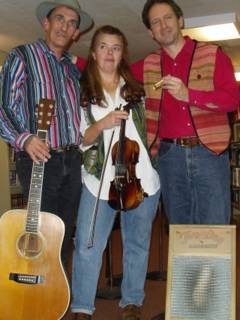
Silly picture of Jim & Colette & me, several yrs ago
Silly picture of Jim & Colette & me, several yrs ago
11.15.2009
Berryman, Blackmur & the "American sublime"
The website digital emunction has posted a mini-essay of mine, on "the American sublime".
11.14.2009
If you go to the preview of Lanthanum, & look at the 1st poem, I'm happy to see how the beginning (including the snow in line 1) predicted my daughter's cover photo. But I'm thinking especially of line 19. (The shade there, in the picture, is the shade of the bridge.) Forms a sort of "decussation" (cf. Sir Thos. Browne)...
11.12.2009
Saarinen's tuning-fork
See Gabriel Gudding's excellent essay on the Gateway Arch. I hadn't come across the "tuning-fork" metaphor before, but it made an independent appearance in Lanthanum.
11.11.2009
Saarinen synchronicity
Just 11 days shy of 11 months ago, in mid-December 2008, I began writing this long poem Lanthanum, which originated in an odd dream I had had a few days before, about the Gateway Arch monument in St. Louis (something I'd never seen, nor thought about previously).
On Monday, I finished the first book of Lanthanum (1st of a projected 3 volumes). Today I self-published it via Lulu (see previous post). & when I got home from work, & stretched out on the couch, & opened the NY Times... there was an article about a new exhibit at the City Museum of NY : on Eero Saarinen (architect of the Gateway Arch).

The gateway monument, by the way, is in the form of a "catenary arc" - the shape a flexible string or line makes when hung upside-down. Jasper Johns has painted a whole series of works incorporating the catenary arc.
On Monday, I finished the first book of Lanthanum (1st of a projected 3 volumes). Today I self-published it via Lulu (see previous post). & when I got home from work, & stretched out on the couch, & opened the NY Times... there was an article about a new exhibit at the City Museum of NY : on Eero Saarinen (architect of the Gateway Arch).
The gateway monument, by the way, is in the form of a "catenary arc" - the shape a flexible string or line makes when hung upside-down. Jasper Johns has painted a whole series of works incorporating the catenary arc.
Lanthanum Bk I - now in print
11.09.2009
some primitive Lanthanum.
(Unfortunately, I haven't figured out how to show some of the original format on the blogged version. There are extra spacings between some phrases in the final 2 stanzas of this section.)
(Unfortunately, I haven't figured out how to show some of the original format on the blogged version. There are extra spacings between some phrases in the final 2 stanzas of this section.)
11.06.2009
One way to read Lanthanum is to think of it in terms of Jasper Johns. The method of playing variations on a few favored symbols.... even some of the same symbols. Hart Crane is a major presence. The Gateway Arch in St. Louis is a catenary arch.
11.05.2009
Lanthanum : another explanatory note
Lanthanum.... may be a little hard to read (too conventional? too unconventional?) - & even harder to understand.
It's a long poem, which is about 1/3rd complete at this point (at least that's the plan). It's slowly (hopefully) gaining momentum; it's a process of accumulation & syncretism, if you will, of symbols & images & meanings. By syncretism I mean (using the term very loosely) a mixing-together of personal & impersonal, private & historical, religious & cultural... aiming toward a kind of fusion - an amalgam, a lanthanum alloy or compound, meant to burn more clearly & brightly as it slowly rolls forward...
It's epigram or motto could be a line from one of Osip Mandelstam's poems : "an arch appears in my muttering" (or mumbling). The arch in question has many-sided meaning... but paramount is the reference to the Gateway Arch monument in St. Louis, which itself takes on a collection of symbolic reverberations or (metaphorical) analogies...
It's a long poem, which is about 1/3rd complete at this point (at least that's the plan). It's slowly (hopefully) gaining momentum; it's a process of accumulation & syncretism, if you will, of symbols & images & meanings. By syncretism I mean (using the term very loosely) a mixing-together of personal & impersonal, private & historical, religious & cultural... aiming toward a kind of fusion - an amalgam, a lanthanum alloy or compound, meant to burn more clearly & brightly as it slowly rolls forward...
It's epigram or motto could be a line from one of Osip Mandelstam's poems : "an arch appears in my muttering" (or mumbling). The arch in question has many-sided meaning... but paramount is the reference to the Gateway Arch monument in St. Louis, which itself takes on a collection of symbolic reverberations or (metaphorical) analogies...
11.03.2009
11.02.2009
11.01.2009
Lear-Lanthanum.
p.s. now linked to some of my books at Amazon. The only link missing as yet is my book partially set in the Amazon (Rest Note)...
p.s. now linked to some of my books at Amazon. The only link missing as yet is my book partially set in the Amazon (Rest Note)...
Subscribe to:
Posts (Atom)


