Showing posts with label literary time. Show all posts

3.20.2014

"Poetry : What's Next?" (postscript)

A few afterthoughts about the panel discussion on "Poetry : What's Next?", convened last week up in Cambridge, at the Grolier Bookshop.

Listening to Archambeau's & Burt's predictions (both the serious & the not-so), I was bemused to realize that, with respect to a number of their specific forecasts about future styles & concerns, I had already been there.  In fact I'd been doing those specific things in poetry for a couple decades.

Archambeau : 1) densely-patterned rhyming; 2) obscure, allusive, cryptic idioms; 3) extended serial/narrative poems...
Burt : 1) documentary/factual poems focused on local history in out-of-the-way places; 2) baroque, playfully pleasing, extravagantly stylized poems; slangy, idiomatic (quasi-slam) styles; 3) sober, restrained "thing" poems...

All these approaches are descriptive of what I've been doing since the 1990s.  "It's hard to predict the past," noted Archambeau.  Especially if "the past" is not being read, not taken seriously.

All these works of mine are easily available, in book form or for free.   In RI is a local-factual-documentary poem, full of obscure New England historical objects & events.  It was translated into Italian by Anny Ballardini & is available in a bilingual edition.  Forth of July (consisting of Stubborn Grew, The Grassblade Light, and July) is a vast, baroque, playful, epic explosion of rhyme, assonance, off-rhyme, near-rhyme, reverse-rhyme, inside-out rhyme... along with layers of Joycean networks of oblique, allusive references.  Lanthanum is a long serial poem which morphs into a dream-vision.

But the very last thing I want to do is turn this post into another pathetic example of special pleading.  I find the contemporary matrix or juncture of the poetry business, on the one hand, with the history of literature (or literary tradition), on the other, to be more strange and disorienting as the days go by.  All three of the speakers at the Grolier tried to address this jarring dissonance.  But the reality is more strange than any of us can comprehend.

When you set yourself to write long epic poems, or you fall in love with the high wild classics of the past... or when you notice the discontinuity between what is influential, what is paradigmatic, what is necessary, what lasts in literature - over the long span of time & times - and the obliterating/scattering power of time itself - the clash of cultures, the decay of material things, the overwhelming power of time & change ...  well, if you meditate on these things, if you live with them as you write... then the pathos and absurdity, the parochial narcissism, of your average would-be poet (me, for example) becomes glaringly obvious.

This is why, in the previous post on the Grolier talks, I emphasized the impossibility of saying much with certainty on this subject.  What becomes popular, what becomes great, what becomes a classic - & how it becomes such - is a real mystery.  Partly, I guess, because how it actually happens is slightly different every time : there is no fits-all method.  All I think I can say is that what becomes important to a culture at large - and what retains lasting importance - is what is somehow necessary to that people or that culture.  The work provides some kind of guidance, light, pleasure, or nourishment over time. And it does not lose that flavor (at least not completely).  & secondly, I never forget the technology of literature, of the written word.  It has the potential to outlast the Pyramids.  In fact our literature consists of the shards & fragments of ancient cultures' hero myths, sagas, folktales, laws, proverbs... the thrilling mythical tales, the parents' words to the wise & happy endings... - all those alphabetical ruins of broken peoples (Celts, Romans, Hebrews, Greeks, Chinese...) which we inherit (like Borges, the spider in his infinite library).  These epic identity claims, these tribal testimonies, in all their sublimity and beauty, bump up against the a-historical nowness of the homogenizing global hive-mind.

The social media rough beasts of the future have yet to emerge.  We've seen nothing yet.  Meanwhile the hordes of Happy Poets & Artists flood the airwaves with their twittering selfies.  Aren't we lucky to live in America & own smartphones?  Meanwhile the established institutions for the advancement of literature have their megaphones on full blast - pre-recorded, targeted drone-wise directly at your head.  Aren't we smart?  We are the coolness of now. 

I think the ur-poem - the ursus-poem - the Artorius-poem - the epic of tomorrow - will have some lineaments outlined by Walt Whitman & James Joyce.  The "song of myself" - of any self - is an epic poem.  Bloom, the Everyman of Ulysses, is like each one of us.  Every human being lives within a wonder-world, so marvelous it cannot be expressed in words : only in broken Babel-bits.  We're waiting for that Pentecost of the Ur-story... the thing that unites all people without emulsifying away each person's fingerprint... distinctive quidditas.

Shakespeare also seemed to dwell on the uncanny technology of writing in the sense outlined here.  Think of Sonnet 65...
Since brass, nor stone, nor earth, nor boundless sea,
But sad mortality o'er-sways their power,
How with this rage shall beauty hold a plea,
Whose action is no stronger than a flower?
O, how shall summer's honey breath hold out
Against the wreckful siege of battering days,
When rocks impregnable are not so stout,
Nor gates of steel so strong, but Time decays?
O fearful meditation! where, alack,
Shall Time's best jewel from Time's chest lie hid?
Or what strong hand can hold his swift foot back?
Or who his spoil of beauty can forbid?
   O, none, unless this miracle have might,
   That in black ink my love may still shine bright.

2.29.2008

I feel like I took a small conceptual leap of my own yesterday, with the remarks on Harriet, responding to Reginald Shepherd. The idea that the poem is only fully actualized in the "big outside" of the public stage (not necessarily a literal stage, but a performance nonetheless), in the "gray area" between art & politics.

Of course a poem can have a perennial life as a text, and be reborn every time it's read, and appear re-shaped again & again... Mandelstam's idea of the "letter in the bottle" to an unknown reader. But maybe the normative aim or trajectory of the poem is directly into the social Now of its time and place. It might be a combination of these two aspects, ie. a renovation or rebirth of a former crystallization; but I think this idea of poetic actualization on the "stage" of the present is important, as it relates to to another idea which I 've followed at various times on this blog, ie. to emphasize a distinction between prose literature, and poetry's embodiment, the human performance of language in the Now of the present, time's "pleroma". The poem's (Aristotelian) form achieves its ontological telos - it flowers - in this shared "gray area", the common verbal/social/political space of its time.

"Time flowers on the lips of whispered clay." Opening line of Forth of July.

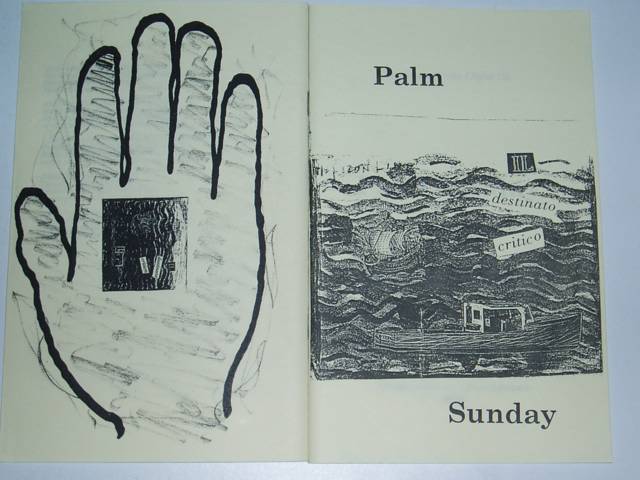
& with what kind of "Now" might my own writing have to do? I'm thinking of the "gray area" of the great Jasper Johns show at the Met in NY, which I saw last weekend. Johns often gestures toward poets, especially Hart Crane. There are the images of the hand-print on a kind of pendulum or radius, as if reaching up from deep under water. I've thought of my own long poems as partly an attempt to perform a kind of ghost dance or resurrection ceremony, for Crane in particular - to play Hart Crane redivivus. (& did something parallel with the "Henry" of John Berryman, in the Island Road sonnets.) An illustration to one of the chapters of Grassblade Light, "Palm Sunday" (which is set in the New Orleans/Gulf area), unwittingly echoes Johns's image in this respect.

4.19.2004

Issue #10 of Robert Archambeau's magazine Samizdat arrived today, always welcome. In it he has one of his "thematic reviews" titled "The New Modernists", covering books & anthologies such as Manifesto : a Century of -isms (ed. Mary Ann Caws), 21st-Century Modernism, by Marjorie Perloff, & poetry by Kruchenykh, Moxley, Salerno, Strickland & others.

Archambeau's general point, in simplified summary, is that literary Modernism never died (contra Postmodernism) and that an array of good poets carry on its methods of innovation & renovation. In his discussion of Moxley, he notes how her allusive style, her attachment to Hart Crane, her melding of Romanticism & the avant-garde, and other characteristics underline a poetics in which all time (in art, at least) is simultaneous - which Archambeau calls a "profoundly modernist idea".

This last is true: but I don't think he takes it far enough. There are a number of ironies inherent to the whole modernism/postmodernism question. Literary modernism could be described as poetry's attempt to catch up - technically, thematically - with the social/scientific realities of the 20th century, with the speed of the zeitgeist. It was, as they say, a "modernizing" effort. It was an heroic & dazzling endeavor. But now it is also "historical". In a sense, poetry has caught up - and the "modernizing" effort, as it fades into historical memory, now becomes oddly dated itself. This is one of the insights of postmodernism, the motto of which might be, "OK, now what?" Because postmodernism provides no answer to its own question, it abides in this limbo or symbiotic dependency on its predecessor. Thus to suggest a proper title for advanced poets of today to be "the new Modernists" - as Archambeau wants to do - adds another layer to this Zeno's paradox of labels, since clearly a new modernist has still not quite "caught up" with the zeitgeist, is still engaged or identified to some extent with the heroic laboriousness of an era which is now past.

It may be a modernist critical cliche that "all time is simultaneous", but, as time goes by, such articles of faith sound more and more like just that, articles of faith. And we know that in poetry, or art in general, faith is not enough : we need the "proof" provided by aesthetic rightness, the "certainty" of the achieved art work. The question for contemporary poets may not be the postmodernist one ("What next?"), but rather - "if time is simultaneous - How so?" Is there some aspect of spirit or self which measures/transcends time? Is there some aesthetic equilibrium (beauty?) which really (or only metaphorically?) supercedes or triumphs over clock time? How, exactly, is this revealed in poetry?

My own sense is that what will be really "new" in the near future is not a new modernism, in which innovative technique is foregrounded as a gesture toward the modernizing value of invention. The "new" poetry will explore and reveal the meanings & values - on many different levels, both thematic & technical - of "literary time", as something characteristic & distinct from clock time. When this contemporary work comes into its own it will be a new era, distinct from both modern & postmodern. I don't have a name for it.

Our mini-mini-essay is dedicated to Gravity Probe B, launched today (cf. para-sestina posted here last week, "A Waiting Game").