So I finished the Divina Commedia last night (in what I think is the very fine Mark Musa translation). Dante gives off a sort of M.C. Escher effect : an oscillation, due to the blending of fact and imagination. Is this Paradisal scene for real? No, it's "virtual", it's a pageant; but every element is grounded in Dante's sense of (ideal, philosophical, yet also ultimate) truth; thus the representative, verbal order impinges on "physical" actuality - the surreal order of the prophetic Word... so there's a wavering back and forth, actually a philosophical test of the reader's own beliefs and reasoning...
This passage struck me - Paradiso XXVII, lines 118-120, where Beatrice is beginning to explain the superfast sphere of the Primo Mobile, the surrounding ball of "light" of God's making which encompasses all creation :
"How time can hide its roots in this sphere's vase
and show its leaves stemming through all the rest,
should now be clear to your intelligence."
- it reminded me of the opening stanza of my own long poem, Stubborn Grew -
Time flowers on the lips of whispered clay.
A spring breeze flows through the branches on the terrace.
The city below flutters and flaps, roars
and drones like a resurrected bumblebee.
There is a lot in Stubborn, and Forth of July as a whole, about clay and pottery wheels (partly because my mother was quite a potter while I was growing up). The wheel of time spins through the clay, and the lips of poetry spin their own complementary vortex.
Showing posts with label Forth of July5. Show all posts
Showing posts with label Forth of July5. Show all posts
9.26.2008

9.18.2008
Doing some reading in Alexandrian "bucolic" poetry - Theocritus et al., & Virgil's Eclogues. Also interesting study, Pipes of Pan, by Thos. Hubbard, on "intertextuality" in pastoral poetry.
The librarian-poets of Alexandria. Bookish scholars transposing epic to something less grand, more scribal and allusive. "Bucolic" poetry as not so much about rural vs. urban or nostalgia for the countryside, as allegories of actual poets' rivalries, their shared (intertextual, allusive) meanings. The contests of the "shepherds".
Sometimes I read things like this through the lens of what I've already written. Somebody someday might see Forth of July through an "Alexandrian" lens. Grassblade Light, the middle book, might be set beside Theocritus' 1st Idyll, about the Adonis-like dead shepherd, Daphnis, and the "Sicilian songs" sung by the rural shepherds. Grassblade enacts a sort of "ghost dance"/Ojibwa/shamanic resurrection ceremony for "dead shepherds" Hart Crane and John Berryman (along with the mysterious Juliet). It transposes its own "epic" narrative into a series of "songs", lyrics, "dream songs". And it's modeled, structurally, on a castle built by Emperor Frederick II, the ruler of the Kingdom of Sicily (Castel del Monte).
I guess it's a stretch. But nevertheless its one of the ways those who should be reading me could read me!
The librarian-poets of Alexandria. Bookish scholars transposing epic to something less grand, more scribal and allusive. "Bucolic" poetry as not so much about rural vs. urban or nostalgia for the countryside, as allegories of actual poets' rivalries, their shared (intertextual, allusive) meanings. The contests of the "shepherds".
Sometimes I read things like this through the lens of what I've already written. Somebody someday might see Forth of July through an "Alexandrian" lens. Grassblade Light, the middle book, might be set beside Theocritus' 1st Idyll, about the Adonis-like dead shepherd, Daphnis, and the "Sicilian songs" sung by the rural shepherds. Grassblade enacts a sort of "ghost dance"/Ojibwa/shamanic resurrection ceremony for "dead shepherds" Hart Crane and John Berryman (along with the mysterious Juliet). It transposes its own "epic" narrative into a series of "songs", lyrics, "dream songs". And it's modeled, structurally, on a castle built by Emperor Frederick II, the ruler of the Kingdom of Sicily (Castel del Monte).
I guess it's a stretch. But nevertheless its one of the ways those who should be reading me could read me!
8.29.2008
I wrote a few days ago about seeing Forth of July as a sort of counterpoint to Pound's Cantos. Forth of July is actually an enormous bubble of rhyme-joy... full of oddities... one of which is a minor thread raveling together Scythia, Sarmatia, King Arthur, Mandelstam...
& as I was looking around while composing those comments to Stephen Burt's piece, I came upon this Wikipedia entry.
The "Scythian" theme is real in Petersburg poetry. Blok has a famous poem , "The Scythians", on the advent of the Revolution.
Ossetia, and the Ossetian language, descend from ancient Scythia, which Herodotus called "the land of the Gerrhi" (see modern day Gori, in Georgia, focus of recent headlines).
Mandelstam set himself "like flint" against Stalin. The priest-kings are still battling for the golden bough in the sacred wood. One of his poems identifies poetry with the free, full-throated song of horsemen bringing children to their wedding. His Stalin epigram, on the other hand, mocks the "barrel-chested Ossete". Here's a passage from July, the 3rd bk of Forth of July :
& as I was looking around while composing those comments to Stephen Burt's piece, I came upon this Wikipedia entry.
The "Scythian" theme is real in Petersburg poetry. Blok has a famous poem , "The Scythians", on the advent of the Revolution.
Ossetia, and the Ossetian language, descend from ancient Scythia, which Herodotus called "the land of the Gerrhi" (see modern day Gori, in Georgia, focus of recent headlines).
Mandelstam set himself "like flint" against Stalin. The priest-kings are still battling for the golden bough in the sacred wood. One of his poems identifies poetry with the free, full-throated song of horsemen bringing children to their wedding. His Stalin epigram, on the other hand, mocks the "barrel-chested Ossete". Here's a passage from July, the 3rd bk of Forth of July :
 He spoke awhile   and was quiet awhile
 and I heard a Scythian golden horde
 thundering in the distance  drone
 of trumpets   pounding hoofs   the tinkling


 of tiny earrings   rustling gowns   robes
 awash with pendants jingling   so far
 so small now   in the infinite   raft
 of grassland   horsemen, sober


 bringing the children to their wedding
 with clear-eyed   innocent song
 full-chested   doubleyoudoubleyou   gone
 by   invisible now   up into the air   like dew


 toward a mound of earth   in Gerrhus
 in the land of Gerrhi   where clovers grow
 quatrefoil   one urn   one lucky seven   worked
 from soil beside   great rivers   &   one Suger-bee
7.29.2008
Dog days at the old HG blog. Enjoying being done with Fontegaia poem. Trying to re-evaluate things, write or not-write in a different way.
Reading Christian Moevs' great book again, Metaphysics of Dante's Comedy. & Richard Farina, Been down so long it seems like up to me. I feel like I met each one of his (fictional) characters back in the 60s.
Whenever I'm in one of these transitional phases, I start thinking about Mandelstam again. My quirks & obsessions.
M's Voronezh poems at a certain time (10 yrs ago) not only gave me some ideas, "themes". Something in the tone of those poems set me free from my own hesitations, over-conceptualizing. A kind of cozy mumbling, gemutlichkeit. A sweetness. "My sadness is luminous" (Pushkin). Permission to improvise (for better & worse, I guess). That was the beginning of 10,000 quatrains.
Reading Christian Moevs' great book again, Metaphysics of Dante's Comedy. & Richard Farina, Been down so long it seems like up to me. I feel like I met each one of his (fictional) characters back in the 60s.
Whenever I'm in one of these transitional phases, I start thinking about Mandelstam again. My quirks & obsessions.
M's Voronezh poems at a certain time (10 yrs ago) not only gave me some ideas, "themes". Something in the tone of those poems set me free from my own hesitations, over-conceptualizing. A kind of cozy mumbling, gemutlichkeit. A sweetness. "My sadness is luminous" (Pushkin). Permission to improvise (for better & worse, I guess). That was the beginning of 10,000 quatrains.
6.19.2008
I'm almost done with the long poem Fontegaia. It's in 5 chapters, roughly 28 poems each. It gets more structured (numerically) starting around chapt. 3.
I see it as the caboose of the ol' Quatrain Line. That is, a sequel to Forth of July. There were some sequel-like things in the book Dove Street (the longer sequences there). But Fontegaia is more clearly a companion poem.
Some things are re-appearing here, toward the end, more or less unexpectedly, which rhyme with the beginning sections of Stubborn Grew (1st bk in Forth of July). It's nice if you think so, as Hemingway said, I think (about something or other).
*
What am I about? My self-image or ambition as a poet has not been ratified by the Grand Concourse of the Literary World. Not yet, anyway, if ever. Who is my gosh-best reader? Not for me to say. Maybe people will find things in my poems that I don't see, for better & worse.
You may want to know that I think of poetry as a pretty high-falutin' project, & that I think there's some pretty Great Examples out there - since Homer, maybe before. Dante, Shakespeare, them guys. Top of the crop. Not to mention Chaucer, Ariosto, Milton, Whitman, Dickinson... you know, the list goes on.
You might want to know that I think every poet shows, obviously or implicitly, who is or is not important to them, as models & competitors (& the blind spots may be the most telling). & in that regard, the game I think I'm playing is specifically an American game, in poetry in English, specifically - & still rooted back in the rivalry between the expats (Pound, Eliot, etc.) & the Americanists (WCW, Crane, Stevens, etc.).
That is, my writing shows implicitly that I'm not as interested in the poetry of the generations coming after Eliot-Crane-Stevens-Pound, as I am in that crux of the early 20th-cent itself. (Though I have my scattered heros - Berryman, for one.)
Now whether this focus is an unmistakable sign of literary over-reaching on my part... well, it's definitely a gamble. Time will tell. Have I merely chosen anachronism? An inauthentic, bookish, archaizing style?
I would like my gosh-best reader, before making that judgement call, to be sure to read all my books... not just the quatrain-train. I mean the short poems; In RI; the unpublished poems... you have your assignment! - because the short poems in Way Stations & Dove Street & elsewhere can possibly help to ground, contextualize, acclimatize the long poems. (The books are (almost) all here.)
& why the focus on that early modernist group? Well, I'm fascinated both with Eliot's efforts to transplant contemporary (& American) poetry back into a Renaissance/English/medieval culture & context - and with the counter-effort (by Crane, especially) to ground poetic vision and cultural authority in "New World" materials & themes. & I'm too interested in history to stay in a more purely Romantic or personal strain (a la Stevens & many others) - much as I love & admire Stevens.
I see the 20th-cent. long-poem projects as a big game - played around the magnetic force fields of Homer, Milton, Dante especially... by Joyce, Pound, Eliot, Crane, WCW, Olson, David Jones, Zukofsky, Jay Wright, James Merrill, & others. I realize these are all men : but it should be kept in mind that there's another oblique feminine impulse in my work, coming especially from some Russian poets - Akhmatova, Tsvetaeva. & of course, the Bible was written by a woman (Book of J).
Not trying to be facetious : I know my limitations, including all the ones I don't know. There are a zillion contemporaries I haven't read. But I started writing in 1965 or so; &
There was never a sound beside the wood but one,
And that was my long scythe whispering to the ground.
(Frost, of course, beats them all - but that's another story.) I've been too busy writing my own limericks to pay too much attention to my contemporaries.
Yes, I know this sounds silly. & I have to be going, so may continue this thread later. The game is big because the longing & vision inscribed in human culture by poetry - well, it's one of the building blocks of civilization. Or, I should say, it's an expression of humanity's attempt to ground itself in a visionary or spiritual orientation. The stakes are high.
I see it as the caboose of the ol' Quatrain Line. That is, a sequel to Forth of July. There were some sequel-like things in the book Dove Street (the longer sequences there). But Fontegaia is more clearly a companion poem.
Some things are re-appearing here, toward the end, more or less unexpectedly, which rhyme with the beginning sections of Stubborn Grew (1st bk in Forth of July). It's nice if you think so, as Hemingway said, I think (about something or other).
*
What am I about? My self-image or ambition as a poet has not been ratified by the Grand Concourse of the Literary World. Not yet, anyway, if ever. Who is my gosh-best reader? Not for me to say. Maybe people will find things in my poems that I don't see, for better & worse.
You may want to know that I think of poetry as a pretty high-falutin' project, & that I think there's some pretty Great Examples out there - since Homer, maybe before. Dante, Shakespeare, them guys. Top of the crop. Not to mention Chaucer, Ariosto, Milton, Whitman, Dickinson... you know, the list goes on.
You might want to know that I think every poet shows, obviously or implicitly, who is or is not important to them, as models & competitors (& the blind spots may be the most telling). & in that regard, the game I think I'm playing is specifically an American game, in poetry in English, specifically - & still rooted back in the rivalry between the expats (Pound, Eliot, etc.) & the Americanists (WCW, Crane, Stevens, etc.).
That is, my writing shows implicitly that I'm not as interested in the poetry of the generations coming after Eliot-Crane-Stevens-Pound, as I am in that crux of the early 20th-cent itself. (Though I have my scattered heros - Berryman, for one.)
Now whether this focus is an unmistakable sign of literary over-reaching on my part... well, it's definitely a gamble. Time will tell. Have I merely chosen anachronism? An inauthentic, bookish, archaizing style?
I would like my gosh-best reader, before making that judgement call, to be sure to read all my books... not just the quatrain-train. I mean the short poems; In RI; the unpublished poems... you have your assignment! - because the short poems in Way Stations & Dove Street & elsewhere can possibly help to ground, contextualize, acclimatize the long poems. (The books are (almost) all here.)
& why the focus on that early modernist group? Well, I'm fascinated both with Eliot's efforts to transplant contemporary (& American) poetry back into a Renaissance/English/medieval culture & context - and with the counter-effort (by Crane, especially) to ground poetic vision and cultural authority in "New World" materials & themes. & I'm too interested in history to stay in a more purely Romantic or personal strain (a la Stevens & many others) - much as I love & admire Stevens.
I see the 20th-cent. long-poem projects as a big game - played around the magnetic force fields of Homer, Milton, Dante especially... by Joyce, Pound, Eliot, Crane, WCW, Olson, David Jones, Zukofsky, Jay Wright, James Merrill, & others. I realize these are all men : but it should be kept in mind that there's another oblique feminine impulse in my work, coming especially from some Russian poets - Akhmatova, Tsvetaeva. & of course, the Bible was written by a woman (Book of J).
Not trying to be facetious : I know my limitations, including all the ones I don't know. There are a zillion contemporaries I haven't read. But I started writing in 1965 or so; &
There was never a sound beside the wood but one,
And that was my long scythe whispering to the ground.
(Frost, of course, beats them all - but that's another story.) I've been too busy writing my own limericks to pay too much attention to my contemporaries.
Yes, I know this sounds silly. & I have to be going, so may continue this thread later. The game is big because the longing & vision inscribed in human culture by poetry - well, it's one of the building blocks of civilization. Or, I should say, it's an expression of humanity's attempt to ground itself in a visionary or spiritual orientation. The stakes are high.
3.17.2008
This last section of Fontegaia chapt. 3 (#26, below) is a wee bit murky, even for me. May have to work on that...
Chapt. 3 is the (planned, anyway) middle part of a 5-part poem. Fontegaia is an attempt to explore certain historical, geographical, religious, political, & poetic phenomena through the lens of Siena (civic murals & artworks, the Palio horserace, local saints & other historical figures, & so on).
Elements of the city sort of shift around - like a lens focusing on different facets - in order to represent lots of other things (beyond Siena itself). If I write about the semi-mythical river "Diana" (which the medieval Sienese, always in need of a better water-supply, went searching for beneath their hilltops) - at the same time I may be writing about the moon (Diana was a moon-goddess), about other rivers (Mississippi, Jordan, Amazon, Nile), about searching for "the source" of things, about baptism (in the "font" or the spring), about masculine/feminine (& psychological) aspects of religious iconography ... - etc. etc.
Chapt. 3 (as you can see if you've been following along) focuses in particular on Diana/moon/river-sources. (As chapt. 2 focused on the Palio, and the 1st chapter on the Lorenzetti murals & other art.)
As I finish new chapters, they've been added to the Fontegaia work-in-progress, in the book titled Rest Note. Chapt. 3 will be added soon, I hope.
*
Also, I think, if you want to understand what I'm trying to do here, you'd want to see Fontegaia as the culmination of a longer "quatrain" train (as I've mentioned before). Stubborn Grew - the 1st book of Forth of July - opens with the poet-speaker looking down from Prospect Park at the "local Rhine" (the Providence River). The Providence, the Blackstone, the Mississippi, the Amazon, the Nile, the Jordan, the little spring rainwater streams that run down Arthur St. in Mendelssohn (Hopkins, MN), & various Russian rivers, all play a very big symbolic role in Forth of July & some of the quatrain-sequences which followed it (like Rest Note).
I could be wrong, but I do feel I am drawing toward the close of this particular long streak of writing. So it's culminating around this little fountain (the Fontegaia) in the main town plaza of Siena (the Campo), over the supposed location of the underground tunnels & channels of the mythical Diana River.
Chapt. 3 is the (planned, anyway) middle part of a 5-part poem. Fontegaia is an attempt to explore certain historical, geographical, religious, political, & poetic phenomena through the lens of Siena (civic murals & artworks, the Palio horserace, local saints & other historical figures, & so on).
Elements of the city sort of shift around - like a lens focusing on different facets - in order to represent lots of other things (beyond Siena itself). If I write about the semi-mythical river "Diana" (which the medieval Sienese, always in need of a better water-supply, went searching for beneath their hilltops) - at the same time I may be writing about the moon (Diana was a moon-goddess), about other rivers (Mississippi, Jordan, Amazon, Nile), about searching for "the source" of things, about baptism (in the "font" or the spring), about masculine/feminine (& psychological) aspects of religious iconography ... - etc. etc.
Chapt. 3 (as you can see if you've been following along) focuses in particular on Diana/moon/river-sources. (As chapt. 2 focused on the Palio, and the 1st chapter on the Lorenzetti murals & other art.)
As I finish new chapters, they've been added to the Fontegaia work-in-progress, in the book titled Rest Note. Chapt. 3 will be added soon, I hope.
*
Also, I think, if you want to understand what I'm trying to do here, you'd want to see Fontegaia as the culmination of a longer "quatrain" train (as I've mentioned before). Stubborn Grew - the 1st book of Forth of July - opens with the poet-speaker looking down from Prospect Park at the "local Rhine" (the Providence River). The Providence, the Blackstone, the Mississippi, the Amazon, the Nile, the Jordan, the little spring rainwater streams that run down Arthur St. in Mendelssohn (Hopkins, MN), & various Russian rivers, all play a very big symbolic role in Forth of July & some of the quatrain-sequences which followed it (like Rest Note).
I could be wrong, but I do feel I am drawing toward the close of this particular long streak of writing. So it's culminating around this little fountain (the Fontegaia) in the main town plaza of Siena (the Campo), over the supposed location of the underground tunnels & channels of the mythical Diana River.
2.29.2008
I feel like I took a small conceptual leap of my own yesterday, with the remarks on Harriet, responding to Reginald Shepherd. The idea that the poem is only fully actualized in the "big outside" of the public stage (not necessarily a literal stage, but a performance nonetheless), in the "gray area" between art & politics.
Of course a poem can have a perennial life as a text, and be reborn every time it's read, and appear re-shaped again & again... Mandelstam's idea of the "letter in the bottle" to an unknown reader. But maybe the normative aim or trajectory of the poem is directly into the social Now of its time and place. It might be a combination of these two aspects, ie. a renovation or rebirth of a former crystallization; but I think this idea of poetic actualization on the "stage" of the present is important, as it relates to to another idea which I 've followed at various times on this blog, ie. to emphasize a distinction between prose literature, and poetry's embodiment, the human performance of language in the Now of the present, time's "pleroma". The poem's (Aristotelian) form achieves its ontological telos - it flowers - in this shared "gray area", the common verbal/social/political space of its time.
"Time flowers on the lips of whispered clay." Opening line of Forth of July.
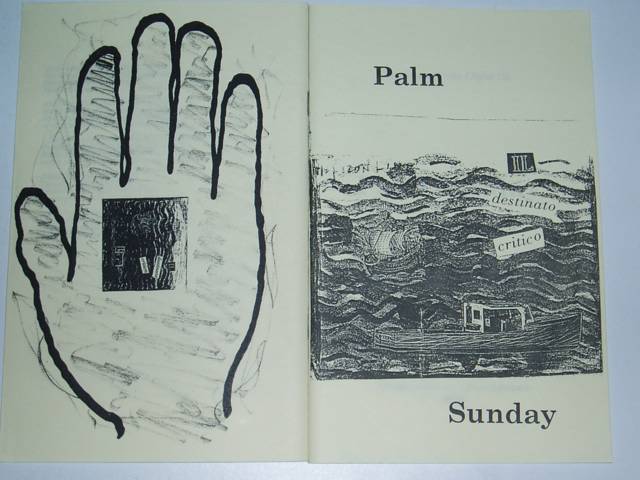
& with what kind of "Now" might my own writing have to do? I'm thinking of the "gray area" of the great Jasper Johns show at the Met in NY, which I saw last weekend. Johns often gestures toward poets, especially Hart Crane. There are the images of the hand-print on a kind of pendulum or radius, as if reaching up from deep under water. I've thought of my own long poems as partly an attempt to perform a kind of ghost dance or resurrection ceremony, for Crane in particular - to play Hart Crane redivivus. (& did something parallel with the "Henry" of John Berryman, in the Island Road sonnets.) An illustration to one of the chapters of Grassblade Light, "Palm Sunday" (which is set in the New Orleans/Gulf area), unwittingly echoes Johns's image in this respect.
Of course a poem can have a perennial life as a text, and be reborn every time it's read, and appear re-shaped again & again... Mandelstam's idea of the "letter in the bottle" to an unknown reader. But maybe the normative aim or trajectory of the poem is directly into the social Now of its time and place. It might be a combination of these two aspects, ie. a renovation or rebirth of a former crystallization; but I think this idea of poetic actualization on the "stage" of the present is important, as it relates to to another idea which I 've followed at various times on this blog, ie. to emphasize a distinction between prose literature, and poetry's embodiment, the human performance of language in the Now of the present, time's "pleroma". The poem's (Aristotelian) form achieves its ontological telos - it flowers - in this shared "gray area", the common verbal/social/political space of its time.
"Time flowers on the lips of whispered clay." Opening line of Forth of July.
& with what kind of "Now" might my own writing have to do? I'm thinking of the "gray area" of the great Jasper Johns show at the Met in NY, which I saw last weekend. Johns often gestures toward poets, especially Hart Crane. There are the images of the hand-print on a kind of pendulum or radius, as if reaching up from deep under water. I've thought of my own long poems as partly an attempt to perform a kind of ghost dance or resurrection ceremony, for Crane in particular - to play Hart Crane redivivus. (& did something parallel with the "Henry" of John Berryman, in the Island Road sonnets.) An illustration to one of the chapters of Grassblade Light, "Palm Sunday" (which is set in the New Orleans/Gulf area), unwittingly echoes Johns's image in this respect.
2.28.2008
In the realm of poetry (& maybe other realms) I find it difficult to balance and reconcile truth & beauty, the didactic & the aesthetic, the legislative/executive & the playful/imaginative, the prophetic & the poetic...
Look at people like Pound, Olson... ambitious-serious "alpha male" epic types. Avatars of the will-to-order, the will to govern, to dominate, to rule. (Yeats's "king of cats".) Though I don't consider myself very alpha, I feel I've muddled along in some similar deep swamps. Hence my affection for figures closer to the "artist" side of this line (Hart Crane, Stevens). Forth of July is really a playful jab toward the crystallization of a "national epic", drawing on contrary models (like Crane, Berryman, Mandelstam, etc.). [ (Will anybody ever notice what I've been doing here?) ]
from one perspective, the sane & ethical approach, as an artist, would be to maintain a strict detachment, to offer an impersonal mirror... from another perspective this seems impossible, an illusion : we are already caught up and involved emotionally & intellectually with the "materials"...
the whole issue of the poet as "unacknowledged legislator" stems from the fact that all our communal social constructs are rooted, at least to some degree, in the imagination itself... or is this an attitude (for an artist anyway) of foolish, over-reaching pride? Is the substance of reality firm & structured & prior to our conceptions about it?
(Another aspect of this is that much social, didactic, political poetry is not really very poetic. It's prose dressed up as poetry. Of course it can be very effective just like that. But it doesn't re-imagine, re-create the cosmos, the way the great epics do. It lacks the orphic fictional-poetic power of Virgil, Dante, Milton, Shakespeare... - the regal sceptre of the imagination - Mandelstam's "baton". I suppose the sceptre has been passed to the novelists, the scientists, the philosophers, the "critical theorists"...)
Old puzzles... this crux perhaps marks the difference between the medieval, the Renaissance & the modern mentalities...
Maybe that's one reason I like the philosophical writings of Nicholas of Cusa so much. For Cusanus, our knowledge reaches its limit in puzzles & paradoxes. God is "the conjunction of opposites". He acknowledges the source of all order & creation in God; at the same time he asserts that all our concepts of God are just that, human constructs, "conjectures", that in fact our whole sensible, knowable reality is a conjectural human construct, an artifice of the mind...
I thought this morning that the resolution of this puzzle or paradox lies in an understanding of the nature of divine love. If "God is Love", as the epistle of John has it, and if Love is a kind of binding embrace of the Other which is at the same time a renunciation, a self-giving to the other, a state of service or servanthood - then it's in the light of this kind of Love that we can imagine another Biblical concept, ie. "perfect freedom".
Imagine a divine nature which wants to create a cosmos of "perfect freedom", because this desire is rooted in love, and love's deepest motive is to "set free". Then this divine nature would of necessity have to withdraw, relinquish control and dominion on some level. Of course this does not necessarily entail indifference (the remote, the clockwork God). "Selfless-love-without-indifference", then, is in itself a kind of incomprehensible paradox. Incomprehensibility, even absurdity, of a kind we meet with in ordinary life (cf. the parable of the Good Samaritan).
I guess I'm simply recycling some old, old via negativa notions going back to Pseudo-Dionysius & Byzantine theology & long before (Plato on love, etc.).
But these notions seem to be essential to any integration of order & freedom, of cosmos & chance, of medieval and renaissance, of theology & humanism. A figure of paradox like Cusanus appears at the cusp of this historic shift (between medieval & modern). He has a mind fascinated with invention and creative freedom. His writings are playful intellectual-philosophical games, conceptual inventions.
But it seems to me the crux of it all is this fusion of the will-to-love ("good will") with the idea of "perfect freedom". Maybe this is the nexus where the gift of artistic detachment & inner freedom rhymes with a more "sober" concept of necessity, reality, history, fact, the moral law, governance, political & juris-prudence, etc.

Look at people like Pound, Olson... ambitious-serious "alpha male" epic types. Avatars of the will-to-order, the will to govern, to dominate, to rule. (Yeats's "king of cats".) Though I don't consider myself very alpha, I feel I've muddled along in some similar deep swamps. Hence my affection for figures closer to the "artist" side of this line (Hart Crane, Stevens). Forth of July is really a playful jab toward the crystallization of a "national epic", drawing on contrary models (like Crane, Berryman, Mandelstam, etc.). [ (Will anybody ever notice what I've been doing here?) ]
from one perspective, the sane & ethical approach, as an artist, would be to maintain a strict detachment, to offer an impersonal mirror... from another perspective this seems impossible, an illusion : we are already caught up and involved emotionally & intellectually with the "materials"...
the whole issue of the poet as "unacknowledged legislator" stems from the fact that all our communal social constructs are rooted, at least to some degree, in the imagination itself... or is this an attitude (for an artist anyway) of foolish, over-reaching pride? Is the substance of reality firm & structured & prior to our conceptions about it?
(Another aspect of this is that much social, didactic, political poetry is not really very poetic. It's prose dressed up as poetry. Of course it can be very effective just like that. But it doesn't re-imagine, re-create the cosmos, the way the great epics do. It lacks the orphic fictional-poetic power of Virgil, Dante, Milton, Shakespeare... - the regal sceptre of the imagination - Mandelstam's "baton". I suppose the sceptre has been passed to the novelists, the scientists, the philosophers, the "critical theorists"...)
Old puzzles... this crux perhaps marks the difference between the medieval, the Renaissance & the modern mentalities...
Maybe that's one reason I like the philosophical writings of Nicholas of Cusa so much. For Cusanus, our knowledge reaches its limit in puzzles & paradoxes. God is "the conjunction of opposites". He acknowledges the source of all order & creation in God; at the same time he asserts that all our concepts of God are just that, human constructs, "conjectures", that in fact our whole sensible, knowable reality is a conjectural human construct, an artifice of the mind...
I thought this morning that the resolution of this puzzle or paradox lies in an understanding of the nature of divine love. If "God is Love", as the epistle of John has it, and if Love is a kind of binding embrace of the Other which is at the same time a renunciation, a self-giving to the other, a state of service or servanthood - then it's in the light of this kind of Love that we can imagine another Biblical concept, ie. "perfect freedom".
Imagine a divine nature which wants to create a cosmos of "perfect freedom", because this desire is rooted in love, and love's deepest motive is to "set free". Then this divine nature would of necessity have to withdraw, relinquish control and dominion on some level. Of course this does not necessarily entail indifference (the remote, the clockwork God). "Selfless-love-without-indifference", then, is in itself a kind of incomprehensible paradox. Incomprehensibility, even absurdity, of a kind we meet with in ordinary life (cf. the parable of the Good Samaritan).
I guess I'm simply recycling some old, old via negativa notions going back to Pseudo-Dionysius & Byzantine theology & long before (Plato on love, etc.).
But these notions seem to be essential to any integration of order & freedom, of cosmos & chance, of medieval and renaissance, of theology & humanism. A figure of paradox like Cusanus appears at the cusp of this historic shift (between medieval & modern). He has a mind fascinated with invention and creative freedom. His writings are playful intellectual-philosophical games, conceptual inventions.
But it seems to me the crux of it all is this fusion of the will-to-love ("good will") with the idea of "perfect freedom". Maybe this is the nexus where the gift of artistic detachment & inner freedom rhymes with a more "sober" concept of necessity, reality, history, fact, the moral law, governance, political & juris-prudence, etc.
2.01.2008
Addressed to Emily (from July) :
(full excerpt here)
 And if nine muses in July slipped
 downstream toward a swollen, stolen
 summa... it were a felix loss
 for Caesar's breastplate - broken jewel,


 cool dove, stone sister - moosed-over
 mossy garnet in a woodland of
 autumnal jasper.  Duels
 of August - golden - over now -


 are nevermore.  Veteran stone,
 an Inca sacrifice - a frozen child,
 limed over, liminal (ditched
 first-born son, whose knot


 entwines the ceremonial sword
 like twine around a strong man's
 house - holds it for a host
 of Jacobean thieves) turned


 gypsy roost now, camel-humped,
 bull-dragged and wobbly, a
 knife-line violin, the last bow
 of your father's father's ho-hum


 poem...  finished.  Built.  Where
 the river flows both ways around
 your coracle's felt node (or
 upside-dome).  So row


 some more, toward summer -
 toward hurtling chords of warmer
 wind.  For the grasslands of your
 mini-Rome are no more rusted


 than busted us (trust me on this).
 Understand, we stand in good here
 for the minor coppers who dug
 her out of the lincoln logs - Scythians


 with charlie horses carved into their
 knobby, needy, bowlegged errors -
 still, they hit the bell's aye - rose.  And
 this is a drawing-out of thundering wraiths.


                             11.13.99
(full excerpt here)
7.03.2007
Poetry, the "fontegaia", is always happily burbling up from some hidden place at the heart of the person... & if you want to get at the proper & pleasant context of my obscure productions, you will have to follow up the clues hidden in homophonics & puns... there is this "Henry cosmos" (where, as Nicolas of Cusa put it, "the universe giulianizes in you, Giuliano") just as there is a "Maximus" for Olson... & probably the easiest way to approach it is by wearing Dante/Beatrice spectacles... thus the thread of the "J" or the "little tree" which runs from the Island Road sonnets all the way (by way of Bluejay & Juliet) through Forth of July... when (as Guy Raffa put it in his book about Dante, Divine Dialectic) the poet transmutes an "object of desire" into a "spiritual guide"...
so In RI is not only "in Rhode Island", but also a pun for "Henry" and for "in our eye" and a glance at the inscription over the crucifixion... and "Forth of July" is not just the "Fourth of July" holiday but the "(coming-)forth of jewel-eye" or Julie or J... (p.s Providence was once the "jewelry capital of the world" at the center of the lil "isle of roses")... & this "incarnational" muse-music displays a faint echo of Dante, from the bilingual (Eng-Ital) edition of In RI (which opens with a scene of a loved woman "walking to Italian class") all the way to Fontegaia fountain, & the Bonaventure-Joachimist themes which are also to be found in the Paradiso... while it also subsumes (draws into its circle), in its stubborn comical "Henryesque" way, Milton-Shakespeare-Joyce-Crane-Mandelstam-Berryman-Melville-Twain-Montale-Poe-Whitman-Dickinson etc....
& despite the fact that Henry World and Poetry World seem to be alternate realities, which never coincide, time may prove otherwise... happy 4th, everyone...

so In RI is not only "in Rhode Island", but also a pun for "Henry" and for "in our eye" and a glance at the inscription over the crucifixion... and "Forth of July" is not just the "Fourth of July" holiday but the "(coming-)forth of jewel-eye" or Julie or J... (p.s Providence was once the "jewelry capital of the world" at the center of the lil "isle of roses")... & this "incarnational" muse-music displays a faint echo of Dante, from the bilingual (Eng-Ital) edition of In RI (which opens with a scene of a loved woman "walking to Italian class") all the way to Fontegaia fountain, & the Bonaventure-Joachimist themes which are also to be found in the Paradiso... while it also subsumes (draws into its circle), in its stubborn comical "Henryesque" way, Milton-Shakespeare-Joyce-Crane-Mandelstam-Berryman-Melville-Twain-Montale-Poe-Whitman-Dickinson etc....
& despite the fact that Henry World and Poetry World seem to be alternate realities, which never coincide, time may prove otherwise... happy 4th, everyone...
5.10.2007
Reading more about Joachim of Fiore these days. I think I'm sort of preparing for next phase of Fontegaia chapter - from the Siena Palio horserace to the 4 horses of Joachim's Apocalypse.
Joseph Ratzinger (currently Pope) wrote a book about St. Bonaventura's theology of history which touches on Joachim. I'm going to look it up.
There's kind of a thread which ties together (in my mind, anyway) Joachim - the Franciscans - San Francesco - Giotto & other painters - hobo America - my Siena poem. (There's also a thread linking Joachim - Vico - Joyce - & me.)
Tying together all these threads about time & history & horseraces & world-renewal. The article on the Antikythera mechanism (basically a very elegant cosmic clock) is in there too somehow.

What is the cornerstone of the wholeness of the poem? Why, the Moon, of course (says the loony poet)! The 7-day week and the lunar cycle... solar reflection (consciousness)... Forth of July (7/4, or "28")...
Joseph Ratzinger (currently Pope) wrote a book about St. Bonaventura's theology of history which touches on Joachim. I'm going to look it up.
There's kind of a thread which ties together (in my mind, anyway) Joachim - the Franciscans - San Francesco - Giotto & other painters - hobo America - my Siena poem. (There's also a thread linking Joachim - Vico - Joyce - & me.)
Tying together all these threads about time & history & horseraces & world-renewal. The article on the Antikythera mechanism (basically a very elegant cosmic clock) is in there too somehow.
What is the cornerstone of the wholeness of the poem? Why, the Moon, of course (says the loony poet)! The 7-day week and the lunar cycle... solar reflection (consciousness)... Forth of July (7/4, or "28")...
4.10.2007
I've always wanted to put out a book in that old 60s paperback size (roughly 4"x6"). Well, I'm getting around to it. Here's the sonnet-sequence Island Road in a new pocket edition, complete with photo on the back and frontispiece. & it's cheaper!

I've also added a back cover and frontispiece photo to the new Forth of July.)
I've also added a back cover and frontispiece photo to the new Forth of July.)
9.18.2005
Exploration Fawcett [clearly, from the evidence of this link, there's also a whacko fringe Fawcett-cult] - I can't put it down. Imagine Poe's Pym novel, except in real life, with a great deal more of detailed description & episodes, & the wisdom of experience & humane spirit. It ends with Fawcett's disappearance in the depths of the Amazon jungle. Notebooks compiled by his son - who is looking out his office window in the railroad yard in Lima Peru at the very railroad car his father was riding into the Andes (on his first expedition) the day he (his son) was born, back in London. Very Poe/Borgesian touch, there.
The Amazon (along with Vallejo & the Andes) creeps into the final passages of Forth of July - mingled strangely with The Countess from Minneapolis (ps. that cover image is a painting of Hennepin Ave) & Pushkin's short story "The Queen of Spades".
"...by the shores of great rivers" (Mandelstam)

The Amazon (along with Vallejo & the Andes) creeps into the final passages of Forth of July - mingled strangely with The Countess from Minneapolis (ps. that cover image is a painting of Hennepin Ave) & Pushkin's short story "The Queen of Spades".
"...by the shores of great rivers" (Mandelstam)
8.09.2005
oh... & Forth of July was finished on 5.28 (2000).
5.28 (as again I repeat myself) : the day William Blackstone was buried in Cumberland RI, on Study Hill, 1675. Also St. William's Day (the day Guillem de Gellone - crusader turned monk made saint - died).
5.29 : The day Study Hill was burned to the ground by a Narragansett raiding party (all W. Blackstone's books & notebooks vanished). My birthday. RI Statehood Day.
On 5.28 ('35?) the Golden Gate Bridge opened for traffic.
5.28 (as again I repeat myself) : the day William Blackstone was buried in Cumberland RI, on Study Hill, 1675. Also St. William's Day (the day Guillem de Gellone - crusader turned monk made saint - died).
5.29 : The day Study Hill was burned to the ground by a Narragansett raiding party (all W. Blackstone's books & notebooks vanished). My birthday. RI Statehood Day.
On 5.28 ('35?) the Golden Gate Bridge opened for traffic.
from toward the very end of Forth of July. The "W" that Bluejay & Henry's wanderings etched on the Providence East Side ridge, took some odd turns.
 6

            The scene, refreshed, reroused, was never to be forgotten,
            the hen and crusader ever intermutuomergent...
                                        – Finnegans Wake


 A cask of negus went barreling down the rhode
 whorled in a victory-fin into the foretimes
 buried in the midnight garden   one St. William's
 Day   where he rose (our W) and rows and rowed


 his henpicked galley   through gales of galloping
 gallic ages   alone, Gellone   (with 28 oarsmen
 and a red coxcomb   for a bully steersman)
 it was a barging line or ink-can sunship


 filled to the midnight brim with Orange   or
 honeyed yellow sweetings for the Bethel brew
 it was a skeevy chicken key V shield anew
 down the rustling river toward   a dey of fire


 on Study Hill   or in Byzantium   an axe
 set to the roots   of Oak Tree Day
 Newport summons   wedding for old El Rey
 old Johnny Atahualpa Hamlet's   summery X


 the omelet ovum all at last   of everywombin' man
 incalculate and calculate   with little pebbles
 small gray veterans from Black Sea pledge
 unto out of   the Son of Man   (here back to then)


 and like a hand-sprung iron spring   by
 golly Moses there it goes   an able nef
 into the winestained cupola's deep
 arrak barrel   diving for the ring


 of south-north stars' lamb-lamp
 beeW your myrrh, my Magdalen
 gleams in those double-emerald
 ships (aye-aye me dewfall-camp)


                             5.25.2000
7.21.2005
Listening to Jubilee on Mars, I was reminded of something I'd read about the cacaphony-harmony of Russian church bells, which reminded me of this section of >July (a kind of found poem):
 7


 Maybe it is the belfry   of the Church of the Nativity
 of the mother of God   but it is still cold as Hades
 60 feet up a corkscrew staircase   shoulders
 brush the cobbled walls   the stumbling ascent


 a blend of dirge, railroad-crossing clanger and
 shattering wine goblet   a disharmonious sweetness
 makes a beeline   what they create and give away
 no Muzak peal can duplicate   It is peace in the soul


 said Mr. Dorokhin, 29   cacaphonous and
 hypnotic   the miracle is that they ring at all
 its bells were carted off   the vacant building
 (gagged) became a holding pen   for circus lions


 When it's cold like this, it sounds better
 Russian bells are stationary   the ringer strikes
 them by pulling the tongue with a rope   carefully
 tuned, but   harmony is coincidental   a tree


 of iron   droning   like a cork   within ethereal
 and capering fire   or an upside-down Higgs
 particle   afloat in a cup   of gegenschein
 or a grain of faith   profound and whole


 lifted overhead into   far-off   rooftop watercolors
 and a basil swell   where the turbulence began
 where a spiral snakes   into interior nègre
 like a turnstone   wheeling   Hamlet's cradle


 of inward sin   simultaneously   out into a hamlet
 of fate   at the navel of a rippling   font of sound
 where his father's   agenbite incuse   nostos
 just   rest   spins the will   toward Elsinore


 a cue for the angel   troubling the water
 in a maze of circles   with a rod of iron
 for restitution at last   this diorite
 horizon of my clay   you   turn...


                              1.26.2000
7.01.2005
 10


 I am coming like a Swede in the night
 to Henry's Diner   (or not coming)
 coming like Ava Gardner   with a spring
 in her step   (and double-cross in her heart)


 to the shores of great rivers   dancing
 with thieves   in gilded armor (and lead)
 I am coming like   Vietnam-bred
 hootchie-cootchie man   breathing


 the same air (brotherhood   cosmos)
 as a summer cicada   hidden in a crown
 of tupelo trees   drowning (almost)
 in their drone   beyond reason


 coming in the sweet child-food
 of Melchizedek   that bees make
 to temper the blood (just as a book
 tempers hot iron paws   along the road)


 to restore you   like the sun
 and prepare the way (here it gets
 omen-like)   for the drama   (the set-
 up)   in a garden   of stone   manes


 where children gather   to appease
 the dead ancestors   ranged
 under the prairie   waiting   red-
 eyed   all night long   for the wise


 footstep   the light wheeling
 pivot   the morning
 birth-rite   (swing
 as you may   to leeward   (heeling


 highway crust   (Hiawatha


                               6.6.99
... & one more bit for today...
 7


 The moon was like a shield of milk   serene
 over the long   lazy-Lazarus   river of mud
 and   a mild music   in 4/4 time   dum-
 dee-dum-dum   a faux tod   blessed   sans


 raison   filtered the willow-limbs
 like a breeze   from the delta
 and forth   came the deadly   belated
 jewel-brow   of an eddying copperhead   W


 like a wily whale   from an upland cave
 speaking in bellicose pitch-tongs
 of sullen fury   green-gutted
 with spite   beneath the vacant lamp


 of a one-eyed Sears   Green Constellation
 the whorl of his   disaster-tail   tipped
 through a pinball furnace   petals
 of velveteen galaxies   the venomous patter


 of his speech-machine   Independence Day
 while the clock with four hands   (not red,
 not black)   in the tiny room   (engaged,
 not vacant)   where he waits (intrepid, with cigar)


 for the helping hand   of an hesitant cripple
 aligns at last   Greenwich and Washington
 Florence   Petersburg  &  Lima   Jerusalem
 and together cry   fly, dove   escape from me


 through the light breeze   in the empty garden
 rustling the vines   beyond the porch
 in the uplands   where the serpents play
 and lying still beneath your palm   the dragon


 at the summit wheels (tame now) for you
 (fireworks rounding out your forthcoming)
 who fused the four hands of the seraphim
 inverting dragonship into green infant nef


                               1.28.2000
Going to post a couple of oddities from Forth of July for the 4th of July. This one was written on the 200th anniversary of the death of George Washington:
 6


 To drift on a raft, in the cold Gulf
 your mother drowned and gone
 to the bottom, your no-go
 father waiting, wanting to lug


 you back to Cuba.  Elián González,
 refugee.  Half-orphan, political
 racquetball.  On elliptical
 orbit... to please the ghost


 of his mother, or follow
 his father’s voice?  A listening
 crane on a listing splinter
 under unknown stars (willful


 beasts beneath transparencies,
 emergencies – self-righteous
 crowds of kinfolk tyrannies –
 calculated raptures, seizures).


 And Henry trying to right the boat
 from a Babylonian mess, a mes-
 tree, a mystery–semblance
 muttered by tabulator-


 oracles, never getting blind.
 All out of fo’csle fire, folks
 – star-speech of sophic
 sophisticates in dabble-


 science.  Dark mutter
 beneath the beautiful city
 of colored stars (drunk on illicit
 l-Iku cubes, original razzmatazz


 of paradise).  Tom Thumb
 (vain little man to the finish line)
 hefting his axe to shadows, Nile-
 willows, round oak boles... mythed


 again.  It was the voice of Persephone
 brought Kore to the well-stone,
 sent Gilgamesh nose-tossing
 downward toward the Scorpion


 or Mother Sun or Dead Zone
 south of Canopus and the big
 muddy vermin-mouthed gibbous
 Nile-thermousine nose-diviner


 raft of pap set loose there;
 was Sarah Wilds for truth, hung
 swinging for it between Hale
 Oannos and Oannos Golden (Rhea’s


 Salem shulamite for real) and
 all the other saints (from Jeannie
 arcing east to Mary Easty, swinging
 west) fled to our island Rhodes,


 colossal Roger Wilco’s will (his palm
 of stone extended over the Terrace
 of soul freedom, calm, certain)
 for every ignited fire-lamb


 of foolishness or wisdom (children
 circling around a christmas tree
 all lit with stars gold-wrought
 and silver-shimmering for their delight:


 some happy pappy’s saintly clause
 exuded from the fireplace or through
 the cedar boughs:  some wraith
 of presence through chalk-


 white blindness:  deepening snow
 of winter night, adrift... a raft
 from the serpentine and far
 Antipodes).  And snow it was –


 since the blizzard of the galaxies
 unfolds in chaos, and the choppy seas
 avoid the careful, coppery seasons
 of Assyrian seizures, accidental


 Babylons, and the dismal
 dizzy darkness bears, it seems,
 the single inkspot of a measly
 thumbprint (on a live-oak dreidle


 backspun against gravity) –
 your will, old Roger’s Will, old Roger
 Williams’ will – the will to rage
 against stars, for heaven’s vague


 unvarying stake – rage like a lion
 against cruel stars, their stories
 and their cold indifference –
 muttered spider tales, nails


 in the coffin of each living
 soul (nursery rhymes, cribbed
 around your eyes – the bier,
 creaking at the vile Nile mouth).


 Ah... but your rage will turn to wonder
 and your Martian heart dissolve
 upon the hearth, when the love-star
 climbs from the depths – the red one,


 turning violet and green - the star
 that fell into the well in Bethlehem,
 the star that guided Balthasar
 from the heart of Ethiopia


 to the rafters sheltering a refugee
 bringing his single gift - an emerald
 jewel-ship (tender shell, immured
 in his palm... a gleaming nef).


                *


 Yesterday 200 years ago
 a humble father of his country set sail
 with Utnapishtim, for the terraces
 of Ocean-Sky, in far Ogygia


 (where all the rivers meet).  O
 you who love the land from the bare
 cradle of the zu-bird to Arabian
 phoenix (Jeannes at the teller teamed


 with arching armored Johns adorned
 with eddying maelstroms, gunslung tattooed
 catch-22s) listen:  alpha beta gamma Pegasus
 at the Florentine font, 529, sidereal,


 intones:  go out to the Exalted Courtyard,
 Iku-Star – where truth grows saltier,
 more regal.  Light along an axe-blade travels
 upstream (pennyroyal mint) to Blackstone’s font.


                                12.15.99
6.24.2005
the Nazir goes along hummin', tying together history's sleepy Wake-up call of beginds-&-hens:
 6


 He walks the thread-thin bloodline
 like a lion on a tightrope, or a Templar
 in Jerusalem, or like a Nazir
 scored by whiplashed Narbonne


 Moorish twine (from Septimania
 or Babylon).  Walks on palm-leaves
 naked as a Galilean, grooved
 for service as a Benjaminite lyre-


 plucked brand – the word God flying
 from his ribcage like an undivided
 pigeon.  Yes, he bears it, laden
 with J-puns:  his mother (Hagia


 Sophia) grabs him by the hair and
 carries him off to Mount Moriah
 singing, dancing (Messiah
 between his lips, under


 his tongue) while the dread iron rings
 of Rome (all nine of them) congeal
 and Pilate's unrevealing,
 convenient surprise brings


 down the curtain of the veil again.
 Yea, upon this Rock I have unfolded
 your Mandylion – my body held
 in golden photoplasm for an icon


 of a raptored rhaptor's kingdom.
 So in present tense infinity
 that honey-hunter's blind tenderly
 scotched his mother's mordant home.


                            4.20.2000
Subscribe to:
Posts (Atom)


