Showing posts with label embodiment. Show all posts

6.26.2019

a partial answer for Tom D'Evelyn


GREEN SAGE

We are born as the story goes, in
medias res – through the hands
of the midwife, to lands
of motherly milk & honey, the Pine

Island of family circles... onto
the clay wheel of slow
seasons – rusty merry-go-
round, with its quaint iron echo...

& you recall how the sun casts a shadow
while the river floats an image;
imagination’s green sage
is always personal, someone you know

& so the circle of epistemology
whorls back to its source.
Whitman shaken by the hearse
Dante dreaming Beatrice

body forth reality – adhesive,
compagnevole, suffused
with ineffable Providence –
thy feather-light & graceful Love

the origin & end of Universe
O playful Alpha-&-Omega.
All poetry is drama
& all storytelling is your father’s

microcosmos; all wisdom is Hagia Sophia
beneath their human dome of light,
& that Gateway Arch might
mark the navel of your motherland’s Cahokia.

6.26.19

3.13.2018

speech after long silence


DARK MATTER

On Ghiberti’s “Gates of Paradise”
(bronze doors of Alighieri’s
Baptistery) mute eyes
read open palms as messages –

clouds’ condensation (mist & spray)
solidifies in glints
of angels’ footprints.
Cerements & shrouds (all hands... away).

Sauntering winter by the river
leaves only this ladder
of snow – bronze adder,
subterranean shiver (moon-silver).

Anonymous Zaccheus of Topsfield
fined for making friends
with Indians &
Quakers (150 years ground

on, before the Revolution
bent the tune).  We are
the salt within the Rio
del Espiritu Santo (many thousand

gone).  We are the Lenten corn
in a maze of amnesia
to the horizon (hallelujah).
Old Hole-in-the-Sky – buffalo-shorn

tepee – pyramid cathedral, aye.
Dark matter between Bear
& Lyre; grey mother,
Jonah’s poncho (oaken sigh).

3.12.18

2.29.2008

I feel like I took a small conceptual leap of my own yesterday, with the remarks on Harriet, responding to Reginald Shepherd. The idea that the poem is only fully actualized in the "big outside" of the public stage (not necessarily a literal stage, but a performance nonetheless), in the "gray area" between art & politics.

Of course a poem can have a perennial life as a text, and be reborn every time it's read, and appear re-shaped again & again... Mandelstam's idea of the "letter in the bottle" to an unknown reader. But maybe the normative aim or trajectory of the poem is directly into the social Now of its time and place. It might be a combination of these two aspects, ie. a renovation or rebirth of a former crystallization; but I think this idea of poetic actualization on the "stage" of the present is important, as it relates to to another idea which I 've followed at various times on this blog, ie. to emphasize a distinction between prose literature, and poetry's embodiment, the human performance of language in the Now of the present, time's "pleroma". The poem's (Aristotelian) form achieves its ontological telos - it flowers - in this shared "gray area", the common verbal/social/political space of its time.

"Time flowers on the lips of whispered clay." Opening line of Forth of July.

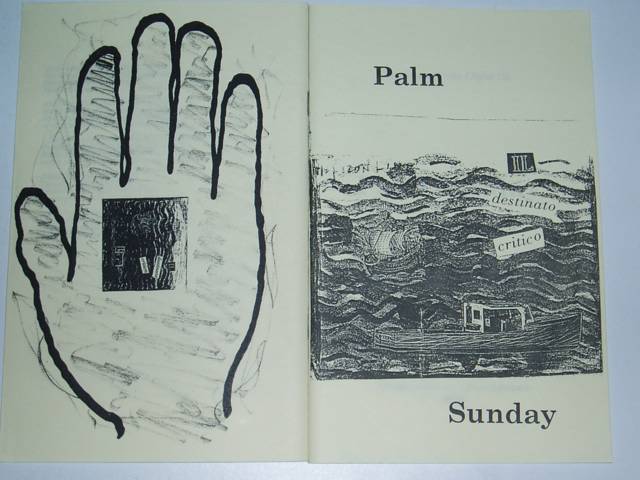
& with what kind of "Now" might my own writing have to do? I'm thinking of the "gray area" of the great Jasper Johns show at the Met in NY, which I saw last weekend. Johns often gestures toward poets, especially Hart Crane. There are the images of the hand-print on a kind of pendulum or radius, as if reaching up from deep under water. I've thought of my own long poems as partly an attempt to perform a kind of ghost dance or resurrection ceremony, for Crane in particular - to play Hart Crane redivivus. (& did something parallel with the "Henry" of John Berryman, in the Island Road sonnets.) An illustration to one of the chapters of Grassblade Light, "Palm Sunday" (which is set in the New Orleans/Gulf area), unwittingly echoes Johns's image in this respect.

2.27.2008

Poetry is embodied speech, language brought close to ordinary conversation and then spun wildly around it. Embodied, embodied, not simply collected, collated, sorted through mandarin effete distortion-filters... thus these readings/performances last night offer a kind of test - a sort of partial & preliminary measure (& not the only one, by far) - of the poetry's substance, reality... (the real test residing in the hidden performance, maybe never actually heard out loud, of the poem's composition).

Mikhail Aizenberg an architect by profession, and you see in his critical writings this constant tension between poetry and rhetoric, between poetry and mechanical, learned, imitation-discourse (the "Leningrad School" his emblem for the false turn toward the latter) - poetry having some kind of inner form, the creative/intellectual/emotional/sensible gesture - a shape, an architecture, in-forming the language.

(Thus the interest in Vvedensky & the OBERIU poets' demolition of everyday speech & literary language etc. Maybe that all goes back to the Byzantine theological crisis-complex, the tense ambivalence between iconophilia & iconoclasm, between the symbol (word) and what it represents.)

"The body is the temple of the Spirit."

For Aizenberg, it seems, ordinary speech & ordinary experience offer the paradoxical, counter-intuitive substance or acid test for the authenticity of the inner unspoken architecture of the gesture... this shared communal language-space being the place where all the human motives for composition are integrated & achieve actuality.

5.24.2007

Here is a cluster of Index labels under the subject : Henry (label : subject/Henry).

I haven't linked to every term in the numerical series for some of these labels (i.e. criticism2, criticism3...), but only to the initial term (i.e. criticism). (See Index for more on this.)

Related topics (there are others) : breakdown, Henry IV, Henry V, Henry's books, Shakespeare...

3.02.2006

(...clearly the whole question goes much deeper than that, however.

A poet becomes identified with ordinary people by way of his or her own passionate identification with same.

But such a passion implies an isolation, a separation, of some kind.

In overcoming that primal distance - in the victory of the quest, the winning of the game - the poet embodies something supremely ornamental in their own person & art.)

(Geez, this sounds suspiciously way too much like D'Annunzio..., or, Lorca, I'd rather think of. Crane. or Dickinson, the Silencer.)

5.06.2005

Latta keeps it close to speech-writing, today. People behind the phraseology, actual warm-bodied human beings, speaking. Literary history as a process of finding a genuine way to talk in print, or imprint talk.

Coming down from physics to chemistry. The phasal interaction between ordinary (not so ordinary) banter, dialogue, musing - truth-telling, directness - on the one hand - and the more basic or inherent rhythms of words & letters, materialized in text - on the other (measured music). I guess Zukofsky put it more elegantly, with his function sign, speech/music.

The American style of bluntness. Stephen Crane, Hemingway. Or the American style of jive. Twain, Melville. Straight or slant. Is there an American middle style, that doesn't become bland & academical or stuffy & academical?

The poet must do a couple of things, I guess - 1. find an authentic way to combine these two phases; 2. once there, actually have something to say.

11.16.2004

Here I compost my difference.

If we accept the R. Formalist 6-sided model, still, we say, language is not dicing. The simple hexagonal formula elides an implication of the fact that the addressor is one of its facets: the implication that motive, impulse, is inextricable from the actuality of language.

"Words are fossil poetry", says Emerson (Thoreau?). The word from its origin is gestural, indexical, representational, mimetic. The "inner image" of the word (Mandelshtam's Potebnia, the anti-R. Formalist) is a complex made up of its etymological-gestural roots.

Imagine, not a six-sided die, but a sword turning every way.

A sequence:
1. the primitive word points to that.
2. the primitive word-maker inches toward self-consciousness.
3. the primitive word takes on the tincture of same (self-consciousness).
4. the primitive word becomes a polished mirror, a flashing sword.
5. the primitive word-maker points toward his/her Maker.
6. the primitive word turns every way.
7. and the primitive word saw that it was good, and rested.

For the (Mandelshtamian) Acmeist, the poetic word exults in liberation from necessity, it celebrates its inner free-standing harmonics, it honors the creative nature of which it is a part, it acknowledges the origin of its freedom in the "historical fact the the Redemption". Thus the primary border is not between past & future, as with the Futurists, but between time & eternity, or heaven & earth, which the intervention of the Divine Word fused together, and which the poetic word echoes & celebrates.

Mandelstam wrote that, ironically, the revolution broke the spine of cultural chronology stemming from the Incarnation (the Christian calendar), and in doing so, led not into a utopian future but a kind of inert state, which he mocked as "Buddhist Moscow".

(Obviously, here, I'm taking Mandelshtam in my own direction, building on certain strands of his oeuvre; I'm not presenting an objective/scholarly version, but a Henry-adaptation.)

To summarize: in poetic language, impulse & representation are inherently meshed & fused with the "verbal material"; there is no toss of some dice-object; rather, language is a human creation which is surrounded by & points toward its maker-matrix. The langpo/futurist/modernist emphasizes chance & formal reconstruction; the acmeist/modernist emphasizes historical fate, the inextricable cultural context. Futurism is construct; acmeism is embodiment & image.
... SO, poetry reflects that special embodiment, that embodied freedom-authority... & as such the messengers of that special space often come up against the other authorities. Thus July, the 3rd of Forth of July, ends on March 5th, the date on which both Stalin & Akhmatova (avatars of these two distinct powers) died.

& anyway, all this providential history is a work-in-progress. So the unpublished history poem In RI deals more directly with Roger Williams & his unique state-founding. & this has been translated, wonderfully, into italian by Anny Ballardini. I'll be a Dante yet.

& what I mean by this "embodiment", in part, involves all these threads I've been tying (plowing?) between my rows of verse, and the "rose" of Rhode Island. Thus I first came from the midwest to this state on the merit of my college application essay, which was a group of Ted Berrigan (of Cranston, RI) imitations. & though my roots are in Minnesota, I've discovered a lot of family background right here. There's a little island in Narragansett Bay called Gould Island, named after Thomas Gould, the nephew of my gr-gr-gr-grandfather Zaccheus. Tom Gould was a friend of Roger Williams, & rented him a field on that island, for raising hay.
Did you follow all that, all that I posted on Friday? The eyes blur over.

It's blurry, I know. The idea is that poetry is a special kind of "embodied" speech, analogous to incarnation. An end in itself, as well as a representation of something else.

& the concept of incarnation stems from a metaphysics, if you will, which includes both divine & human; not one without the other. A religious perspective which includes BOTH divine will and human self-will, human freedom. This is the general idea that underlies Renaissance christian humanism, Dante's polemic for a balance between Pope & Emperor, Roger Williams' demand for liberty of conscience and the separation of church and state.

When I look back at the poem (Stubborn Grew, etc.) I see it as expressing a position in the middle, facing 2 ways: first, by celebrating Roger Williams & echoing Dante in certain ways (the "octagonal" design described on Fri.), it represents this humanist stand for freedom of conscience & the separation of political & religious authority; second - especially in the 3rd book, July - it represents the distance between present-day dispositions of political power ("Julius" - military-state force) and a utopian future ("Jubilee").

6.02.2004

I'm searching for an equivalent to the word "image" as applied to poetry, which is not limited to the sense of a visual picture or illustration.

What I'm thinking of is the way a poem indicates, points toward something, by way of suggestion or allusion or evocation. That "something" may be a physical thing or an idea; but what the poem does is offer a verbal embodiment or gesture or narrative.

In painting, the wholeness of an image is valued (the way the parts of a picture are subordinate to or supportive of an integrated whole): the painting projects a unified image, something the viewer can grasp as such.

If there is something similar in poetry, we would have a verbal embodiment as a kind of accessible or recognizable whole: there would be a substance (intellectual, sensible) imparted by the poem to the reader.

Some poems impart that substance purely through harmonics. That is, there may not be much of a visual element at all; the verbal formulation may be abstract and discursive; but the language may work through its harmonics to create this kind of embodiment, which I'm relating to the idea of "image". Sound, rhythm, and diction alone may create this harmonic envelope.

Yeats was very interested in this notion of poetic holism, the formation of images which are both exact and precise, on the one hand, and full of open implication, on the other, and the holism of the entire poem, and groups of poems (see good book by Engelberg[?], The Vast Design).

I'm interested in how "embodiment" - whether through actual visual images, or through allusive, evocative language - lends itself to natural vision & sensation, returning the poem to the ground of ordinary experience. A poem's finish or fitness would seem to have a lot to do with its capacity to transfer a complete embodiment or image from poem to reader.

And it seems that these concerns are not emphasized in poetry much these days : there's more focus on baroque distortions of diction and syntax, jarring juxtapositions or rhetorical exaggeration for effect (I know there's a term for this out there... - catachresis, I thought of it!), the dilemmas of undecideability. These all seem like surface phenomena. There's less focus on holistic embodiment and its transferences, and more on immediacy, shock, surprise.

2.12.2004

See John Latta's circumspections & link to Dale Smith's reviews for what's happening now.

In both Jarnot & Foust, minimalism seems to enhance "embodiment."

I have my own peculiar take on the "incarnational" nature of poetry.

The figure in the landscape. The hero in the not-so-sacred wood. The word in the woodwork. The curse at the crossroad. Woden hanging from the world-ash-tree.

4.14.2003

Island Road moves slowly, zigzaggedly, from autumn to spring, from despair to hope, from cynicism to love. When I listened to the recording of my awkward Reaganesque/Clint-Eastwoodian whisper through the whole 99 "sonnets", I re-experienced, recognized again the EFFORT that is part of giving birth to a new poem. It's an "incarnational" poetics - & perhaps hearing these mutterings, while reading along, is one consequence. "Entering" the form of the sonnet (I almost wrote sinnet), answering Shakespeare & Berrigan & Berryman - it was a physical, embodied encounter, represented by the "muse" figure - the figure of Spring or Persephone or Dark Lady - right from the beginning, in sonnet # 1. It felt like an encounter, a MEETING - and indeed it was.

Whether the awkwardness is finally a sign of artistic defeat - well, I hope not. Listening to the whole thing felt like listening to some big untidy Cantos getting underway. I wish someone else, some smooth actor, could read it FOR me : but it's better this way.

3.11.2003

More on poetry as embodiment: think of Joyce's concept of "epiphany" (the particular thing seen in its "quiddity", an intellectual light). Pound's heavy acorn of light.

Think of poet & muse: Orpheus/Eurydice, Dante/Beatrice, Henry/"J" (see me being pretentious!). The child-bearer vortex - Venus, Virgin Mary, Magdalen - and her absent (ghostly) presence. & the imperfection of formulae - the vanishing point of recognitions. The embodied absent one, the story, the index. M, W, mother-night, Cassiopeia.

The black-haired young woman in the dark green skirt walking ahead of me in Fox Point (a slim stringed instrument, heft tuned to her gait).

"Heavy-hearted woodlands."
Thus maybe the encyclopedic or didactic aspects of epic (the catalog of ships; Pound's lectures; Dante's or Joyce's grids of correspondences) are secondary to, or subsumed by, a PLOT, a personal story, the shadow of the hero or the anti-hero or the poet. Why? because poetry is a voracious force-field, a conjunction of opposites, a conjunction of word & flesh, knowing & being. This is the telos or aim of its powerful energies : embodiment.

This vortex or vanishing point of poetry, where knowing & being, soul & body meet in the pleroma of the word.

& the epic becomes the "personal epic", the tale of the tribe becomes the mirror of the person, the microcosm, the reader.

What is the paradigm for this literary shape? It is "incarnational". The paradigm is the Gospels, where the telos of history is the Person, and God incarnate returns like Odysseus as the alpha-omega of the entire Scriptural-historical process.
. . . but then, isn't poetry where, through speech, we try to fuse "knowing" & "being"?

Which is a futile vain Quixotic effort. & we end up representing human nature through failure.

Comic gargantuan example : Charles Olson. His "Maximus" gains from its ungainliness. The reader's imagination is swayed by the image of the fat man in squalid little apartment in Maximus-town, trying to "say" the Great Unsayable. The mundane seeps in around the edges & gives the would-be Ezra color & humanity.

Another example : Montale. He was very aware of being the voice of the "man in the middle", between transcendent glory and human pettiness. His poems build on the contradiction.

You end up with a doubleness : a sort of incarnate word (poetic language - full, packed, weighted, embodied - Keats), & the shadowy feeble negatively-capable poet who utters it.

1.31.2003

There is a "Biblical" way of thinking about this poetic notion: fulfillment of the Scriptures. "Before Abraham was, I am." One theory about why Jesus was said to be from Nazareth or a "Nazarene", holds that he was a "nazir", or nasr - which could mean both a member of a special sect set aside for holiness (called the nazirites), or a poet, a singer. "The Kingdom of Heaven is in your midst"; "the Kingdom of Heaven has come upon you" - what a Blakean-poetic way of speaking! The Now. I don't want to reduce or exalt Jesus to poet-status though - that would be a big mistake. Only to say perhaps that there is a teleology inherent in poetic language use, tending toward immediacy, the event now, the living presence, the embodied word.

I have played around with this in my poetry, both in Stubborn Grew and its sequels, & in the sonnet sequence Island Road: the notion of "making" the literary name of "Henry," in various places (Shakespeare, Dante, & esp. John Berryman). The notion of embodying, fulfilling the "Henry" scriptures.