Showing posts with label Hart Crane3. Show all posts

8.28.2015

The whole race is a poet

The whole race is a poet that writes down
The eccentric propositions of its fate.
                 - Wallace Stevens

My wife Sarah & I have been enmeshed in a drawn-out campaign to pack our belongings & sell our house & make a move out of Rhode Island, back to my home town (Minneapolis).  We're vacating this place & buying my mother's house.

"Home to his Mother's house private return'd."  So ends Milton's mini-epic sequel to Paradise Lost (that is, Paradise Regain'd).

His mother's house.  Milton's Jesus goes home, after his confrontation with Satan - back again, out of poetry & mythology, to his mother's familiar house, encrypted somewhere in the archaeological past, in the disputed chronology of an actual, historical Nazareth...

In an interesting study first published in 1950, titled The Nazarene, Eugenio Zolli traces this epithet for Jesus not so much to his native village, but to the term "Nazir" - which he refers not only to the sect of holy men called Nazirites, but also, etymologically, to one of its meanings in Hebrew : "singer, poet".

The past many months have been relatively changeful & tumultuous for me, the meek little library worker inured to Brown-mouse quiet, books, walks, silence, routine.  I made these choices at least 25 years ago.  I didn't want to teach.  I didn't want to be an activist anymore.  I didn't want a high-energy job.  I wanted to read & write.

Did I have the moral-political grounds to make this choice, to have such an option?  I don't know.  I was responding to what felt like a calling, a vocation.

The fact that I'm even sitting here noodling these ruminations is due to the aforementioned disruptions of my usual mode.  I'm trying to revive the productive state of mind, which I've been unable to do for a couple weeks at least.

It really is a kind of trance state.  Not so much irrational as sponge-like, responsive - yet focused on certain landmarks or compass-readings.  Ravenna Diagram, the big canvas I'm working at, does indeed have its own sort of structural foundation or center of gravity.  The "trance" process is aligned with that.  "The way, when we climb a mountain, / Vermont throws itself together." (Stevens)

I don't yet understand my fate, in Stevens' sense (see epigraph above).  Maybe I'm blind, a sleepwalker.  Maybe I inhabit a solipsistic ego-bubble.  But I don't think so (at least not quite yet).  It is hard to avoid the doubts, the undermining of self-confidence, when the reception for one's labors seems effectively nil, sums up to zero.  Is this evidence of my mistake?

I try to grasp the self-designed blockades to such reception.  There are all sorts of personality issues as well as problems related to the work itself.  Regarding the former, I haven't helped myself.  I am introverted & shy.  I over-compensate with an internet poet-persona I started to manifest in the late 1990s - often annoying, iconoclastic, provocative.  I do not swim with the schools, I don't "network" very well.  I do not teach writing.  Yet I have become something of the typical online self-promoter - self-publishing book after book... understandably, this does not sit well with fellow poets & editors.

But I have tried to get published in journals.  It has been an uphill battle.  It seems likely that, with regard to reception, the issues with the work itself are the more determinative.

I've been writing poetry for nearly 50 years!  The hegemonic critical mantra about "two American poetries" - mainstream and postmodern/avant-garde - has always been a waste of time.  I've liked neither Language Poetry nor New Formalism.  I've been engaged longtemps with the long poem - as Berryman was, & others.  Berryman is not considered part of the "experimental" wing, which seems ridiculous to me (see Brendan Cooper's book, Dark Airs, on this whole question).

Unlike Berryman, in the early 1980s I got absorbed into a mode of elliptical "telling it slant", sourced in the radiant music of Osip Mandelstam.  I found analogues for this approach in both Pound and Hart Crane.  It took me 20 years to elaborate my own manner in this general field.

Such obscurity & obliquity is probably one of the rocks piled on my personal blockade to reception.

Probably a bigger rock, though, has to do with the worldview, the preconceptions.

But enough about me!  Let's get back to the trance state.  What is my trance?  Who is my "muse"?

I think maybe my writing telegraphs on a frequency out of range for many.  The preconceptions & background are too abstruse or occluded.

Why am I writing about "Ravenna" (if I am, even)?  Ravenna was an outpost of Byzantium.  It is a nest of amazing mosaics, towering icons - an outlier from Hagia Sophia and Byzantine Orthodoxy.  But for me, in my poetry, this is a kind of meta-icon for something else.  It leads back to the "Russian" roots - in Mandelstam, in Acmeism.

But those roots too are like the upper layer of a psychic puzzle-box.  Why Mandelstam?  Why Acmeism?  Why Nabokov?

Orthodox Christianity - one aspect of which includes "iconophilia" - is bound up in my mind with the purposes of art, for one thing.  It is incarnational.  The theological dimension includes a commitment to the divine embodiment in the human - their fusion in the process of overall cosmic purpose, the "plan" of the whole.  Art is a limb of Creation in general - a bloom, the flower of flowerings.

Dante is buried in Ravenna.  Pound is buried in Venice.  Rimini sits on the Italian coast between these two.  The complex here is a way of symbolizing something perpetual in poetry - something tying together Dante & medieval Italy with Pound and contemporary America (by way of the "long poem").

But why do this?  Here we get down to another layer of the archaeological dig.

Why Christianity?  Why incarnational, etc.?  This is the 21st century, after all!

Jesus, the "nazir", the poet, the singer, may be the eternal 2nd Person of the Trinity : I'm not going to go into that here.  My focus is on the "Jesus of history" - the real individual who acted and spoke & made claims & taught, suffered, died.

Jesus had charisma.  I think it was founded on his confidence in the divine goodness.  No one, ever, has expressed more serene joy & love for the "Author" of life, the source.  St. Francis tried to replicate this spirit, & perhaps came closer than anyone else.  But Jesus expressed it first and most firmly.

"Home to his Mother's house private return'd."  What shall we say is represented by "his mother's house"?  I would say Judaism itself, the historical people & faith.  The Jews are & have been many things, but perhaps most signally they have been a people of the Word.  Poets.  The Psalmist & prophets sang of the promises of their God - promises of a land of milk & honey, of an era of peace & safety & abundance.  These words were crystallized in writings, encased like scarabs or butterflies in exact & exacting speech, which drills through centuries & eras like the point of a diamond - the hardest thing on earth.

Literalists & fundamentalists & sectarians (of many Abrahamic strains) try to reduce it to their own stingy formulae.  They don't understand, they do not grasp the message.  It is a global human message, representing the whole earth, Earth as a whole.

So, Henry!  Here we go with another preacherly rant.  No wonder you have no readership as a poet!

The matrix of Ravenna Diagram is a Venn diagram.  It is Henry, the American poet, writing in America, now, at one point of the Venn design (of double circles).  It is Jesus, the Jewish poet, singing in Galilee & Judea, at the center of the second circle.  The mandorla in which they overlap (the middle of the Venn diagram) is poetry itself - epic poetry, long poems, on the track of Dante (who finished his Paradiso in Ravenna).

Poetry is one mode of spiritual metamorphosis, of transfiguration.  In this case the epic poem is a vehicle for transmuting history into an expression of divine purpose.  Reality is henceforth framed by the personal : that is, by the human person, who experiences & interprets the given & its meanings.  Prose is the "objective" and impersonal : poetry is the ecstatic and personal.

Poetry is essentially affirmation, the praise song of the "nazir".

Obviously this is far too much baggage for most readers, editors.  It certainly has to be proven by the work itself : no amount of explanation will suffice.

Why must Henry pile Pelion on Ossa to establish such a Baroque or Gothic superstructure for poor little ol' poetry?  My enthusiasm must scare people.  Literary folks like to sit back & evaluate, which is only right.

It's simple, really.  I had an encounter with "the Word", back around 1972.  I was around 20 years old.  I was burned, I was branded, by Gospel fire.  The Word sinks its tongs into you - the word of the old desert, going back to prehistory.  The proverbs, the parables drive like nails into your conscience.  Yet the meaning proves true.  It is enough to transfigure life on earth - it is Milton's "divine Providence".  For poetry has its lion-claws, too - digging down through the sediment of time & shifting cultures, of languages and nations.  They might be one & the same, these nails, these claws.

design by Joachim of Fiore

12.18.2008

Since the 1970s, periodically, I've become fascinated with number symbolism, gematria. The books of John Michell, something of a New Age (& old British) eccentric, on ancient/Egyptian/Pythagorean/Platonic canons of number & "sacred" geometry. (Related somewhat to viewpoint of another eccentric author, Giorgio de Santillana - see his book Hamlet's Mill.)

Much of it needs to be taken with massive grain of salt - in particular, the notions (unsupported by much evidence, if any) of 1) superior ancient civilizations (Atlantis & such), and 2) the extrapolation of Plato's arch-conservative and anti-democratic political tendencies. (Michell's sneers at democracy, & such.)

Yet I am, as I say, recurrently absorbed with such explorations of ancient number symbolism in both Plato & the Bible - the detailed measurements of the Ark, the Temple, the New Jerusalem (Bk of Revelation), the canons of architecture in Greece & other parts of ancient world, the correspondence of harmonic ratios, numbers, names, & themes in archaic literature...

& it shows up in my poetry, especially the long projects... maybe someday these works will be understood as playful percursors of a new/old sort of philosophical & literary culture...

This is something of a Hart Crane theme (cf. "Atlantis" in The Bridge), & a Whitman & Melville stratum... it comes through in sometimes (I think) funny ways in my poems (see for ex. the role of eccentric Minnesota Senator, Shakespeare crank, & Atlantis theorizer, Ignatius Donnelly, in Stubborn Grew... if you click on this link, you see the book cover - that's Ignatius, down in the lower lefthand corner).

(I guess I've blogged on this before...)

12.13.2008

Re-reading some parts of Crane's Bridge. The picayune dismissals of Logan & Kirsch, like those of their predecessors in this vein, just miss the point. Someday when I get my act together I will write that essay about this. Yes, he is uneven, sometimes bathetic, sometimes bombastic. But when he is good, he is simply head & shoulders above anyone else. He is the genius of These States. In the section titled "The River", for example.

How does he do it? Marianne Moore called him "erudite". This is very apt. I think Crane better than all the rest absorbed lessons of Renaissance poetics. He mastered the measure of a rich pentameter. When he added this, first, to his native musical talent, and 2nd, to his sense of mythos (the symbolic plot - the "myth of America") - then what he accomplished in 45 or so pages is equal to what Olson or Pound did in 600 pp. of musical "notes"... (but it's not just 3 things... there's the essential 4th thing - that Platonic-demonic-orphic enthusiasm, that boldness, that inspired-fiery "afflatus"...)

Crane's work sets him in a small group, with Melville, Dickinson, Whitman, Poe... maybe Henry James, Hawthorne, Eliot, Stevens, a few others... the true original American masters...

12.04.2008

Re-reading yesterday's post, I see I made a sort of Harold-Bloomian slip. The one poem of that group which displays an oceanic sense of vastness is, of course, Hart Crane's Bridge. That's maybe one reason Crane is a favorite & was a model for me.

10.14.2008

Posted a comment to William Logan's latest piece on Hart Crane, at Poetry Foundation website.

8.30.2008

Hart Crane aspired to be "Pindar of our machine age". Praise-poems like "For the Marriage of Faustus and Helen" and "The Bridge" have, in that sense, a Pindaric elan vital.

2.29.2008

I feel like I took a small conceptual leap of my own yesterday, with the remarks on Harriet, responding to Reginald Shepherd. The idea that the poem is only fully actualized in the "big outside" of the public stage (not necessarily a literal stage, but a performance nonetheless), in the "gray area" between art & politics.

Of course a poem can have a perennial life as a text, and be reborn every time it's read, and appear re-shaped again & again... Mandelstam's idea of the "letter in the bottle" to an unknown reader. But maybe the normative aim or trajectory of the poem is directly into the social Now of its time and place. It might be a combination of these two aspects, ie. a renovation or rebirth of a former crystallization; but I think this idea of poetic actualization on the "stage" of the present is important, as it relates to to another idea which I 've followed at various times on this blog, ie. to emphasize a distinction between prose literature, and poetry's embodiment, the human performance of language in the Now of the present, time's "pleroma". The poem's (Aristotelian) form achieves its ontological telos - it flowers - in this shared "gray area", the common verbal/social/political space of its time.

"Time flowers on the lips of whispered clay." Opening line of Forth of July.

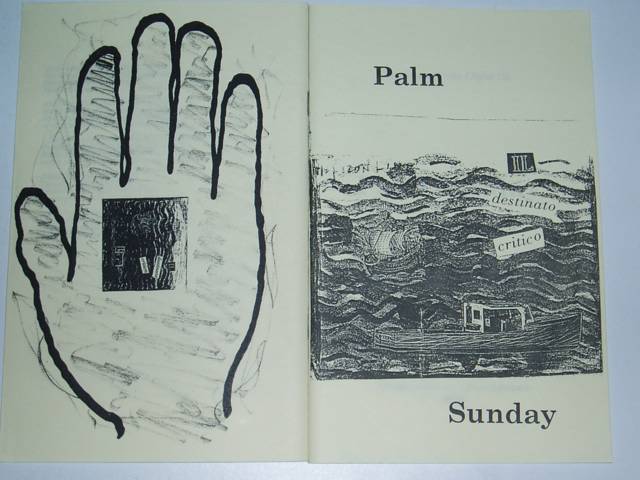
& with what kind of "Now" might my own writing have to do? I'm thinking of the "gray area" of the great Jasper Johns show at the Met in NY, which I saw last weekend. Johns often gestures toward poets, especially Hart Crane. There are the images of the hand-print on a kind of pendulum or radius, as if reaching up from deep under water. I've thought of my own long poems as partly an attempt to perform a kind of ghost dance or resurrection ceremony, for Crane in particular - to play Hart Crane redivivus. (& did something parallel with the "Henry" of John Berryman, in the Island Road sonnets.) An illustration to one of the chapters of Grassblade Light, "Palm Sunday" (which is set in the New Orleans/Gulf area), unwittingly echoes Johns's image in this respect.

2.26.2008

I suppose I was being foolish (again), over at Reginald Shepherd's Harriet post announcing his new anthology (Lyric Postmodernisms). Maybe even rude, to intrude on his publication announcement. The discussion (for me) was leaching over from other posts - one by Shepherd on the term "post-avant", another by Christian Bok on contemporary experiment (in response to Shepherd). Actually it was Bok's (re)formulation of some discussion by Shepherd & Paul Hoover - in which Bok summarizes Hoover's idea of a compromise, in current poetry, between postmodern experiment & tradition - that I was criticizing. Shepherd's new anthology seems (from its title & brief descriptions) to represent or illustrate some such compromise. (Bok himself suggests the limitations of such an idea - this compromise - & proposes something else, along the lines of multifarious simultaneous experiment - the "pan-avant".)

Anyway, I was being silly & provocative, using Shepherd's post the way I did. But I get irascible when I hear the term "postmodernism" too often.

& I was registering a protest of my own against this notion that today's cutting-edge & influential poets have found a way to blend postmodern concepts of language & subjectivity etc., with more traditional modes of lyric poetry.

Because actually I think the real new & radical step right now would be a rejection of the recent compositional & stylistic formulae - those which fixate on
20th-cent. notions of language, on language per se as the sole formal, structural material of poetry. I'm saying we go back to the Cranes : R.S. Crane's (& the Chicago School's) Aristotelian concepts of poetic form; Hart Crane's sense of the poem as a mute or silent gesture toward the unsayable.

But I've already explained all this. & the attack dogs are lurking. & the machinery of professional poetry prestige (in which, for the time being, I am not a player) must roll on.

It was gauche of me to add all this to the comment thread at Shepherd's publication announcement. & I owe it to him to actually read the new anthology, which I will do.

& yet I have to be silly, stupid & out-of-sync sometimes; that's part of this loser's game I'm playing.

2.18.2008

Robert Archambeau writes a thoughtful extended response to the blither-blather on "post-avant" over at the Harriet site (Reginald Shepherd's posts).

I tend to see the negative side of what Robert's calling "negative legislation" (the contemporary poet's refusal to judge and emphasis on the ambivalence & waywardness of language). To me it often feels like a cop-out, to the extent of denying human agency in the creation and use of language. That's one reason I'm being provocative myself (see the comment on Shepherd's anthology Lyric Postmodernisms).

But I'm not merely being negative about the negative. I'd like to replace the ubiquitous 20th-cent. fixation on "language" (as system : as the currency, the substance, the organizing matrix, of poetry) with an emphasis on silence, gesture, mime. Hart Crane's statement should be its motto: the poem is

"a single, new word, never before spoken, and impossible to actually enunciate".

A poem is, in this sense, the sum of the poet's strategic gestures toward something never-before-said or -sayable. It is absolutely uncategorizable according to any prior linguistic grid, and the poet bears complete responsibility for - is the human agent of - the final & efficient cause of - all its meanings and reverberations.

2.15.2008

A great American exemplar of the sense of poetry I tried to outline in previous post is, of course, that valentine friend of George Henry Gould - whom Crane apostrophizes here as the "Silencer":

To Emily Dickinson


You who desired so much - in vain to ask -
Yet fed you hunger like an endless task,
Dared dignify the labor, bless the quest -
Achieved that stillness ultimately best,


Being, of all, least sought for: Emily, hear!
O sweet, dead Silencer, most suddenly clear
When singing that Eternity possessed
And plundered momently in every breast;


- Truly no flower yet withers in your hand.
The harvest you descried and understand
Needs more than wit to gather, love to bind.
Some reconcilement of remotest mind -


Leaves Ormus rubyless, and Ophir chill.
Else tears heap all within one clay-cold hill.

6.28.2007

It's always an uphill battle defending the greatness of Hart Crane. The attacks come in a steady, evenhanded critical stream over the decades.

He has many weaknesses, yes. But he's a great American poet because, to put it in a nutshell, he unites his music (melopoeia) and his imagery (phanopoeia), with an ecstatic-visionary quality (culminating in the concluding section of The Bridge (Atlantis).

Crane's "visionariness" is not like Pound's conservative/archaic mythologizing. Nor like Eliot's resignation/spiritual renunciation. It has, rather, a kind of "titanic" quality, which seems distinctly American - perhaps because it stems directly from Whitman. (Whitman got it from Emerson, & amplified/electrified it. Whitman is to Emerson as Bob Dylan is to the New England folkies.)

As I see it, this American "titanic/ecstatic" visionariness is not simple and pure : it contains a certain ambiguity. "Atlantis", according to the myth, was a high-tech civilization which fell, eons ago, through its own pride & corruption. Crane opens The Bridge with an epigraph from the Book of Job (something like "walking to & fro upon the Earth"), which was spoken by Satan.

The ambiguity I'm talking about stands at the core of that prophetic/apocalyptic mentality in which the poet/prophet, situated between Iron & Golden Ages, looks beyond the conditions of the present into a completely transformed future. One could diagram the situation like this :

[ Titanic-Atlantean high civilization / Present Age / Franciscan-Edenic future ]

- with the poet's vision wavering between, or blending together, all three "ages".

In both Judaism & Christianity, the path from present to future (from earth to kingdom of heaven, or from "this world" to the "world-to-come") goes through redemption and then resurrection (into a new form of angelic or heavenly "body").

The question of how such ideas are to be translated into personal life, and into history in general, has been answered in very different ways. But the visionariness I'm talking about ultimately stems, it seems to me, from an underlying awareness of some kind of crisis or disjunction - between "this world" and "paradise", or between the vicissitudes of mortal life and some kind of different, angelic realm (the pupa/coccoon/butterfly effect).

6.12.2007

J. Latta, as always... Lights are on, somebody's home. He has a fine-grained way of reading... I think I stand back more & look at the picture from a slight distance. Take his Crane "Cape Hatteras" comments of today. Faulkner's telling a tale, with his droning southern rambling drawl-whisper. Crane, on the other hand, is painting a mural. His individual sections of The Bridge are like odes, or (in this case) Charles Sheeler machine-landscapes. An ode has a big frame : kind of unfair to nip & tuck at individual lines or stanzas, without taking a look at the whole thing. Thus "Hatteras" should be looked at as part of a wheel (or ring of suspension guy-wires, or rainbow) - one of the tones in a huge tone-poem. Look at "Hatteras" through the other panes : ie., the opening invocation to Columbus, or the closing rhapsody, or the ode to 19th-century clipper ships. Each ode should first be taken in & measured in terms of its scope as a whole song among a series of songs, before (over)-reacting to in-grained mannerisms...

Another way to think about the quoted stanza, too, is as parody. "Power's script" shifts the substance of true poetic-visionary power - "The Bridge" as comprehending a new perception of civilization on earth - shifts it to the machinery of power itself, and thus its "script" is diluted or corrupted. So the stanza includes gimcrack takes on Rimbaud's lines from "Illuminations".

Eliot did something similar, it's said, with the 3rd of the 4 Quartets. The whole thing is a self-parody.

I guess this is all special pleading, but anyway.

6.08.2007

It seems John Latta, in his Hart Crane post of today, is providing an illustration for the concepts I've been pondering here lately : the poet/seer & Beauty's dislocation...

JL is sharp to point out how Crane muddles & roughens up his own acute (prose) notations as he turns them into poetry...

but I have a different take on this, and I think "The Idiot" is a better poem than John suggests (Crane's complaints aside). The juxtaposition of the prose and the poem serve to point up the difference between prose and poems; and it's not just a stylistic difference. The essential difference illustrated here is between prose, as anecdote or reportage, and a poem as both song and symbolic representation.

I read this poem as a kind of parable : the poet-speaker actually identifies with the idiot boy, who scans the heavens through his tin can and sings his wacky Dio gracias tune. The "song" of the poem essentially seals this identification, asserting a kind of harmonic relation or hidden unity among things or events (subjective, objective) which are (on the surface) jarring, absurd or pathetic. "The Idiot" is an artifact of Crane's laborious effort to "sing his own song" : ie., Crane forges an initial anecdote into the pattern of his typical style/tone/voice/theme, the unified substance of his work as a whole. Look at how that "late" (for Crane) poem mirrors this earlier one :

CHAPLINESQUE

We will make our meek adjustments,
Contented with such random consolations
As the wind deposits
In slithered and too ample pockets.

For we can still love the world, who find
A famished kitten on the step, and know
Recesses for it from the fury of the street,
Or warm torn elbow coverts.

We will sidestep, and to the final smirk
Dally the doom of that inevitable thumb
That slowly chafes its puckered index toward us,
Facing the dull squint with what innocence
And what surprise!

And yet these fine collapses are not lies
More than the pirouettes of any pliant cane;
Our obsequies are, in a way, no enterprise.
We can evade you, and all else but the heart:
What blame to us if the heart live on.

The game enforces smirks; but we have seen
The moon in lonely alleys make
A grail of laughter of an empty ash can,
And through all sound of gaiety and quest
Have heard a kitten in the wilderness.

Note how, in "The Idiot", Crane has "faced [or re-faced] the dull squint" with the idiot's "squint lanterns". He has echoed the moonlight/ashcan with the tin can/telescope. The humorous/perilous social role outlined for the poet in "Chaplinesque" still holds in "The Idiot".

JL laments the loss of Crane's initial clear reportage in the process of composition; but (unlike most 20th-cent. poets) he's not writing prose. Not only is he not writing prose; he's making a peculiar song which asserts the fundamental difference between the poet and everything "prosaic". The distinction is epitomized in an old Ojibwa term : dream song.

10.25.2005

Jack Kimball notes amazing fact of new publication of some poems by Samuel Greenberg, very obscure New York poet, who died in 1917, at age 23, of TB, and whose work influenced Hart Crane (Crane actually stole some of his lines in the poem "Emblems of Conduct").

I have a copy of an early edition of Greenberg's poems. Once, back in the 70s, I was walking down Hope St (here in Prov.), wearing a pair of paint-spattered jeans (I had just been painting my apartment). An elderly gent, in passing, suddenly said : "A painter, I presume?" I said, "well, no, I'm a poet." He asked, "Who's your favorite poet?" Just for fun, I said "Samuel Greenberg." The fellow did a double-take. He turned out to be another Jack - Jack Birss, retired Cornell(?) english prof, rare book collector, Hart Crane aficionado (I noticed years later that he had donated a small privately-printed vol. of a couple of Crane's letters to the Brown library.) Birss knew all about Samuel Greenberg. We were both struck by the coincidence.

8.05.2005

The Crane thing, I know, seems a trifle obsessive or recherche. In the panoptic view, hey, look at all them poets! But I don't have a panoptical. "My Hart" is a part of my own program.

It began, it seems, with that chance find of Mandelstam in the bookstore back in '77 or so (David McDuff translation). Leibnizian monad of verbal image, detaching itself... (see OM's "Conv. About Dante" - where he talks about images in terms of aeronautics - images flying off from other images).

Strongly ecphrastic imagination. Verbal icon. The compact elegant phrase - like those Ecuadoran birds that sing with their wings. Nucleus of poems. "The Bridge" as exponential expansion of this process - the free-floating resonant image. Atlantis - hold thy floating singer late!

This image-making power in conjunction with epic scope & national ambition. How it cross-cuts the other & contemporary long poem projects. This I find fascinating. This I've built on in my Crane-Mandelstam US-RUS amalgam (Forth of July).
Mark, with more give-back on the question of Crane et seq.

That it comes down to an unresolved divide between remnants of the Romantic and the new strictures of the Modern.

Wasn't it coming from Pound (with Stephen Crane, Whitman, Poe in the background, mocking, in their different ways, the enfeebled denatured exhalations of Victorian poetry) - the notion that poetry should be as exact and exacting as prose, as science? Wasn't this part of a general trend toward hardness & toughness & clear-eyed objectivity throughout 1st half of 20th cent.?

Scientific perception grounding the autonomy of the art object. Eliot's strictures : "the classic". (Stevens & Crane is a diffun't animal.)

Unable & unwilling to go too far into that huge issue. But again, it seems like Crane was working from a different basis. I think he was looking at Joyce's Ulysses as an objective correlative to the spiritual or intellectual substance - the quiddity - of Ireland & Dublin in the modern world.

The Bridge would do something similar for the aura and spiritual destiny of America. Once he found the accurate form - that is, the plot of his poem : a dawn epiphany leading through a sequence of dream-panels of American history, & through the hell-gate (Poe in the subway) to achieved affirmation (the final panel, which he actually wrote first) - once he had recognized this inner plot or structure, the specific materials fit into place. It seems important that he composed the last section first : this underlines how the methodology differs from that of Pound, WCW, Olson (stemming perhaps from The Prelude) - their long-poems-as-autobiographical-diaries, as Ulyssean nosti, as record of the poet's ongoing struggle with "the facts" & with him's artistic soul.

I understand Mark's reservations about the hifalutin' & artificial diction of some passages in The Bridge. For me these serve merely to accent the visionary strangeness, the otherness, of the whole. There are other weaknesses which are probably much more damaging (sort of a faded 20s hyperbole, a kind of febrile gusto). But again, in the several re-readings I've given the poem, there was sheer enjoyment, stimulated by the shifting forms & voicings of the sequence of panels, the melodic force of the diction, the way the two threads of "plot" (the narrator's dream-day and the flow of American history) mingled & spread, like the river at the poem's center. The pleasure of aesthetic finish, the sense of rounded completion, is a powerful effect, which should not be discounted - and which is missing from the endless ongoingness of some of the other looooong poems.

8.04.2005

Just one more thought on this for today. This contrast noted earlier between Crane's finish and the others' various ongoing (quasi-narrative, Wordsworthian) agons : how key this is to 20th-cent. aesthetics! (All the debates about "process", the autonomy (or lack thereof) of the art-object, etc.)

And I am reminded again of a remark made to me at a Russ-Amer poetry conference many years ago by Elena Shvarts (we were talking about how the Russians memorized their poems for recital) : "Russian poets compose the poem in their heads, then write it all down. Americans start writing, and it takes them a long time to finish, if they do."

And this notion of finish can perhaps be linked with the notions of the self-sustaining, free-standing image in Crane & Mandelstam et al. Which leads back, ultimately, perhaps, to the Byzantine tradition of the magnetic, charismatic icon.

Sailin' to Byzantium.
... Because, and this gets to the root of it, what appeals to me in Crane above all is that intrepid, improvisational, brave, audacious, crazy, ecstatic spirit of affirmation - the bell rings out - that "exultance", which he flung in the face of Eliot, Yvor Winters, Allen Tate... (& paid for it in their dismissals). This for me is the authenticity of the authentic, the true insignia, the mark of the poet. Crane said he was aiming to be the "Pindar of his age" - the great praise-poet. He was drawing on Whitman for that. & there is some validity to the claim that his aim was true.
I wouldn't want to be stuck with the unwinnable argument that Crane is a greater poet than Pound, etc. My thought, however, is, that Crane's sense of, feel for, the image acts as a kind of tuning-fork (in relation to what's beautiful in Pound et al.). (Just as, for me, Mandelstam acted as a tuning-fork for Crane.)

Hast 'ou seen boat's wake on sea wall,
how crests it?
What panache?
paw-flap, wave-tap,
that is gaiety,
Toba Sojo,
toward limpidity,
that is exultance,
here the crest runs on the wall
(Canto CX)

(note the Yeats in the background)
I should say (tho' I've said it before), that I was able to get into what Crane was doing by way of Mandelstam. I latched onto something distinctive in Mandelstam - something about the emotive-evocative integrity of the image, the way the image emerges from the poem as a kind of free-floating, self-sustaining entity. A lyrical salience or monad. Free-standing beauty. & then I noticed the same thing in some of Crane's short poems.

It is the imaged Word, that holds
Hushed willows anchored in its glow


- that's it all right, exactly. Crane built on that to make a whole, integral long poem - a bridge-span.

(Curiously parallel to Pound's attempted extension of the Imagist photo into ideogram-montage.)