9.18.2004


4. Ghost Dance (caption under photo reads: "Henry Thunder Winnebago, recording songs in a grove")Posted by Hello

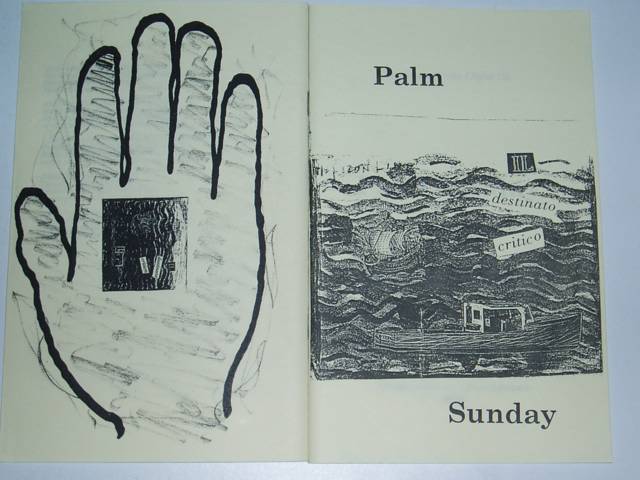
3. Palm Sunday (collage by J. Lesselbaum) Posted by Hello

2. Letters to Elena. (Top right: Petersburg poet Elena Shvarts. Lower right: yours truly, with polar bear. Left: London, Greek neighborhood. Orthodox church in background. Street sign reads: "St. Petersburgh Mews") Posted by Hello

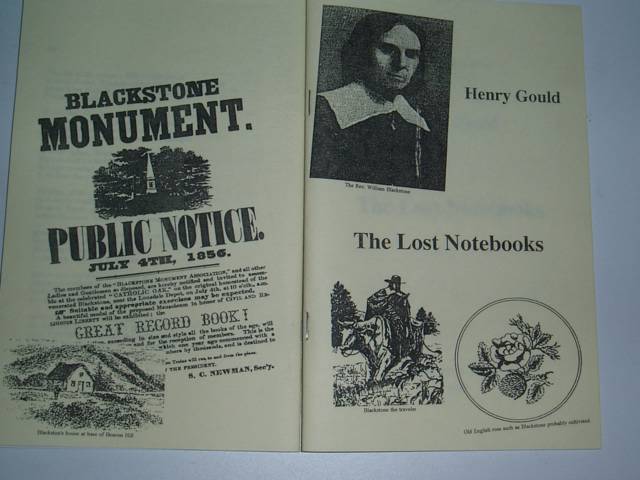
The first version of Grassblade Light was in the form of 7 chapbooks, one for each chapter. Here's the cover art. Chapt. 1. The Lost Notebooks (click the image to enlarge). (top right: William Blackstone. lower left, front cover: Blackstone astride his famous white bull, reading a book. caption under lower right image: "Old English rose such as Blackstone probably cultivated".)

These extremely rare and valuable texts are currently archived in the poetry libraries at Buffalo & Brown, and in the private collections of a very few fortunate individuals in remote corners of the universe.Posted by Hello
Reading fine book, Sienese Painting, by Timothy Hyman (a painter himself). The miniature narrative images - saints' lives, journey of Dante, Virgil & Beatrice - resemble graphic novels of today. In one scene, reading from left to right, you'll see a figure in three different actions (falling sick, visited by angel, cured...), like a cartoon.

Siena loved the Divina Commedia (maybe partly because Dante was so hard on his home town Florence). Public readings were given outdoors on feast days.

9.17.2004

today is Constitution Day. & sister Cara's birthday. that's her on the tricycle.
long poems, epics, the writing & reading of same - a way of overcoming the jadedness referred to earlier? By absorbing all forms of discourse & narrative - a voracious counter-pressure. Turning knowledge to account & back toward lyric state.
Days of hectic. Yet must I drone, drone I must.

Reading about Sienese painting, history. Sounds abstruse? Not really. Democracy, civic values, religion, art, Black Death.

Ambrogio Lorenzetti's frescos of Good/Bad Government in Palazzo Pubblico. Probably influence on Bruegel. Exploratory, panoramic improvisation.

Providence I am reading your local papers. Same issues - gov't overburdened with inertia, selfish interests, bureaucracy. Various levels & types of apartheid longstanding ("suburban golf protection racket" as Stubborn puts it). But hopeful civic efforts underway everywhere - creative projects of betterments.

Lorenzetti read Divina Commedia and was one of first - maybe the first pictor of Dante.

*

Walking about today with fleeting quarter-thoughts in between work. Mild, muggy.

Stevens' Adagia - the ones where he holds "poetry" and "poetry of life" in each hand. Maybe no other way to apprehend it??

Poetry is a sense. Not words, really. We have to feel our way into it again, blindly - into the sense of it we had in our youth, man' decades ago.

I mean poetry in its psychological/experiential context. . . what am I saying? When you ponder the vast variety of human capabilities, personality bents, individual experiences - such ground the vast differences in taste, apprehension, appreciation, valuation. & often I think we literary leeches are the most blind - through jaded appetite. We no longer respond as we did, to a new world speaking to us from the page.

But my own argument here excludes the word "we" to some extent (talkin about myself, I guess). Nothing is determined or set in stone in this regard. We may again find ourselves caught up in a new literary charm, a new discovery, a new love.

Poetry is a sense. A sense of reality-as-poetry. A premonition.

I have a literary reputation as odd, eccentric. Also boring, conventional, traditionalist. Actually I am Super-Normal Standard Poet. My literary memory is an echo chamber. I keep alive certain normal ways of speakin'.

9.16.2004

Here's the path I take to India Point, over the freeway bridge (cf. poems posted recently). From a photojournal produced by Donald Tetto.
Thank you, Allen. You make my day, today. Generosity. (& Kent, ever alert & compagnevole.)

(On this day in 1999 I started the sequel to Stubborn G.)
I've started a new blog called AlephoeBooks, linked at left. Not meant to be a daily thing, but sort of a display case for HG publications. The links there provide a handy map of my scriptorial fabricattoria (new word). Since I'm hoping to release some new, revised, cheaper editions of previous efforts, AlephoeBooks is where I'll explain what they are, & how to import them into your cosmos.

9.15.2004

This just in (Pravda) : Allen Bramhall reading Stubborn Grew

Allen - word of advice from the Author Position. Do not begin to feel that reading it is work, or that you are guilty, inadequate. I Author have ofttimes done my Readers (& Author-Self) a disservice by harping on the deep complexity and High Postoffice-Modern Seriousness-Quality of my Work.

Remember : the Poem was written by a (drunken/sleeping) snail (Dung-Beetle) trying to munch his way into Providence. It should be read in that Spirit as well. It was written for fun, fun, fun and is meant to be fun, fun, fun - a true Leisure Time Activity brought to you by Prof. Leisure Time himself.

I have found that the best way to read my Work is in the Tub, out loud, while your Significant Author pours buckets of warm Water over your head. This tends to bring out the real "Ocean State" flavor (or material status) of the Verse.

9.14.2004

Kent Johnson informs me there are few mosquitos in La Paz! (see previous poem posted here). The man is not only well-informed & -traveled - he can read Henrybrew!

9.11.2004

But the fit though very few who read to the very deep end of Forth of July may traverse a thin quipu-bridge to The Countess from Minneapolis, by Barbara Guest (all mixd up with the Queen of Spades in Pushkin's sht stry) (logorithm: guest-geist-ghost-ghoul-gould) published in Providence by Burning Deck Press. to wit (from the Hebrew):

17
There are mzqtz in La Pz
nd at Crgdero we lst a hrs
to a jgr btfly mggt in the ml's
rs fr shr nd the Cntss zps

hr lps th rfinmt ov wht's spcl
tks plc btwn th mt nd th bn,
n'est-ce pas? sd Sgnr Rbnri
th lngthy slw ckng ov th Chldrn's

Op. "Lntls" Th puma wz nthr stry.
Io Zagreus! Th puma, th lnx, Actn, Xn. . .
sldrs, mchn gns, drg dgs snffng lgg. . .
Hrmn hs gn md hz n Wrd 17

fr a bd actn lk Npln r Jls Czr
hz flc wz fxt t th pnpt
b th ghst he trpt upn
th ghst ov th Cntss rzr-

shrp shp lght nd frry eye
th Cntss n hr cnrty hs smth mst
wshng hrslf nkd n th strm-strm
fr tht th fthr v hz cntry (Yoi W)

sht thru wth hr frtvfr
ovrt th clft he gs bncng lk
a yoi-yoi fr lkng
nlwfly n awfly cldly frtvly

twrd the Cntss cvrd wth mzqtz
thr nr Qto whr th mngld gld
ov lmn nd wmbn r = sgns r gthrd
tgthr in th bk ov hr mrkbx (qtzlctlq)
I'm a better poet than Osama Bin Laden, and always will be.
a little more from India Point. (passage to more!)

1

Autumn gathers everything together.
The ache of Orpheus rhymes with the atmosphere.
The air makes an arc of cold, toward Halloween
or Veteran's Day. Lovesongs are no more.

On the bench at the Point, he waits for the ships.
Oil tankers, long lean hammerheads (Rosevean,
maybe, or Providence - a windy microcosm slips
anchor, skims across skipping waves –). . . lips

whisper a hollow sound, through a dry reed:
surrender the romance of enunciation,
Now
. The form was broken on the Golden
Gate, forever. From shady earthbound seed

(soft pussy willow bud) came the desiccated
husks. Yet he'll behold his Beatrice (constellate).

*

Yet she will not be the star of your design.
A changeable moon rides over the rigid pine

and her name (unspoked, unspoken-for)
won't let you croon sweet Nod, forever. . .
forlorn for nevermore
. It was never translated
(she never bothered to read it herself, either).

This then was the cruelest impasse. Crux
of dilemmas. Cul-de-sac. Unable to sing her
back into his arms. The hapless flummox
fosters laughter. . . a sadist's paradox.

The skipper's iron yawn pulls away from shore.
Something of reddish iron takes tincture
(leached, homeward, from the heart it makes);
slight leaves curl slowly toward hibernal cure.

9.16.02


2

Along the promenade at India Point, at noon.
Two kinds of blue, of sky and limbeck bay
divided merely by a sketch of land – a green
marsh (going pale) and the smooth cones

of the oil tanks (throned, expressionless).
And something leaden like a plumbline
or something iron like an anchor draws
him toward autumn (with everything else).

And autumn is an old stone church, with snow
just dusting the cornices, the slate pavement;
a cool wind out of azure sky, strewing
carnelian maple leaves. He'll hunger then

for Indian summer – ripeness, ruddy perennials,
a hearth in the heartland. Break open the seals.

*

Something iron in the dividing line, spun thin
to lightest gold, like dawn – threadbare, glassine. . .

the line between my here and now, and yours.
The difference between ghost and angel, it was
the border between a feeling and a thought,
between listening and action (granite fathers,

mica sons). As if, on the circumference
of a wheel, the shadow of another wheel
impinged (weightless trine within bronze)
at eventide (as October light declines).

And it's not the maternal muttering, May-
fair's foreground, nor glittering of stars'
cosmetic romances (in Holy Wood). Strange,
steadfast. . . must pierce to marrow's otherness.

9.17.02


3

The sound of the hurricane was not the twirl
of an old fantoche. It seeped from stony habitus
of one who is what he is: freedom in the whorl
of one infinitesimal (rudimentary) snarl.

Orpheus, left alone on the docks, leans out
toward his image, shimmering in the sea.
Shaken by her shade (it shapes his hurt)
he would not die, withal – and the fiery heart

of the whirlwind felt like a pillar of smoke
by day. Follow the lead of the plumbline
to the anchor
, summoned the sprite. Swift arc
from the prow of the Point, the line beckoned

as though a pearl gleamed there – a sunken
epiphany – consoling harmony, beyond his ken.

*

Transparent, behind your back, they rise:
the misty, vernacular academies.

Fogman, Everyman know them instantly
(rhymes or rhythms of innate identity).
Sullen, foiled, brittle antinomy, toughened
by lack of justice. Yet. . . your Book of J.

Where she curls around corners, a spy
playing hide n' seek, in Hell. Labyrinth
of concrete. Where flame flickers fitfully
and droopy Charon whines for every penny

beneath an abandoned India Jade tree
at the corner of the house. Only (after 132
heartache years) the rooster sex waltz will be
redeemed. . . by an unlikely, yearning, iron trinity.

9.18.02
prodigal today. this is from India Point, a chapter of a sequel to the sequels titled Time Flowers. will post a photo of the real India Point, soon.

9

Bands of muffled sunlight over the water
above low gray cloud banks. The Bay is
wintry today. The old man you see,
patched in ragged bundles, tottering

like Orpheus taking baby steps (she let go
her hand) looking for the key perhaps,
back to the womb (as he is, lapsed
from world-lap). Orpheus the hobo.

Autumn brings on the cold distances.
His vagrancy resembles a jumbled
freedom, aimless, trembling
since her touch withdrew. Since

then, a little touched. Head-wounded,
light-touched, sounded, he sounds.

*

Ripple of finger-water over the keys
long ago in Mendelssohn (pianissimo).

Quadrilateral structure fanning from
your palm, a fugitive touchstone
unfurls through lightweight bone:
light-weighted simultaneous drum-

ming above chambered metronome
and spiral nautilus make homespun
harmony. Time comes undone
as prodigal Hand begins to roam

and quiver like Northern Light some
motionless afternoon, near the drone
of the river (where you tossed a stone
from shore deep into Hobo Kingdom).

10.30.02

10

Steady breeze across restless silver.
Light flickers in a hobo face. Dry
maple leaves race along the pier
(late afternoon, early November).

Oily staves, blackened lumber creak and
wobble in the wind like living creatures
bent around the dead sunflower
of sunken hull. Meek fingers

make a mask for an aging face (ark-
nave for absent child). Tired hands
recall prodigal canvas, and the keel
sets stuttered sail into empty park,

heavy prow jaywalking anchor-figurehead
(lambent pinewood, mewling abba, abba).

*

Light through crosshairs of a stringent compass.
The old man in us, Pater on path P, NW.

Snow on the shoulders of St. Michael's
coming down (All Saints, All Souls).
Autumnal magnitudes, after the spark
goes dim, after the luminous departures.

With tardy reason we remember
how the coracle urged onward toward
her shore (a circle in a wider world) –
O Orpheus-heartache, so tragic-somber!

Mendelssohn children run into the wind.
Animal nature, mother-wit descend
from heavenly lamps, bare bearings,
potter's pole. Snow-crossroad beckons.

11.2.02
something apropos, maybe.

Mississippi, below River Rd. (near border of St. Paul/Mpls.). Believe that is Berryman's fatal bridge. Posted by Hello

Poet's mother (the painter/potter), inspecting old rose near River Rd. Posted by Hello

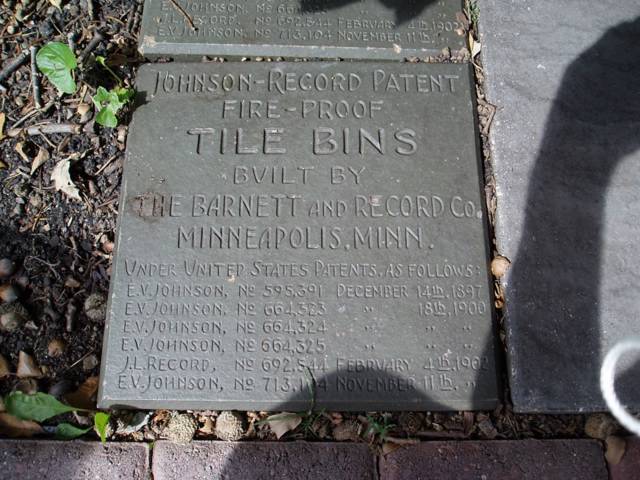
My grandfather's tile, from Barnett & Record Co., which he put as stepping-stones in backyard (River Road) around 1927. Still there, I discovered last week. (Mentioned in "dream-vision" poem "Grain Elevator", here. )Posted by Hello

OK, I got it right side up! Posted by Hello

Lake Vermilion, in the iron range, northwest of Duluth. Posted by Hello

9.10.2004

Proust. The idea that our only real experience of Time is in the form of personal time. But art's transpersonal effect - leading us out (errantly, erroneously) into the world, and back again into ourselves - draws maker (& reader) toward a hidden self, experiencing"beyond-time".

The only real experience of Time is personal. Corollary : all time, as humanly understood, is Now (the now, that is, of a 5-act play, lasting roughly 3 score years & 10).

But this is not quite right either. Because at the same time we recognize the pastness of the past. Caesar may yet be living his "now" - but for us, his dust stops a bunghole in Neder-nederland.

Hard to grasp how these two dimensions really intertwine.
Two faces, two aspects of literature - light & heavy. Pastime - and funeral rite for past time.

Literature, memory, nostalgia, time-travel, reincarnation. . . all efforts to ameliorate Time's irrevocable power, to soften the blow. "Humankind cannot bear very much reality" (or something like that). Who wrote that history is not simply the past, but the "pastness of the past" (more Eliot?)?

But what good is the present without memory & memories (personal & collective)? Question has a bearing on my "poetics", I guess. Memories (commitments) which we share - & in so doing "redeem the time".

After the Good Friday end-stop of Stubborn Grew, the "return" of Juliet-Eurydice, the Forth of July - an expansion/acceleration/attenuation in two directions: toward a remote (& secret) personal past, and a remote (& imaginary) collective future (Jubilee). By way of the Mississippi River ("upstream, down").
Latta-day Proust.

What a mighty vast meme was early 20th-cent. "memory"! The cork-lined French chap made a Mots-Valeurian personal epic out of it.

Out of Baudelaire, Bergson, Nietzsche - "eternal return". The Future is possibility; the Past is fixed; but the Present of writing, through reflection and reiteration, turns the Past once more toward possibility - a spectral revivimummifictation.

Memory functioning like a time-analogy for the spatialization - the multidimensionality - enacted by words on a page (blossoming into imaginative vision & empathy). Bergson's "fan of phenomena" (cf. Mandelstam) enacted (paradigmatically) as the reader opening a book.

Crane's Bridge thusly miniaturized Joyce's Ulysses technique. "America" as a cinematic sleight, an entire history dreamt in a single night in Manhattan.

Eliot's elegant epitome for the whole thing, at the opening of Four Quartets :

Time present and time past
Are both perhaps present in time future,
And time future contained in time past.


(But : see Keith Ward's book, Religion and Creation, for a discerning reconsideration of the whole traditional Platonic eternal "block time" changelessness perspective.)
This just in (Corriere della Sera): Mayhew Writes Poem About Something
Too bad about Wordsworth Bks in Cambridge, & Jim Behrle's job. Hope he lands something new & better even.

Does that make me the last reader in the Avengers series, after this guy? If so, how ironic - the effete neo-classical Samsonite brings down the roof. (But I'm sure there will be more Behrle productions.)

9.09.2004

Anny Ballardini, poet, editor & translator, has a new blog. Con bella fotografia - architettura italiana, etc.

8.31.2004

I guess this is a problem I have, talking too much about my own writing. I come across as self-centered, selfish, solipsistic, egotistical. Too true, maybe. The accusation has been made. Then again, maybe you could look at it as someone caught up in his work.

I don't write much about contemporaries. Some poets around my age are much better at that, much more attuned to the other poets around them. Again, perhaps egotism could account for it. On the other hand, the path I've taken - as I see it from inside, anyway - led through the poetries of the late 60s & early 70s, back through the Bible & Shakespeare & Renaissance poetries, then the Russians, then the Moderns & some postmoderns. . . & in a way I feel satiated with poetry & as if there's enough there already to inspire, annoy & motivate me. . .

WCW, Pound, Crane, Olson. . . all of them felt strongly the dilemma of balancing the contemporary with the past achievements. In large part in reaction to Eliot's powerful schema for same. & simply put, I was greatly influenced by the readability, flair, intensity, sound-richness, of Crane, in relation to these others. I liked the organic consistency of The Bridge in comparison with some of the flat & slack stretches of some of the others, the way it climbs & climbs.
Mr. Silliman, in his post on R.Duncan today, touches on the design of modern long poems, and the vexed question of how parts relate to wholes in these big, often seemingly unbounded "life-works".

Somebody intrepid other than me will have to figure out someday how or how well the 3 books + coda of Forth of July compare/relate to this particular issue. But since that doesn't seem to be happening anytime soon, I will just throw in here that the capability of beginning the poem came from an examination of Mandelstam's sequences of linked short poems & their variants. So the 1st chapter of Stubborn Grew grew out of a sense of the possibility of doing something similar. Then the 2nd chapter ("Ancient Light") took that a step further, creating an autobiographical mini-narrative out of more-closely linked individual pieces. Then the 3rd & 4th chapters ("Once in Paradise" + "Two Cats at the Atheneum") took it another step further, mixing autobiography with both local history and a sort of "magic realism" (the Bluejay walk-on). Thus concluded the 1st Part of Stubborn. The 2nd Part of same also contains 4 chapters, which constitute a kind of retroversion to autobiography mixed with parody (the 1st 2 chapters parody the Cantos; the 4th and last chapter parodies Finnegans Wake). This 4th, Finnegan chapter, basically runs the entirety of the previous sections (Stubborn 1-7) through a Wakean-Viconian ricorso, ie. re-enacts & repeats them through a Joyce-Irish slang machine.

Moving on to Book Two of Forth of July : The Grassblade Light. But I've gone over this ground before on this blog, so I will simply say that this central book of the poem is a highly-configured array of 7 separate-yet-consecutive poems.

Book Three (July) and the Coda (Blackstone's Day-Book), again, have their own distinct design (though the whole poem is structured on a variety of rhymed quatrains). Whether it all works & "makes sense" is for someone else to decide. But I think that the particular way I handle autobiography & narrative & part-to-whole structure tends to aim for a middle ground between the expansive "life-work" (say of Leaves of Grass) and the more autonomous, objectified shape of Crane's Bridge. Zukofsky managed this too, with "A".

But folks, ya know, I'm tellin ya, people like me represent an alternative history of "New American poetry", which has traveled far beneath the radar of the anthologies & the literary historicists & canonizers. They have no idea what I been doin' over there in Forth of July-land & the Island Road sonnets etc.

*

Poetry : a stone fallen from heaven.
No one judges it.

- Mandelstam

(I play a lot with this "stone" metaphor in Forth of July, what with "William Blackstone" & his timewarp-boomerang "black stone" at the Dome of the Rock, & the otfe (meteorite) stones of the ark of the covenant, & the glittering "jewel-eye", the "almond" (mandel) of Jubilee at the center of Time. . .)

8.30.2004

There is no connection between Stone & the Rolling Stones, as far as I know. Stone was published in 1979, some years after I spoke with Keith Richards (at his rehearsal studio in Richmond, outside London) about the Mick Taylor replacement job. To my knowledge I have never been a member of that band. If you see me on any of their albums, consider it some kind of pirated edition.

Come to think of it, considering the fact that I have walked talked & diddled in near proximity to this library ("the Rock") for nigh on 30 years, with only a few interruptions, you might say that the essentialist core of my identity consists in being a non-rolling stone.

I'm on a roll today.
I was in Hahvahd Squirrel Saturday night, after the reading. There was a 4-pc street band playing 60s music. I had me E harp with me, which is not as useful as you might think, but they started playing "Sympathy for the Devil" so I went up to the mike & joined right in. Of course they were a bit miffed to have the devil actually join them (but what's confusing you, is the nature of my game. . .). We had something of a mini-Altamont moment, though no limbs or instruments were broken. How could they know I was just coming down from a poetry reading. . .
David Hess has set up a handy Bramhall e-connector, so you can read for yourself.
Happy to notice Allen's early interest in Robert Benchley. Yes, he could have a big influence on poetry. Robert Benchley was my absolute favorite writer & hero when I was about 12. I wanted to write like him & I tried. (Started an independent school paper just so I could do Benchley-like routines on the weekly happenings around the old prison yard.)
Allen Bramhall seems a little like a solitary miner who's struck a vein, or an old New England water dowser with his birch-twig divining rod, out in the woods. His sentences don't describe anything directly, but you see things; there's nothing programmatic about his "abstraction", instead his poems convey a lot of feeling, without asking the reader to acknowledge anything in particular. He can be ironic, even sardonic, without being sarcastic or edgy in the usual (boring) ways. Much of his humor turns gradually outward and then back at himself. His work is fun to read, but it was good to hear him read: maybe he should get together with Jim Behrle for some audio sessions, & put out some sound blogs.

8.29.2004

I have to get Sarah at the train station in a few minutes, a bit rushed here. But feeling warm & happy about Cambridge reading yesterday, courtesy of the mysterious Jim Behrle. Happy to meet Allen Bramhall & Beth, and hear him read his [afraid to use conventional adjective] poetry, which I enjoyed a great deal.

A fine thing today to see Allen had been reading my poems in Stone (written 30 yrs ago) & liking something he read.

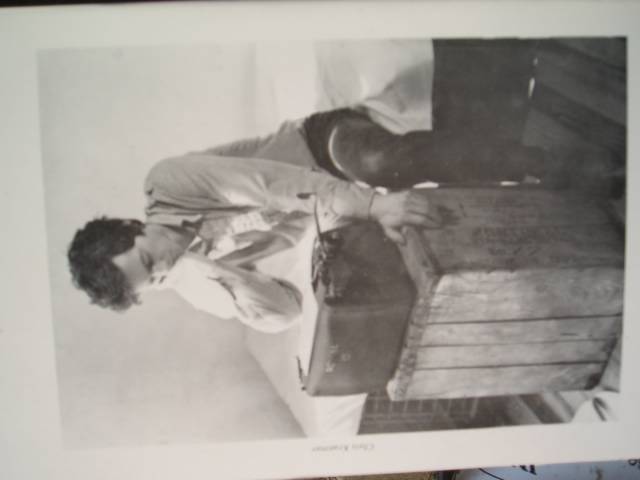
About the photo : it was taken on Houston St, in my high school friend Chris Kraemer's loft looking over at the World Trade Center, in 1975. Chris was a promising photographer in NY, who made a living as a builder (he is an archetypal Finn from MN, whose dad ran a hardware store there). He knew some bigshot artists at the time, Vito Acconci, Susan Acolella(? - don't know who I'm talking about). Also a whacky Russian sculptor named Ernst Niesvestny. When Stone was published, Chris arranged a little party at his studio someplace in Williamsburg. I remember sitting on a huge wooden crucifix sculpture he had laid out on the floor, being toasted with vodka. The title Stone, of course, was an imitation of Mandelstam's first book, Kamen ("Stone") - an acronym of akme ("acmeism"). So this party felt appropriate. Chris married a New Zealand clothing designer so she could get a green card, & they ended up staying together & having kids. He lives out in the Bay Area now. That's his typewriter & cot (I use a Sears Constellation myself). I was living with them for a few months in NY, helping Chris on interior painting jobs etc, before going over to London to try to take Mick Taylor's place in the Rolling Stones.


(p.s. Monday morning : through Denny Moers, a former student of Robert Creeley & studio assistant to Aaron Siskind, I was able to get an actual Siskind photo for the cover of Stone - some sections of Inca wall in Cuzco. The Inca/stone/Mandelstam/Vallejo configuration shows up 25 yrs later in the penultimate sections of Forth of July. Yesterday was the traditional anniversary, by the way, not only of the death of John the Baptist, but of the execution of Atahualpa, the last Inca ruler.)

Here's a lopside photo of the photo Allen wrote about. More later (wish I could figure out how to flip this). Posted by Hello

8.27.2004

torque x risk - quietude + hebetude/hesychasm divided by sq.rt. divagation = nift (don't ask me what this means. I am going on the hypothesis that there is no connection with "nifty")
Here's Jonathan on the aforementioned latin bit. (& he becomes reader # 8 of Stubborn Grew, the book that changed history (at least until the Johnson-Silliman Pact of 2004, outlined by that Walden guy) - thanks - & congratulations!).

I would never think of Robert Creeley in relation to that notion. Ars et celare artem makes me think, not so much of plainness & simplicity, as of a kind of crafty guile, combined with all sorts of indirections, including perhaps a surface moderation or transparency. But Jonathan's concept may be more accurate.

This gets me to Jordan's aside on "depth". I'll have to think a little more deeply about this. Somewhere in the book Hamlet's Mill, mentioned here a while back, there is something about archaic astronomy-astrology as the search for. . . man, now I can't think of the word! It's not consistency. . . it's not continuity. . . but it's like that. . . it's like a philosophical term for steady duration, a pattern which remains the same. . .

Anyway, what I'm trying to say is that it seems to me that hermeneutics or interpretation of art works often involves searching for the deep motive, the wellspring which connects all the dots, the answer to why an artist or writer chose this particular obscure symbol or image or emphasis.

The presence of such a motivating plot or plan is one signature of depth. You could also talk about an artwork's "emotional depth", but such is usually brought, paradoxically, to the surface (the crisis, the denouement). Depth of purpose, on the other hand, often remains hidden & disguised - and the reason for this is because there is the deepest emotional commitment to the deep-ocean argument which actually triggered the work in the first place.

8.26.2004

Spiritual Charity is the real motor of social change. Lovingkindness - unselfish, not proud, not greedy, based on pure natural supernatural affection & devotion - the spiritual force adumbrated most eloquently in Paul's epistle - this is the force behind the betterment of life everywhere on earth, in all its facets and modes.

Because spiritual Charity lends meaning to this familiar Gospel comment : "The greatest among you shall be your servant." That explains everything about both mercy and social justice.

Lookin fo de Day ob Jubilee.
Good op-ed piece by Robert Pinsky in today's NY Times, about Czeslaw Milosz.
follow-up thought to previous...

Each literary work does reflect a particular emotional tenor - or an amalgam of several. And there are plenty of works in which the writer's very labor at craft crowds out the subject or impression he or she is attempting to convey, so that the emotional tenor and/or the tone of the writing itself come across as shallow. The author shows his/her hand.

This is one of the implications of a certain rubric I'm fond of repeating : ars est celare artem (art conceals its art).
"Risk"... ya waal, as t'that I agrees wid de doorman.

Mister Ron's analysis appear to be the beginning of another of them dichotometoys, whereas there's high-style "good" (read bad) writing, vussus adorable lovabobble "bad" (read good) writing, ie. "risky".

We's have here a level of critical artifice which subsedes even the artifice of bad good writing! Follow me?

All "risk" in literature is calculated, hence not real risk. Unreal risk - very risky!

I personally will accept any degree of good writing. Bring it on baby, sez.
the revolution will be televised on Saturday. take careful note of yellow-black scarf. (this woman was arrested for infiltrating Newish American Poetry last week without the required literary stretch limo.) Note the SOA phono-volumetric earrings.

8.25.2004

Perhaps, henceforth, considering the new cultural climate sweeping the nation (behold the swarming anthologies!), we should refer to "poetasters" as potato-tasters????
I can already feel the cultural waves rippling through society from the Johnson-Silliman rapprochement, announced here.

For instance, take a look at the new Potato Poetics. The potato is a risk-taker : observe how furiously they plunge into the earth in raw chunks as into a scrap-heap, then evolve into vast, blowsy (frankly, somewhat ugly) green stalks & leaves, all the while fobbulating those knobbly grey tubers underground. There is nothing like a risk-taking Poetato.
The word in poetry, as an end-in-itself (we read it for its own sake), is in that sense like a person, or like the cosmos considered as a creation or work of art.

It has been popular for quite a while to emphasize the transitive nature of art, how its value lies in the fact that it leads to something else, that it represents possibility rather than telos (end, purpose).

But a major quality of aesthetic experience is stillness, intransitive repose. The thing at rest in equilibrium - or better, active in equilibrium.

The poetic word inhabits a borderland, a dawn/dusk liminal area, between the visible & the invisible, known/unknown, things/values, being/intellect, time/eternity. Out of this well emerges mysterious water.

8.24.2004

Poetry epitomizes and sums up what language does (or what we do with language) in practical life.
Why poetry? I mean, why do we do this?

We take aesthetic pleasure in words, what language does?

That, and something else. With language we acknowledge, define, order, shape what we experience. This is a techne intimately fused with that which it represents. With poetic speech we "surround ourselves with domestic utensils, the warmth of the hearth" (Mandelstam's description of the poetics of Acmeism - "domestic hellenism". He was doing this in deliberate contrast to the more otherworldly & abstract qualities of Russian Symbolism).

The equilibrium of artifice - craft, techne - and nature is at the root of civilization.

So perhaps we can recognize a certain solemn (&/or playful) objectivity, disinterestedness, at work in poetry - a reflection or emanation of the poet's serious effort to follow & express truth - the poet's equivalent of the philosopher's or scientist's activity.

The image of "the city" in art (as I said, I'm reading about medieval Siena), representing an ideal of equilibrium between know-how & nature, individual & community. (And hidden within every image of the city is that of a garden.)

The word bears the techne of a global equilibrium (Mandelstam also foresaw this). When he talked about the poem as "like unto an Egyptian bark of the dead, carrying everything necessary for life" - he was talking about the word-itself as a sort of Noah's ark.

The curious focus in the American long poem on the local, the city. The unavoidable and only shared "here & now" where any real equilibrium (political, cultural, natural) becomes possible.
Jim Chapin wants me to play harmonica & countrified piano for a new CD this fall. This will be fun. The 3 of us (Jim, Colette & I) have been playing farmer's markets this summer. The jug band fits in well. People come up & ask for obscure old 20s tunes, which of course Jim knows. He has a homemade songbook the size of a phone book. He is the thing itself - sort of a Hank Williams/Brownie McGhee. Colette is also the real thing. She plays her grandfather's violin, which he made himself in his chicken coop-workshop up in Quebec, back in the 20s or so.

I'm not exactly the real thing but I'm a good improvisor. It helps (occasionally) if the harp player is a little bit of a ham.
Reading these days:

books about the Comune of Siena (1200s-1400s). & the artwork produced there.

my wonderful library.

(pondering where to go with a new poem-project.)

very worn out lately. trying to think about Wordsworth Bookstore reading. I will probably not be reading a lot of Wordsworth.

8.23.2004

strange juxtaposition : defense of Olympic medals, defense of Kerry medals (Bronze & Silver STARS for valor a few decades yonder)
I will be reading so-called poetry with Allen Bramhall at Wordsworth Bookstore, in Cambridge (Harvard Sq.) this Saturday, Aug. 28th, 5 pm. Courtesy of Jim Behrle. Admission is free. Omission? That will be $5. So see you there!

8.21.2004

Most of the time I have about 3-4 writing projects in mind, for which I'm jotting down notes.

When I actually start writing poetry, it usually feels like a release from the burden of all those plans, & has nothing to do with them.

Something similar with music : I often do better when I haven't played or practiced for a while.

Is this because I'm left-handed? A gemini? Lazy? All of the above?

8.20.2004

Saw my friend Tom after work. He is just back from another trip to St. Petersburg, where he saw Elena Shvarts, who is living on an air mattress in her burnt-out apartment. She lost a lot of personal things & art work, but most of her manuscripts are safe. She is a bird-like (I mean really bird-like - under 5 ft, under 100 lbs) woman in her mid-50s. Her mother died a few months before the apt. fire.

Tom told some good Petersburg stories. Just before he left for there, he was in line at a car repair shop, and ahead of him in line was the other Tom Epstein in Providence, whom he had never met, who was also having a similar problem with his car. This is a Petersburgian happening.

Tom lent me a copy of Elena's prose book, Vidimaia Storona Zhizni (I will translate later). According to Tom, there's a story about me in it, disguised as a character named "Silver" (since she thinks of me as H. Gold). Looking forward to trying to read this...

[p.s. who knows, possibly she was referring to. . . - or maybe. . .]

8.19.2004

A lot of claims are made for poetry. Poetry is made the vehicle for every memory, passion, ideal and value under the sun.

I've been one of the worst dabblers in that pursuit, I know. (I wrote, for example, about how poetry's special form of representation allies it with religious vision.) But today I'm focused on a notion of poetry's uniqueness, its separateness.

Poetry does something unique to words, shepherds them into its own aesthetic field. Poetry is essentially an art form, the art of language per se (as opposed to the "language" of visual art, or music, or film, etc.).

Aesthetic response - that is, response at least to some degree self-conscious - begins here, in the recognition of poetry's proper, independent sphere. All poetry, in a sense, creates its own world ex nihilo. When we approach it thus on its own terms, we can respond to what it does with the materials of the ordinary world which it absorbs and remakes - harmonizes into its special poetry-materials. And with this recognition, maybe we can moderate some of the magic thinking which sometimes asks too much of poetry (politically, spiritually, intellectually, etc.).

I guess all this is pretty elementary & obvious. As per.

But I like the idea of looking again & again at the most general, universal concepts about it. Because this is a way to make what is most ancient, foreign, and different, appear close and familiar. I guess this is an acmeist, a Mandelstamian idea (or proto-Mandelstamian), a Bergsonian notion - discovering anachronistic, cross-cultural affinities.

The sense of working in a timeless, universal medium, with long views & deep traditions - doesn't this affect how we speak verse, how we make lines? Where we try to stand in this playground?

8.18.2004

the earlier poem In RI is more "objective", documentary, evidentiary in that sense. Not yet available to the public, though the mysterious Anny Ballardini has translated in toto into italian (as I've mentioned here before). Someday the bilingual edition will be pubblicato.

that poem celebrates Roger Williams & New-Englandy independence - contrasting Rhode Island city-state and Boston theocracy - but the story is overshadowed & undershadowed by the stark suffering & injustices of pioneer days (Narragansetts, Quakers, women, especially).
I guess township democracy was of a piece with pre-industrial do-it-yourself pioneer life. You grew your own crops, made your own homes, tools, clothing, etc. (with the help of family, hired hands, indentured servants & sometimes slaves). & you do your own municipal democracy.

things have gotten a bit more centralized, professionalized, & technical since then, yah? but people still get involved.

Stubborn Grew touched on some of these things in RI experience. The Dorr War (over extending the franchise to non-property owners), populism, slavery, Newport gilded age, Nelson Aldrich & the corruption of state politics, etc.

But the poem doesn't really examine them. There's no dispassionate observer, no lingering over historical events. The narrator of SG is deeply corroded, you might say. There's more to be said about this, but enough blah blah for now. SG's divided narrator (Henry-Bluejay) is bound up in an interior psychodrama for which local history is mostly furniture.

This is not necessarily a bad thing, though it goes against the grain of certain modernist ideals.

8.17.2004

Charles Olson started working on poetry after he dropped out of his job as apparatchik for Democratic Party, right? Or something like that. With a sense of disillusionment.

Someone could do a history poem (in Olson & WCW vein) based on investigations & juxtapositions of "democracy" as global phenomenon, as a project of states & multinational groupings - "democracy in Middle East/Asia/Africa/South America" etc. - juxtaposed, that is, with historical roots in New England local politics (sovereignty of the people out of village town meetings). What it all means to have a superpower on a democracy mission compared to the felt reality of actual civic life (what that used to mean, what it amounts to now).

(Been reading de Tocqueville lately.)

I might even try doing this myself, if you don't get there first.
Jonathan's comments on translation & Milosz are interesting. But to say you have a unique aversion to translation's effects seems a little like special pleading. Obviously the reader has to make allowances. But a diet consisting solely of poetry in the original would exclude a lot of readers, for one thing, and impoverish poetry in general on the other. Poetry thrives on translation and mongrelization.

Jonathan's aversion (should this be a name for a symptom?) is connected also with what seems to me to be a rather narrow focus on surface elements of style. Some of the awkwardnesses of Milosz might even be seen as virtues, if the telos or overall motive of his poems is viewed from a different angle (say, in Poundian jargon, through the lens of logopeia rather than solely through melopeia).

He's probably right, though, that much of the clumsiness is due to the translating.

8.16.2004

the region of writing per se.
Good read here - Gander/Johnson voyage to Bolivia & haunts of Jaime Saenz.

Now there is a poet who created a distinct, autonomous region for making poems, outside the sphere of "reception". I'm not saying you have to be a whacko drug-addicted mystical impoverished quondam-fascist Bolivian in order to find such a region. But you have to find it.
Milosz does come across as a little slow & stolid, compared with the eccentric brilliance of Aleksandr Wat, for example. But his other fine qualities outweigh all that. His luminous simplicity, patience, metaphysical hope.

There's a fascinating book of conversations between Milosz & Wat, basically an oral history of Wat's incredible life, in the context of 20th-cent. Polish literary & political history (titled My Century).
Good poets often find good translators.

Good poetry sometimes breaks through - to some degree at least - translation's inherent barriers.

If all you can see in Milosz is flatness & dullness. . . oh well.

The new benchmark for US poetry (judging from Boston Poetry Massacre reports) appears to be "stand-up surrealism".

Y'all pass my effeteness test.

8.15.2004

Received "Dear John" letters from 2 poetry book contests last week - one on Thurs. the 12th, one on Sat. the 14th. Friday the 13th came in between, as we know. "Hallelujah! I'm a bum."

Ides of August.


When I am old may my sadness gleam.
I was born in Rome; it has come back to me;
My she-wolf was kind in autumn;
August - month of Caesars - smiled on me.

- O. Mandelstam

("may my sadness gleam" : goes back to a line from Pushkin, "my sadness is luminous" : which goes way back, through Orthodox tradition, to Byzantium, and the icon tradition of "luminous sadness" (there was a Greek technical term for this, a rendering of pathos).
A great poet died on Saturday. You could say that "the real, not the calendar 20th century" ended yesterday too.

There was a good obituary for Czeslaw Milosz in the NY Times front section this morning, which included several of his poems.

(Seem to hear a little of Whitman & Eliot technique in his lines. Especially Whitman. That sort of patient, stately-humble reticulation of ordinary things, landscapes & people, rivers & trees. Simple, sonorous, direct.)

American poetry could learn quite a lot from the literary values he projects. It's not easy to write this way - simple, direct, yet not-so-simple, not-so-direct. His style stands as a kind of rebuke to shallow formalists & experimentalists alike.

I know what was left for smaller men like me:
A feast of brief hopes, a rally of the proud,
A tournament of hunchbacks, literature.

And this:

I imagine the earth when I am no more:
Nothing happens, no loss, it's still a strange pageant,
Women's dresses, dewy lilacs, a song in the valley.
Yet the books will be there on the shelves, well born,
Derived from the people, but also from radiance, heights.

This early poem, too:

Encounter

We were riding through frozen fields in a wagon at dawn.
A red wing rose in the darkness.
And suddenly a hare ran across the road.
One of us pointed to it with his hand.
That was long ago. Today neither of them is alive,
Not the hare, nor the man who made the gesture.
O my love, where are they, where are they going
The flash of a hand, streak of movement, rustle of pebbles.
I ask not out of sorrow, but in wonder.

Vilnius, 1936

A memorial in Gdansk to shipyard workers shot by police in the early 70s carries these lines of his:

You who harmed a simple man, do not feel secure: for a poet remembers.

8.13.2004

Josh, Jordan & Jonathan on literary value & "scarcity".

Maybe in order to write something of genuine value, poets somehow have to make themselves scarce (from the literary-professional marketplace).

I don't mean that they have to opt out of contests & readings & magazine submissions. But they have to find some mental or physical space apart from the whole realm of "reception".

This will sound artificial, hypocritical, unnecessarily restrictive, if not impossible.

But if we think of the hypothetical attentive reader of poetry, we might imagine someone who also creates a kind of private order or realm of receptivity and awareness - through a patient attention to literary values and meanings.

I'm suggesting a kind of disinterested aesthetic objectivity. If one is willing to admit such a creative/receptive, writerly/readerly realm exists - even if its borders are ambiguous, perhaps invisible - then the simple fact of its existence renders issues of "quantity" (the massive number of competing voices, the supposed Darwinian/commercial unfairness of publication and prestige, the theoretical divide between "establishment" poetry and true-believer in-the-know avant-garde, etc. etc.) somehow beside the point, a major distraction from the ongoing unpredictable life of poetry.

8.12.2004

I left out the most basic "structural analogy" between poetic language and theism : the fact that a poem or work of art is a "creation from nothing" : somewhat autonomous and complete-in-itself.

Thinking unsystematically (that's for sure) past few days about these issues. Keith Ward leaves out feminist perspective. The maleness of the Trinity (at least in most of its representations, which admittedly are only representations, but same are powerful).

Theology of Dante, pivoting cosmos on his memory of girlfriend Beatrice. Joyce in Ulysses & FW.

The poet, the artist, seeks happiness(?) in state of equilibrium which only creative process itself provides. And this process hinges on emotional resonances, love & desire, which are at least as much feminine as masculine.

Jesus (imagined) from psychological perspective. Man without an "earthly" father. Orphan.

(Presence, role of "J" or "Juliet" in Forth of July.)

"Enarees" were the effeminate soothsayers of the Scythians (cf. Herodotus).

Effeminate image of "poets" in American culture.

(Giving birth to a poem. The 3rd vol. of Forth of July is titled July.)

8.10.2004

I guess Jack Kimball was criticizing me (in his post of Fri. 8/6). I could be wrong. It's hard to tell sometimes where he's directing his barbs.

My ruminations are often belabored, for sure. But I don't think it's impossible to understand what I'm saying. The point about poetic mimesis:

If you believe, or at least accept the possibility, that nature, the universe, reflects some kind of spiritual order, some creative beauty, signs of consciousness - the means or meaning or purpose of which may be far beyond our comprehension - yet nevertheless it seems there - then, among the many possible means of its representation (its mimesis) - scientific discourse, prose argument, etc. - poetry might exhibit some special capabilities. Why? Because its means are "number", vivid (vitalist) imagery, and metaphor. What you might call a structural analogy could be in effect, which relates the beauty-in-itself of poetic language to the beauty-in-itself of creation. ("Number, weight, and measure" - cf. Augustine's classic defense of sacred music - his definition of which included poetry).

The vitalism of poetry is one of its throwback qualities - G. Vico has a lot to say about this. A world ruled by spiritual forces is certainly archaic and unscientific, and a religious perspective for today would have to take this into account (cf. Keith Ward's books, Religion and Revelation and Religion and Creation). One of the big contemporary problems is the way sacred scriptures which are essentially poetic in nature are fronted with doctrinaire, literalist polemics - the new superstition.

8.05.2004

Now I wish I hadn't said anything about religion & poetry.

In a certain sense, it seems irrelevant. Poetry absorbs everything & turns it into itself. Response & criticism have to be aesthetic, not burdened with excess mental baggage. [p.s. if you read Alan Bramhall's blog, you eventually notice brief 1-line responses to poets he's heard or read, which are pretty direct & disinterested, not related to any obvious program or philosophy or allegiance. This is refreshing. Yes, full disclosure, I am giving a reading with AB later this month. But I've never met him, I only just happened upon his blog, because Jim Behrle, in the infinite burly depth of his behrlehood, stepped out of mutual poet-catpiss-contests & surprisingly invited me to read in Beantown.]

This whole issue has been an irresolvable knot for me, for a long long time.

Because one aspect of the experience of making poetry has been a certain impulse toward "purity", which seems quasi-religious in itself. The effort of composition has always felt like a refining-away of dead or unoriginal or inauthentic speech (often unsuccessful). Always threatened by distraction or the temptation to cut corners. But even more prevalent is the time spent not writing, because the concept or inspiration or feeling of access was not there.

Another aspect, for me, is indeed the religious impulse or motivation. One of the recurrent conceptual frames, to which I return again & again in my thinking, is the idea that the mode of poetry is a specific kind of mimesis or picture-making, which models the livingness or the living-order of reality, that is, of a possibly spiritually-sentient or spiritually-meaningful cosmos : Aristotle's "universals" (cf. Poetics). This capability differentiates poetry from other kinds of discourse. & so, thanks to this capability, poetry-making becomes a special mode of witness & interpretation, a special kind of meaning-making.

I realize however that even these momentous capabilities are only one aspect of poetry. Turn the figure around, and you recognize its character as a free, autonomous artistic creation : a product of a play-field, with no necessary mimetic or utilitarian function. (I refer once again to Mandelstam's brilliant resolution of this impasse : where, in one of his essays, he asserts that the freedom of Western art is an outgrowth of the historical event of the Redemption : Christ's world-saving sacrifice allows art to become utterly free of external obligation or constraint; the world is already saved, if you're willing to recognize it : art doesn't need to save it!)

But if you are interested in encountering my particular poetry, then you will want to understand that the general function of mimesis, outlined above, is, in my case, elaborated within a particular orientation : my own set of beliefs, commitments, hunches, experiences & assumptions.

The application of an Orphic framework to Stubborn Grew - by going back to the ur-poet & his descent to the world of the dead - was an attempt at origination or poetic priority : in order to frame the set "poetry" within the field "Henry's worldview". On another level, the Orpheus story just seemed like the most natural narrative embodiment for human (& personal) feelings of love, forlornness, & healing/rebirth. On a third level, it offers possibilities for syncretism (I was interested in the Native American background & presence behind any New World long poem endeavor). "Bluejay", the real bird in my backyard who became a hermetic ghost-guide, is the protagonist of Orpheus-tales from Northwest Coast tribes (as I know I've mentioned oftentimes before.)

8.04.2004

Reading Keith Ward's book (Religion & Revelation) mentioned here recently. A lot of food for thought.

A Christian perspective, but develops a concept of revelation which is inclusive without relativism, acknowledges parallels & affinities with other faiths. Fascinating commentary on Hinduism, Buddhism, Islam, Judaism.

Faith can't be simply equated with a body of opinions, information or knowledge, which a person can accumulate and then assent to, and assert to others. If God exists, revelation is a divine self-revelation, meant not to convey information but to enter into a relationship, to change your life.

Thinking (in this space) about my "poetry life" through this book's lens. My relations with "poetry community", so ambiguous, ambivalent, sometimes conflicted & frustrating.

A large part of it is simply my ornery personality. Another aspect, though, has to do with the fact that religion has played such a big role in my life. For some, this is less problematic, since they understand how to keep a seemly distance between creative literary efforts on the one hand, and their faith-commitments on the other.

For me it's been more complicated. My "faith life" has been stormy & dramatic (at least for me). Charismatic events when I was in my early 20s had an irreversible effect on my view of things - and those (personal) experiences were tangled up with poetry and writing. A poet is a communicator, a purveyor of speech & verbalized concepts : with me, literary ambitions and religious commitments have been mixed together, mixed-up & confused sometimes (much times!).

Aside from my personal quirks, though, I think that another factor in the aforementioned ambivalence arose from an inherent dialectic - a contrast - between religious vision and poetics or literature per se. This dialectic was brought to the fore, in my case, by the simple effort to balance or combine the two. Magnified also by something in the genres themselves : the prestige or authority of the epic mode, as "poem containing history". Because Christianity, more so than some other faiths, is rooted in particular historical events (though their "historicity" is highly contended). One doesn't need to be obsessed with "the historical Jesus" to grasp that this particular faith - in which the Divine enters directly into history in order to save humankind and creation itself - and which calls believers into a new spiritual Now - might result in epic shapings quite different from those offered by Pound, Crane, Zukofsky, et al.

My own long poems are probably too wayward to be acceptable as "Christian" works. But the background motivation is there : to re-write the American epic on a very different ground. One way to look at Forth of July is as a "transumption" (sort of a surpassing-through-osmosis, or stealing) of Modernist epic. I "underwrote" Crane, Pound & Joyce in Stubborn Grew: I contextualized them in the plot of a Mardi Gras/Lenten shriving/redemption : and then in the sequels I practiced a kind of ghost dance/resurrection spiritual ecstatics, flying off into deep American vision-space.

To take on the epic this way was a fairly radical gesture, I'd say, within the "progressive" poetry community. Radical in a religious sense, also: for the Christian, "the Word" is not a material-in-itself, an aesthetic commodity, but something else entirely.

I realize that to blend discourses this way, to speak so baldly of faith, is a recipe for alienating others through misunderstanding and settled notions (especially in today's divisive, overheated discourse world). But this is my form of "personism", like it or not.

8.02.2004

Here be Ron Silliman's extended encomiae (have I got that right, Gabe?) to Charles Bernstein's new book The Sophist.

Wagrant thoughts: a sophist is a professional rhetor, one who makes the daily bread by means of a persuasive appeal to Wisdom presented appealingly. Criticized, I believe, by Plato, whose notion of the transcendent Truth precluded a simple 2-step verbalization (ie. 1. Truth is; 2. I'm telling it to you). Maybe Aristotle too, who wanted a more disinterested Logic.

Bernstein works out an interesting confluence of Langpo & NY School attitudes; he imitates Ashbery, who perfected the wry self-negating/self-persuasive zennish non sequitur ("Beautifully the words reveal there is nothing to say." - HG imitating JA).

So to title a book The Sophist is classic self-deprecatory/self-affirming - disarming the critic beforehand.

Ashbery (& Bernstein) take the self-reflexive, narcissistic quality of poetry - inescapable, since poetry is the word, unlike any other language use except maybe the joke, which embodies a celebration of itself, among other things - and turn it into a comic system.

The limits of this kind of poetry are the limits of the comic: it appeals to the mind through a stringent disciplining (or mockery) of the feelings. There is something gnostic about comedy: those who are in the know get the better of the dolts who don't get it.

I suppose the opposite of the comic is pathos. Tragedy is based on pathos, the empathy with suffering. A lot of art, not just the tragic, appeals to pathos (think of Portuguese fado, for one thing. or Chet Baker). Emotion, feeling, music, duende. Language poetry built itself on a politically-motivated (moral?) mockery of the bathos of sentimental, self-centered 70s free verse.

Fisherville Posted by Hello

more Fisherville Posted by Hello

Pine trees at Fisherville Refuge, Exeter, RI Posted by Hello
This book, which I can't put down these days, gets my highest marks. For anyone interested in the nature & interrelationships of the various great religions (Judaism, Islam, Hinduism, Buddhism, Christianity). Wonderful insights.

Religion and revelation : a theology of revelation in the world's religions, by Keith Ward (Oxford: Clarendon, 1994)

7.30.2004

Bemsha quotes an interesting email from a high school teacher in Spain.

I bought an old 2nd-hand copy of the Cantos once.  Inside the cover, when I got home, I found what seems to be a little original photo of Ez in old age, sitting with his white cane, looking druid-like.  It's up on the bulletin board by my desk; he's keeping a hawkish eye on my long poems.
I don't found literary movements, I don't rail against the publishing biz, I don't mock magazine editors, I don't work in the creative writing industry, I don't bond with fellow careerists, I don't even bond with poets I admire. 

I don't look for admiration or prestige as a poet.  (To hell with all that : go find another guru!)  The process of making poems is too mysterious and contingent for me to even think of myself as a "poet", as if a poet were some sort of steady-state identity. 

What I hope is that an occasional reader love my poems as I do.  I love them in part for being (or seeming) somewhat autonomous, standing somewhat independent of me : little creations.  I love them for being musical in feeling and thought.
I may give the appearance of being a cranky self-promoter.  But I think that's partly because I don't really believe in literary networking, or using political ideology as a template for literary politics.  I don't believe in networking because, in my experience, making poetry involves a kind of "self-test".  (Maybe it's because I'm a gemini?)  You wait for a state of mind called inspiration (for lack of a better term), and then you make poems in the presence of your own conception of tradition - the benchmarks, the affiliations, the paths & poets you recognize.  Networking is really inimical to this process, because your own "subjective objectivity" is influenced by those who haven't really grasped what you're doing - and their attitudes, whether well-meaning or malicious, are really distractions or diversions from your path.  I can keep hoping, in the face of professional failure for decades, because I realize that all editors are human, and despite the best intentions, lots of things don't get a proper hearing.  I can have complete respect for contests and magazines and those who do well by them, without despairing, because I realize that the struggle for publication and recognition is not based on objective principles of quality in any sense, and I trust my own taste and judgement (I know better than anyone how weak and imperfect and limited my own poetry is). 
This is one of my best books.  It distills my efforts with short poems, before the longer ones of the last few years.  I published it myself, because I haven't been able to find a publisher (besides Spuyten Duyvil, for Stubborn Grew) since 1979.

7.29.2004

You can find most of my tiny unknown publications here.
Walking through bookstore on errand for library, pass the poetry shelf, see Beowulf.  Recall that poetry is sort of distillation/projection of one's experience of beauty.  Recurrent memory:  high school, leaning barefoot on back porch reading anthology of French poets.   Luxe, calme et volupte.

Distillation, charter, code. 

7.28.2004

Responding to Jonathan's riposte of today:

There's no getting away from criticism.  They criticize "the mainstream"; I criticize them for it.  It may be that Steve Evans' lists are positive - I agree they certainly show a helpful initiative & healthy interest on his part.  But my beef was directed at quote from Evans' comments over at the Hotel (yesterday).  There Evans was quoted lining up the usual ideological game-formations  (the mainstream is fortified by big bucks, etc.).

I also agree that Ron Silliman puts great effort into his response to little-known & marginalized poetries.  That's nice & impressive, I can only respect that.  But he often frames his diatribes and polemics around a "we are better than them" scaffolding.  See for ex. his post yesterday mocking "self-similarity" in mainstream poetry publishing, vs. the wonderfulness of the usual names (Zukofsky, Olson, etc.).

Today I processed 25 books from SPD that crossed my desk, for the great poetry collection over here.  All brand new, from publishers large & small across US & Canada.  They will go on the shelves.  In the long run there is little difference between a famous poet & an unknown poet : they all end up on the shelves.  & the challenge for every poet, as I was strongly reminded once again when I glanced through these 25 volumes, is to create something sustained, original, interesting, memorable. 

In such a context (I mean my context, in a library, in a library, in a library... which collects thousands & thousands of books of poetry), it seems so clear to me that the us v. them po-biz maneuvering is really a form of intellectual simplification for po-pol-biz purposes, rather than genuine criticism.

I'm not cranky, Jonathan; just slightly depressed.   I do indeed respect those who put more interest & energy into noting/reviewing/etc. individual books & poets than I do myself.  Yet I'm entitled to my beeferoni.  A line in the Jessica Stern book struck me:  "Sociologists argue that the first requirement for mobilizing a group that feels oppressed is the identification of a common enemy. 'Without the identification of an adversary, or another social actor in conflict with the group for control of certain resources or values, discontent and protest will not engender a movement,' sociologist Alberto Melucci argues."

How much are unhappy frustrated under-published under-rewarded poets being manipulated and rewarded by "literary organizers"?  How do these organizers profit from creating these us/them worldviews & literary "movements"?  They become "leaders", for one thing. . .

But this literary organizing, I argue, is deleterious to genuine criticism & reception.

 
Stern speaks about the dark & light sides of religious behavior.  How religion can get caught up in identity politics, since it tends, sometimes, to set up an ultimate us/them, insider/outsider dynamic (believer/unbeliever). 

This is one of the most important themes in Moby-Dick, Melville's "counter-Bible".  "Ishmael" is the name of the other, the outcast son.  Melville's God is the god of democracy, of equality (the gold doubloon from Quito, Ecuador - equator - nailed to the mast at the center of the ship).

"We hold these truths to be self-evident..."
current reading :  Terror in the Name of God, by Jessica Stern.  published a couple years ago to great reviews.  & it is a remarkable book, written by a Harvard academic who is anything but "academic" (the stereotype).  It's a page-turner.  She traveled the world interviewing religious terrorists of all denominations, at some danger to herself, trying to get into their minds & hearts.  Her style is original, personal - oblique & direct, analytical & anecdotal at the same time.

She describes how terrorist leaders, fanatics themselves, manipulate vulnerable young people (men, mostly), until religious ideology (& its psychological & material rewards in this world) becomes a kind of drug.  The phenomenon of psychological "doubling", whereby a humiliated, lost individual takes on a strong, heroic double identity - in a simplified us/them world which allows the terrorist-double to dehumanize & victimize the enemy, the other.

Stern does this with empathy (not sympathy - & she defines the difference) & insight.

As something of a religious person myself, & obsessed with the struggle with Islamic fundamentalism, it's helpful for me to see the dark side of religion (she interviews Christian & Jewish, as well as Islamic, fanatics).

We who are saying the word "God", who find the reality of God undeniable, had better turn to the light.

This notion of psychological doubling got me thinking about its relation to writing, too.  The idea that we create a "speaker" or narrator-identity whenever we write creatively; that this is, on a certain level, role-playing.  Kentjay is of course very focused on this.

I believe in the writer's capacity to write the truth, at least in a limited sense, imperfectly - that is, to write "with transparency" : though I guess it becomes some kind of "boundary problem" - on the one hand, whenever the writer identifies too strictly with her/his own expression, and on the other hand, when the writer becomes a trickster, a hoaxer, completely unreliable.

To think of Holy Scripture as role-playing.  Book of J, Wizard of Oz.

7.27.2004

Ron Silliman, Steve Evans specialize in denouncing the Dominant Mainstream.

This just makes me depressed.  All these pigeonholes & lists. 

Focus on the close reading.  Focus on the substance of the poetry.  Maybe you'll find a poetry that holds your attention for more than 2 seconds, that has something to say to you.

Are the politics of publishing more important than politics itself (or maybe it's all that wee poets can handle, with their wee brains)?

7.26.2004

Good dialogue here between two very articulate poets.

"New" or "progressive" just seem too vague.  Of course, if a poem is found to be imitative or derivative, it's immediately recognizable as 2nd-rate.  But much so-called progressive or experimental poetry is just as derivative as is much so-called traditionalist poetry.

The work of writing topical or relevant contemporary poetry is so difficult that the poet requires all the resources he or she can muster, and it doesn't matter if they come from yesterday or 500 B.C.  The old is new.

I wrote a lot about this early on on this blog. (stop what you're doing & read the archives straight through.  coffee can wait.)   I ruminated, then, that poetry exhibits a special relationship to Time and Now; it speaks a contemporaneity which overpowers, outwits or transcends clock-time as we know it; and much prose fiction thematizes, in retrospect, what poetry continually performs & enacts, Now.  Thus notions of progress in the arts, tied to progress in politics, are, with respect to poetry, on a certain level, anyway - redundant.
Boston's in the news this week.  I've added Paula's Palaz to my blog links.  Dig big for civilization, straight ahead.

7.23.2004

"Those were times of fracas & uproar," spake Sir Henry, adjusting the corset of his rusted cuirasse.  He leaned against his plastene shield, marked with the scarlet Cross of St. Andrewe and 3 yellow puffballs, insignia of the Fellowship of the Golden Fleas. 

He spake at length, then, in his gruff knightly-hangover voice, of his glory days in battle against Poesie de Langage, and other reprobates and infidels.  "Twas at the dusk of the last millennium, during the reign of King Bill, in the Ville de Buffaloe" quoth he; "many were the scuffles and duels, then; oft'times single-handed, 'gainst all comers, belike.  Methought then, and methinketh now yet, that one signal cardinal sin bore down, with plumbous bars, that dur Langpo :  twas their feigned or attempted extinction of Personality.  For personality, my young lads & damsels, may be likened unto this checker'd insignia, inscribed upon my battered, trusty old shield.  Tis emblematic of one's very Soul:  like that fransiscan brother's - his name escapeth me - Walt, was it? - his grassy handkerchief, designedly drop't by his own winsome Lord.  Or as that other brother - Nicholas, of Cusa fame - quoth:  "All things Giulianize in you, Guliano" - every word of every poem, no less so."
Language poems resemble the town dump :  little piles of denatured objects, detached from their original usefulness, still glimmering faintly with the light of their former existence.  Is a chair on the dump still a chair?  Such objects hold a certain fascination for morticians & scavengers.

"Language poetry", the phrase, has a sort of Orwellian ring to it - the kind of phrase that creates a verbal mask for something of opposite substance.   Because the language in language poetry is not language : it's only words.

7.20.2004

Kent's take on the effect of WCW/Rakosi-style prosody (in his essay linked here yesterday)  is the opposite of Mike's & New Formalist theory.  Kent says that the unpredictability of same creates the possibility of clearer poetic perception, less mediated by ego or tradition.   NF theory, as Mike has described it, holds that the metrical patterns & their variations help create the conditions for meaning to emerge.
 
These are basic 20th-cent. positions on the difference between free verse & metrical form.  Pound sought to "break the pentameter", pushed for ideograms/imagism.  Stevens, I think, used rhythm - with both free & metrical bases - as one facet of his own musicality (which also employs phonic values, repetition, fantastic vocabulary, and other means toward this end).
 
The idea that poetry fulfills its function by reflecting natural & divine order by means of measure & harmony is very olde.  It hasn't gone away, either - witness the various theories promoting iambic pentameter as based on biology and natural form  (cf. - for fun - Sir Thomas Browne's Garden of Cyrus for the prevalence of the number "5" in nature). 
 
The general critical take on Modernism, though - reflected in Kent's analysis of Stevens - has been that this intellectual/artistic era had no faith in overarching order or natural harmony : rather, art imposed its autonomous orders as a guard or protest against the violence & chaos "outside".
 
So the free-verse/postmodern/(Taoist, Kent?) position faults metrical formalism on two counts: its idealism and its traditionalism. The idealism layers over nature with an imposed order; the traditionalism blocks innovation & new perception.
 
How to get beyond these (rather worn-out) dichotomies?
 
Rather than arguing that "there is no such thing as free verse", say : all verse is free.
 
How so?  Verse is free in the sense that the poetic word can function as both music and anti-music, as order and disruption.  Poetry can be song, but it is not only or necessarily song.  Poetry can be the closest thing to a curse, or to silence itself.
 
I would say that the activity of the poet is essentially an orientation toward harmony.  But harmony operates on more than one level : there is an intellectual as well as a sensible harmony, and sometimes the former counters, opposes, negates the latter; sometimes sensible harmony is configured ironically to veil a very different intellectual substance.  Intellectual harmony is logical, reasonable, ethical : it may have formal or mathematical or aesthetic aspects - but these elements may be at work to break superficial or oppressive "harmonies" of "nature".  It may be subversive in this sense.
 
Order, pattern, harmony - the interwoven wheels and forms and numbers of time & nature are irreducible facts.  We take physical pleasure - perhaps even physical health - in the octave and the circle of fifths and the pythagorean triangle & the shapes and colors of leaves & sky & fresh air.  But when Stevens, say, writes that "poetry is the sanction of life," I don't think he's granting poetry such prestige simply because of its ability to mimic or model the physical harmonies of nature.  The freedom of the poet to find and articulate intellectual harmony - another name for it might be justice - functions at the active, living center of the purely aesthetic or natural harmonies.
 
So these general notions of the poet's role have some implications for prosody, perhaps.  The sovereign freedom of the poetic word moves toward musical harmony or against it, at will.
 
The general ground I'm trying to sketch out here, though, doesn't support the arguments of the free verse wing any more than it does the New Formalist.  I repeat my comment posted yesterday:  the argument that WCW/Rakosi style imagism or impressionism allows nature or reality access to the poem, in a way that a more rhythmically-patterned prosody (such as some of Stevens') does not, avoids the whole issue of pattern and regularity and form in nature.  The coherences of formal repetition in poetry can represent the fantastically interwoven coherences of natural ecology:  the subsuming of line to stanza to poem can mirror the overlay of forces and powers which move through time and space, and also the overlay of themes and meanings which the poet wants to emphasize or interlace.  These patterns have at least as much reality as the contingent perceptions of the romantic imagist.

7.19.2004

I've added Allen Bramhall's tributary to my blog links.  I've been told we may be giving a reading together next month, up in the Hill-uv-Beans to the north (otherwise known as The HuB).  I haven't given a reading in 700 years, to be precise.
He's back at the Hotel
 
Latta on Loons.
 
The loon is the poet of that gloomy solitary different (sometimes beautifully bright & clear) landscape (north woods).
 
I've entered loon call contests in Ely, MN & Minneapolis.  With no more success  than the poetry contests, aw shucks.
Kent's essay, noted below, links prosody to what was perhaps the main divide in 20th-cent. American poetries - bigger than that between "raw vs. cooked" or "New American vs. New Critical" (at least before the advent of deconstruction and langpo, anyway) :  the divide between symbolist/"idealist" and objectivist/"realist"  (Stevens/Crane/Eliot vs. Williams/Pound/Zukofsky, for example).
 
The divide represents a sort of inherent conundrum of thought & perception.  B.J. Leggett's book Wallace Stevens and Poetic Theory argues that Stevens actually played both sides, pondering & negotiating his way around issues of imagination & reality.  His skill in doing so registered in the fascination, controversy, sheer volume of criticism of same.
 
I'm always jealous of this kind of well-organized well-informed essay.  But leaning as I do toward the Stevens end of the spectrum, I guess, I have a few quibbles.  There's a value judgement being made:  the line which includes Rakosi is supposed to represent a humbler, more active/passive, more direct apprehension of "things as they is"; Stevens' mode is seen as imposing a priori categories of interpretation on experience.
 
A problem with this analysis arises, though, when you grant the possibility that reality itself and the things of reality display order, logos, Dike, Tao.  Then the self-reflexive and circling "prosodies" - the rhythmic patterns which Kent describes so succinctly - may be understood as poetry's function or capability to evoke or represent such a situation of "realities-within-Logos".  And this may be, ultimately, at least as realist as the more indicative particulars of the WC Williams vein.

7.16.2004

I'm going to read this essay of Kentjay's on Stevens, Rakosi, & prosody!
& speaking of prosody, if you want to know why Herman Melville was one of the greatest - or at least one of the most technically-adept and ingenious - writers in English of the 19th-century, take a look at Viola Sachs' book Game of Creation.  Despite its eccentricities, Sachs's book makes it pretty clear that Melville's prosody in Moby-Dick involved a level of organization which is nothing short of astounding.  We are talking about symbolic values of syllable-count, numerology, esoteric sound-meaning & etymology, which rival or outdo Joyce.  The book is an immense cipher, a deeply-coded array.  Here is a prosody not based on strictly rhythmic pattern/variation, which nevertheless encrypts layer upon layer of meanings.  Such a "prose" prosody could also find applications in "free" verse.
My two half-beats toward the prosody discussion:
 
read an interesting book once by David Keppel-Jones, The Strict Metrical Tradition.   Focusing only on iambic pentameter, he describes very specific innovations, starting with Spenser, through Matthew Arnold, which made it the powerful mode it was.
 
But every era in language & poetry develops its own approaches to rhythm.  I don't think the special pleading for form or freedom really helps much.  The formalists have done a service by keeping the issue alive at all; but it seems like there may be a fundamental misprision in taking prosodic analysis (which is always belated) and applying it prescriptively to the craft itself.  Even the particular innovations outlined by Keppel-Jones grew out of a specific literary milieu, which is not our milieu today. 
 
I have no problem with Mike's promotion of accentual-syllabic practice; if he can help bring it back into circulation, all power to him.  But the claims that it is better than free verse, that free verse can't express meaning as well (because it doesn't have a pattern against which to project variations) - this seems needlessly categorical.  A milieu that supports both approaches is the one most able to generate new rhythmic discoveries and capabilities.
 
In my own poetry, I've counted beats and not counted beats; I've worked within set patterns (both given forms & ones I've invented), and not.  Everyone has their own distinctive feel for rhythm.  When I think of how I work, it seems to me that I revise a poem intuitively until it has a requisite smoothness or "elegance" according to my own standards; I focus on sound values per se and on the symbolic (mathematical) values of line-count and stanza forms, while at the same time aiming for a rhythm which is not clumsy, jarring, perfunctory or seemingly random.  What I dislike more than almost anything in the poetry I read, is the sort of casual lineation - line-breaks which simply chop up the sentence any old way.  This lazy practice makes for very dull reading.  Rhyme, for me, adds interest and tension to line-breaks.


7.13.2004

Out of the blog loop (or "bloop") these days. Poem (which I've been excerpting here) somewhat in abeyance, have been working on novel novel idea. Using index cards, it feels right. Also reading a lot of Melville & other boat books.

Wrote here a few weeks ago about the book Hamlet's Mill, which explores the links between archaic star-mapping and storytelling (myths). Melville basically replicated this process in his odd puzzle-novel Mardi. All the characters, all the events in the book are personifications of astronomical-astrological readings using the typical star almanacs of the time (an 1845 almanac, to be precise). Mariners were the last great Babylonian star-gazers. This is all brought to light in Maxine Moore's study, That Lonely Game (Missouri UP, 1975). ("That lonely game" is solitaire, or sol-itaire, or writing.)

7.07.2004

Have been sort of busy/distracted lately, not much bloggin'.

Interesting juxtaposition in this week's New Yorker : excellent review of the "Bush dynasty" books, talks about how George W. views the current situation as a religious war; then in article about contemporary Egypt, quoting confident young Islamist who has the same opinion. Feel like we're regressing to Middle Ages, when there is no distinction between faith and politics, theology and ideology. Where is Roger Williams? Help, Rog!!

latest sketch (from Shakespeare's Head):

16


Hobo hides his head in the sumac shade
of deep July. Way overhead, titanium scouts
penetrate the misty rings of Saturn. Motes
of moons shepherd the circling parade


while Hobo doodles his own star-map, out
beyond Babylon – talking in his sleep beside
the iron railroad tracks, before time was.
Before the golden Cyprus oak was rooted


(quercus alnifolia), before Venus turned
and tumbled beneath its limbs, before
the pantheon was knit (the yarns of yore);
when his iron heart (spurned) yearned


(magnetic) for the light of those eyes
more gold than golden (slow surprise).


*


On a curtain-sleeve (painted in Paradise-
Byzantium) the adamantine letters


will not be effaced. Through shadow
of death and laughter of jackals,
through snarling gods, sheep-killers,
armies of neighbors, they go


on shining, they go on shining
through derision, through the dark.
Until that day – Hist! Hark!
I have it!
– you grasp their meaning:


on that benevolent summer day
in the heart of July, when you know
the bowl cannot be broken: Love’s vow
rings Time itself with titanic mastery.


7.7.04