Showing posts with label Pushkin. Show all posts

4.22.2020

the clay wheel of America


HARLORN NINT

The tiny Russian church on Franklin Avenue
like an Easter toy box
– St. Pantaleimon – is
slowly, slowly, expanding in size (cinnamon-blue

eggshell transept… more light from East).
& this is Sirin-Nabokov’s birthday;
my mother’s interest led me
to find him too; Pnin, Pale Fire, a kind of yeast

for hilarious risings into Harlorn Nint
(you sense what he meant).  &
never mind, supercilious gent,
that I myself am bumptious Pantaloon –

(hint, hint).  Her ocarina loon-call
from Petersburg bridge
stays here, with me; the edge
has never left my raven-knife; Hope’s all.

We saw the Pantaleon window, painting light
across the massive maze
at Chartres.  He was
a Nicomedian healer-martyr, “all-compassionate”;

the tromping Emperor (sick Pantalone
himself) despised his expertise.
Some judgement-grave (not nice)
whorls in a spiral from Big Muddy Zone;

the clay wheel of America is heavy
as concrete.  I set my seal
across him swamp-gray dollar bill –
the eye of Providence over the levy

*

dealt by Pharaoh.  Each eye shall be
flooded with Cairo salt
when Black Elk’s figure 8
echoes (6 ways) Ravenna’s quay Rhody.

& then the Isis-eye of that palm-print
curls into acorn coracle…
green glint of dovecote-oracle
(Ionian emerald, honey-gold & mint)

when two wheels meld in one almond
& a blood-red waxen overlay
(the shattering of JFK)
molts Newport ships to ancient Trebizond.

I set my seal there, in a double ring
where the canoe binds equilibria
– Gateway curving to Cahokia
& up & down, from Delta to the spring.

It is a Janus-face – past & future
reconciled there, pain
& hope.  Because the vin
et pain of his free-will suture

like that flint beak of Mandelstam, reaching
into the wound, to heal
will reconcile Love & the Real
with a Redemption already achieved (teaching

of Cullmann, as in Pushkin & Scriabin).
& so the grail-stone of the eucharist
whence the 4 Eden-streams will burst
marks twain upon our Mississippi spin.

4.22.20

7.16.2019

call him Halfway Hank


FICTIONAL GARAGE

Hobo staggers along the riverbank
halfway between Henry
& Osiris (bury-
man).  Call him Halfway Hank.

Like Bluejay all out of mummer’s tricks
memories of a Myth America
detach from his hat (ha-ha,
caw-caw).  Tall Tale of Two-Sticks

maybe – or The Time We Had a Picnic.
Nostalgia for infinity
invokes our Plenty-
Big-Prairie; mysterieux Henri Pick

was anonymous, along with Alexander P.
These meadowlands are Russian.
Thunder’s Oblomovian this
afternoon (American iz you & me).

So memory would like to dab a fresco
containing a continent.
As when a canoe is bent
around a bough of yew, or spent willow...

in some fictional garage in Ferrara
where recent immigrants
gather for sustenance
like Jonah huddled in a whale’s cantina

& the eye in your hand opens like a tear
& the river streams into the Gulf
where Wolfram & Beowulf
celebrate Thanksgiving (more Grail? – here).

7.16.19

11.25.2018

when morning stars sang all together


ROSE QUARTZ
                  
The delicate crystallographer
chipped at rose quartz
in a mica mirror.  What’s
wrong with the signal?  Fuzzier,

now, out of Nazireth.  We’re
missing the calendar,
oh hazy November –
have to find a new atmosphere.

Hobo (along jungle river)
envied that lofty poet
on the hilltop.  What
brings you here, Indian-giver?

The Song of Minnehaha (Henry
Wordfish Lungfellow);
light black-&-yellow
swallowtail (aye, amen, Re).

In Happy Hunting Ground,
HHG.  Your twin
brother – like the sun
breaking through Narragansett Sound –

when morning stars sang all together,
hearty & brave (children
from incandescent freedom-
sun).  Under the tender tether

of ineffable Intellect   O
lambent   star (Grace
Ravlin   Falcon-Ace)
with Notre Dame   at zero-

                 *

hour.  Your brother is a simple
carpenter, Hobo.  He
studied Victimography
with Cyber-Ciphering, & Ample

Anthropology (Social Jeering) –
yet loved that golden
bubble (in the cauldron
of the level) more than anything.

Because the sense of being right
flows like a burbling
stream – wondering
into verbal dirigible... bright

speaking thundercloud... imaginary
friend of Liberty
(Decembrist charity –
Crimean exile, Pushkin-boy).

The government of Liberty
is of consent, not force;
our kingdom of remorse
enfolds Redemption at its source.  See,

child?  We have outlived the Minotaur;
Ariadne’s simple thread
leads to your kindred
by the glowing gemstone samovar

of hearthblaze – everlasting joy
warm crystalline kingdom
rose-violet   freedom
smokehole to Wakan Tanka   in the sky

11.25.18

9.16.2018

banquet at the end of time


PUSHKIN MOVE

The banquet at the end of time,
the invitation read –
the living & the dead
to celebrate.  This pantomime

of solemn feasting they perform
beneath cavernous timbers
(burnt resinous embers)
foreshadows that preternatural storm

of joy, tasting our expectation –
when Eli’s empty chair
so hopeful (floating there)
is overflowing with affection

once again.  As we well know,
observes bright Magdalen –
beseeching, in the garden,
gardener (raw moon of woe).

& what it all may mean for Hobo
Hank, lazing out
his salvation-boat
conundrum (Solipsism, ho!)...

Can it be can-do canoe?
If anyone thinks they
know anything (See
St. Paul!) they’re in Pig’s Eye

sez he.  My inconsequence
is like a Pushkin move;
chess is like love,
government... clear as Providence.

9.16.18

9.07.2017

O splendiferous butternut


SALT-CUBE

September butternuts bombard the ground,
soft lime-green globes a-burst
with rich black compost-
muck.  By genealogy of sound

they must descend from Milky Way
on high; from some black hole
of fiery Moloch-El
shifting the gravitational display

plummeting like an otfe-stone
out of St. Peter’s burg
to vertiginous epilogue
(Akhmatova-agate, or Pushkin-

bone).  Sealed with a raven-knife
tattoo, absinthe still-life –
l’Affaire Dove-Sister-Wife,
mired in a faro-game of civil strife.

Her smile’s invisible as air.
Now Phoenix is on fire
& flooded Lone Star Empire
waits for Milly the Kid to appear;

up here in Minneapolis, Frank Gehry’s
fishtail art museum
harbors Hartley’s muse.  Glum
Crane surfacing as white shark – hairy

situation! & out the window, there’s
Berryman’s burnt span –
marooned sad son of Man
abridged to riveted soul-tears.

                   *

Some autumn in King Lear, mayhap
(John’s doggèd copy?)
may Heav’n shed mild mercy-
milk through these blind spokes, old Pap.

It’s waiting for you, Cain, McCain –
open your magnanimity
to gratitude!  See
to the superflux...  She comes again

light-feathered through your heart –
Cordelia, Columbia;
unscrolls the epigraphia
footnote on warped LP (dappled 8-part

harmony) – spectrum of a weedy
Jonah-flag.  Within gray
scales, smoke-signals (hey
ey yo) her hand waves complimentary

colors – black earth, jungle green
& orange flaring yellow-
gold (passage to indigo);
red, white & cinder (ultramarine)

complete the ashen diamond
salt-cube of Manitou
(that Hiawatha 1-3-2) –
whose handspin sets a table ronde

for Pilgrim as for Wampanoag
& etches mene mene tekel
onto Minotaur’s tough Jekyll-
hide (only a promise, Nadia-Mag).

9.7.17

3.30.2017

in the zigzag brambles


A GAP

The effect of insight is a sway
of blindness.  Hobo stumbles
in the zigzag brambles.
Fractured fractal frater Francese

camouflaged beneath the Franklin Bridge
(Brownian motion
through a brown mountain
of thorny lozenges & Persian sedge).

The little we see is like a microdot.
A pimple on an eager
pupil – light more meager
in the spokey distance than we thought

– a black hole at its vanishing
girdled with gold penumbra.
His hairs are all numbered,
Galla... fine fit for banishing.

& out of Purgatory rose the diamond
circled by dark chocolate figs
in Sydney.  Wisdom’s digs
are Solomon’s life-shade (moribund

quincunx in the quipu knot);
mild oil of Cyrus
poring shaky chess
wi’ Vladimir, in Paradise (not

Petersburg – Neva). & milky
black, El K arrays
6 ribbons in a Coke display –
the cosmic fizz is finished, Blackie

                    *

Pushkin (Abyssinian catastrophe).
I sense a communion
in an eyelid’s tear-borne
Rimini.  Her ruffled water-symphony,

her Moth Star – bracketed by wagon-
train or Charley-horse –
rose (by reverse Morse
code, or languish tombsk) to fill a flagon

slithered by play claw (dogwood
& oaken twig matter,
merged in a stream-mutter
toward Troezen crown).  Shivered

the Quaker grave.  Some Isis-ghost
of prodigal Ox-Iris lifted
Isaac from the scripted
crumb – some rose Mosaic host,

some chorus of arboreal grief.
Pacific prescience,
aquiline benevolence
ring from that innocence (belief

by kid in Hart’s magnanimous
Columbia-flow).  A simple
crossroad marks the ample
shadow every Geraldine or Uncle

Roger filed, & Dickey bird loves
just this – reciprocal
acknowledgement of all
a gap entails (Thanksgiving doves).

3.29.17

9.16.2016

not made with hands


RHODOS-COLOSSUS

I’ve spun a zigzag ziggurat
not made with hands, muttered
Oblomov-Hobo – squared
round Galilee with palmy lariat

lime-green & violet.  With Okeanos
built a pineland font,
a Big Rook Candle Mint
that floats majestic Liberty to Rus

by U.S. Forest Service (Lincoln
would).  There’s still life
in a copper penny, if
you’re willing to be leaf – we can.

Disenchanted materialists
unlock a spiny Jenny
idle now for many –
Berkeley’s little tree twists

like Atlantic rotor, like Bermuda
paddleboat... clap hands
& sing, who understands!
A dream – dream-songe (Ojibwa)!

Great Manitou be Hole-in-the-Sky now,
mind – love’s apple-tree
a laurel (Victory).
She beams from the heart of Notre

Dame, my voyageur, extending her
green crystalline moss-
copper palm of sobornost –
Rhodos-Colossus 56 (soul harbor).

9.16.16

8.09.2016

Henry's Blunderworld

Back in 1993, Langdon Hammer published a book titled Hart Crane and Allen Tate : Janus-Faced Modernism.  As I have absented myself from the groves of academe, and from my job as an underling in the beautiful Brown University Library, I can no longer zip down to the stacks & grab any book using fingertip osmosis.  Like ol' Ez in his Pisan cage, here in Minneapolis I must rely on slippery Mnemosyne.  Yet as I bethought myself of certain poetic problematics, cruxi & conundrumistai, this book quietly surfaced from the Henry Blunderworld.

Janus-faced... how?  On one panel, there you have Hart Crane - the troubled gifted genius, the gay man in a land of homophobiopoetics, the impossible character, the Nietzschean-suicidal narcissist egomaniac, the artist, the graceful creator.  On another panel, you have the Salieri (as opposed to the Mozart) component (in Nadezhda Mandelstam's incisive paradigm, with respect to Pushkin, Mandelstam, et al.).  The craftspeople; the literary actuaries; the devotees, the acolytes, the Pharisees, the priests, the gatekeepers, the bouncers.... Allen Tate representing the highest order of compositional learning.  He will mimic the Great Poets by sheer force of pedantry (that giant forehead!) and guile (he sounds like Crane at his most sane).

This is unfair; this is irresponsible.  Allen Tate was a scholar of "the scholar's art" (though Wally Stevens, who coined the phrase, might consider Tate one of those academic "bought men").

Hey - everybody does the best they can.

It's just that Hammer's iron bonk or slice might illustrate a divide we ought to recognize.  Not between raw & cooked or Beat & Formalist or real & conceptual or whatever latest epiphenom floats with the campus curds - but rather something to do with poetry's original communion with its audience, its historical moment.

I have a theory about poetry which is extremely simple : poetry is the summit or bloom of a particular culture's sign-system.

Signs are sacred - they are gestures, pointing everyone toward what encircles, embraces, uplifts, defines.  Yet every culture is obsessed with its own mortality, its own weakness... and Time is the scythe reaping all our faulty sign-systems.  The poet represents and enunciates these ambivalent poles, these magnetic valences.

This representation is a mode of theater.  An enactment - unpredictable, evolving, adapting to particular circumstances.  Ovid sending letters to Caesar from his remote (& final) exile on the Black Sea became a model for both Pushkin in the 19th century and Mandelstam in the 20th : a model corresponding to actual existential personal and political circumstances.  Shakespeare (whoever he was) wrote popular plays in a renovated medieval genre in order to... huh?  Speak truth to power?  How with this rage shall Beauty hold a plea? (Sonnet 65).  Maybe.  The form adapted to the motive.  & little Tuscan epileptic Alighieri... don't get me started.

& who am I, what am I doing, paddling here in my noxious blogorrhea?

I'd like to overturn the Leaning Towers of official literary certification, along with the squirming anthills of generic rebellion.  I am bored with officialdom.  I am done with Academic Poetics.  I am fed up with Popular Poetics.  The noise is killing me.  Poetry is subtle, like the tender fur on a butterfly wing.  If you manipulate wing, wing becomes useless - Butterfly goes back to her musty thread-womb.

The poet has to have all the skills & training & smarts & gifts... but nobody can teach these.  Experience teaches them; the character of the poet brings them out of the ineffable treasure-house, and polishes, sharpens, aims.

The shaman swims through the fatal air.  Raven writes in flame on the tyrant's wall... in water (on the port side of the Ark).


12.17.2015

A nighttime sun

If my own experience in poetry is reflected in, or has any bearing on, the common culture of our times, then I would have to insist that the obscure mirror or skeleton key to understanding our times is to be found in that obviously & oddly unfinished fragment of an essay by Osip Mandelstam, "Pushkin & Scriabin".  It was first published outside Russia, long after the poet's death; but scholars believe it was written about a century ago, probably in 1915.

The unfinished character of this text is like an open invitation -  pregnant with future (exploratory) life.  It's been for me what they used to call a touchstone : a word, a gospel, a message - a voice that keeps coming back, recurrent, at unpredictable intervals.

Mandelstam is writing about Pushkin, and about Scriabin - but the words are prophetic in their weird self-portraiture.  He himself is foreshadowed in Pushkin's & Scriabin's exemplary suffering.  "They served as an example of a collective Russian demise, they died a full death... their personality, while dying, extended itself to a symbol of the whole people, and the sun-heart of the dying remained forever at the zenith of suffering and glory." [tr. Sidney Monas]

This is only in the opening paragraph!

M. sketches out a symbiotic contrast between the two culture heroes, with Scriabin as a sign of Russia's cultural regression from the wholeness and integrity of the "Christian chronology".   Pushkin is the perfect icon of an "encrypted" Christian sacrifice for the whole people; Scriabin is the sign of its dissipation or betrayal.  Yet watch how Mandelstam refuses to descend into some kind of elegiac complaint!  He himself is enmeshed in both Pushkin's chaste clarity (the whole essay is rooted in prior Acmeist insights & formulations of his martyr-friend Nikolai Gumilev) and in the "Hellenic" (revolutionary) frenzy of Scriabin - the Dionysian element of the Greek dyad (Dionysus/Apollo).

But the substantial, the quintessential nectar embedded in this garbled fragment is sketched out in Mandelstam's vision of the relation between Christianity - as the fulness of God's free & loving redemption of the whole cosmos - and the soul and personality of the individual artist.  It is this "logic" of soul freedom and integrity - again, foreshadowed in Pushkin and Gumilev in particular, along with Akhmatova, Tsvetaeva, Nadezhda Mandelstam, so many others - as actually a result of the divine gift of free grace & redemption - which, for Mandelstam, explains the vitality, wholeness, and integrity of Western art in general.

"Christian art is free.  It is, in the full meaning of the phrase, 'art for art's sake'.  No necessity of any kind, even the highest, clouds its bright inner freedom, for its prototype, that which it imitates, is the very redemption of the world by Christ.  And so, not sacrifice, not redemption in art, but the free and joyful imitation of Christ - that is the keystone of Christian esthetics.  Art cannot be sacrifice, for a sacrifice has already been made; cannot be redemption, for the world along with the artist has already been redeemed."

"What then is left?  A joyful commerce with the divine, like a game played by the Father with his children, a hide-&-seek of the spirit!"

Mandelstam does something here akin to one of his 19th-cent. heroes, Chaadev.  He distinguishes clearly between religion and art, in order to illuminate the actual relationship between the two.

"Nourishing art, giving art of its flesh, offering it in the way of a sturdy metaphysical foundation the most real fact of redemption, Christianity demanded nothing in return."

This is a very fascinating formulation.  But for contemporary Western culture, it sounds like some arcane, indecipherable mathematical equation.  This too, however, is foreshadowed here (Russia has a strange way in general of foreshadowing & echoing cultural phenomena in the West).  Mandelstam talks about the contemporary regression from "the Christian calendar", the sense of history under the sign of a metaphysical Redemption.  There is no spiritual light at the end of the tunnel.  We have forgotten, or forsaken, or bowdlerized, the pure affirmation of the message upon which our culture was built.

"O ye of little faith!  Verily, if you say, lift up this mountain & toss it into the sea, & ye have faith, it shall be done for you!"

What is the meaning here?  It is not to declare that any one of us can perform weird magic tricks at any time of our choosing.  It is to say : The Son of Man is coming with Power, on the clouds of heaven.  The Earth has already been redeemed, by the manifestation - the incarnation - the sacrifice - & the heroic victory - of perfect Love.

This is a kind of pure Christian Classicism.  It can be heard in the taut moral scales of Shakespeare.  It can be heard in the ineffable organ-music of Donne.  It can be heard in the melody of Andrew Marvell.  It can even be heard lifting under the anxious heartbeat of John Keats.

It's that to which Wallace Stevens alluded, perhaps unknowingly, as his desire to celebrate the "normal" (a hard thing to do).

The world is not "normal" now.  The world is undergoing the symphonic stress of global birth-pangs.  Yet the Redemption stretches out the warm spiritual hand of healing, reconciliation, sanity, wholeness, integrity, hope, joy, freedom & love.  The structural harmony of the world is - the Redemption itself.   This metaphysical-historical fact, according to Mandelstam, is the substance of the "poetic license" of artistic freedom & truth.

America has in some respects lost sight of its own cultural inheritance.  The arts, and society as a whole, are overwhelmed with a righteous, judgmental, Puritanical fervor - splintered into multifarious factions, partisans of subcultural identifications.  The soul seeks some kind of moral justification : but it's an anxious, deracinated search, akin to the Dionysian frenzy of Scriabin & the revolutionaries of 1915.  God is playing hide & seek; but no one knows where to look for release... & yet...

"I shall be released."

9.25.2015

& the ship sails on


CAUTANTOWWIT

The sweet old pussy willow’s gone
that once o’ershadowed Pushkin’s
backyard grave (great Russian
cat).  Leaves not a leaf behind –

only an empty space (alas, 
alack) anchors a magic
carpet o’ masticated
stump.  So we hung up our lyres

on the bow of that stubby caravel,
Acacia – stuffed to the gills
with incoherent motorings,
burbling Barranca Straits – with Mal

& Papa consulting the cabinet
non-stop... coat, liquor...
What have I left her,
now, here?  These were all spirits,

veering toward Prince Eddy’s Island.
Wracking my brains... hollow
ravine in the pupil, valley
so low... black hole of Depression

Inlet.  Perdita, somewhere in
the safety net, under
the ark at Porta Aurea –
dear lightsome daughter!  Ravlin,

unraveled so.  Now rainbows flash
Medusa-shells, O
Mountainous Sad Shadowship –
to wit, to woo... (by Narragansett ash).

9.25.15

where was the willow once

Pushkin

5.24.2007

Here is a cluster of Index labels under the subject : Russia (label : subject/Russia).

I haven't linked to every term in the numerical series for some of these labels (i.e. criticism2, criticism3...), but only to the initial term (i.e. criticism). (See Index for more on this.)

Some related topics (there are many others) :

byt, Futurism, Glazov-Corrigan, Potebnia, Russian Ark, Russian art, Tom Epstein, translations, Tsvetaeva...

8.18.2006

I want an immaculate, difficult, Pushkinian poetry : smooth, refined, powerful, serene, limpid... and rhythmically, syntactically, lexically, rhetorically, thematically, conceptually perfect. Capable of absorbing and reflecting and refining every other social discourse. Utterly School of Quietude, certainly.

Fascinating article in New Yorker this week about the art of the conductor. (In "Conversation About Dante" Mandelstam relates poetic composition to conducting.)

I'm going to Minnesota this afternoon, until the 27th. See you all when I get back.

8.17.2006

Haven't read much further in Riffaterre yet. But this morning his framework seems both too narrow & yet close to something... I've always been interested in the differences between prose & poetry.

Of course their regions overlap... yet generally prose (fiction) creates a "scene", a world, a time - and the narrator hides behind a curtain... whereas poetry emphasizes the presence of a speaker and the time of Now... not so much a mimesis of reality as the actuality of a speaking person, edging or counterbalancing the autonomous quality of the art werke...

Pushkin famously addressed poets as "Sons of Harmony". The poet brings music & measure to the various & contrary discourses of the social world. The poet stands in the middle of it all & transmutes it into a song... this can be dangerous, too (the poet puts him or herself on the line - the prophetic stance).

(The self-consciousness of poetry : first humanity in general created, or came to the consciousness of, language, with which to shape and define reality. Then the poet came along, to bring self-consciousness (reflective awareness) to the shaping of language itself. The word turns on a pivot - revolves there, motionless. Poets and prose writers both do this - but in very different ways.)

Such generalities might have consequences for what passes for the canon of style and aesthetic value. Perhaps it comes down to the question : what is this poet - as "speaker" - actually saying? What is the logos within the melos and the phanos?

5.25.2006

Article in this week's New Yorker on the House of Ice (actually, a palace) built by Empress Anna in the 1700s & replicated last winter in St. Petersburg. Ochin interesnye.

Story of Pushkin, his poem The Bronze Horseman, & the Petersburg flood of 1824. How can I relate this to Katrina? Maybe I can't.

12.27.2005


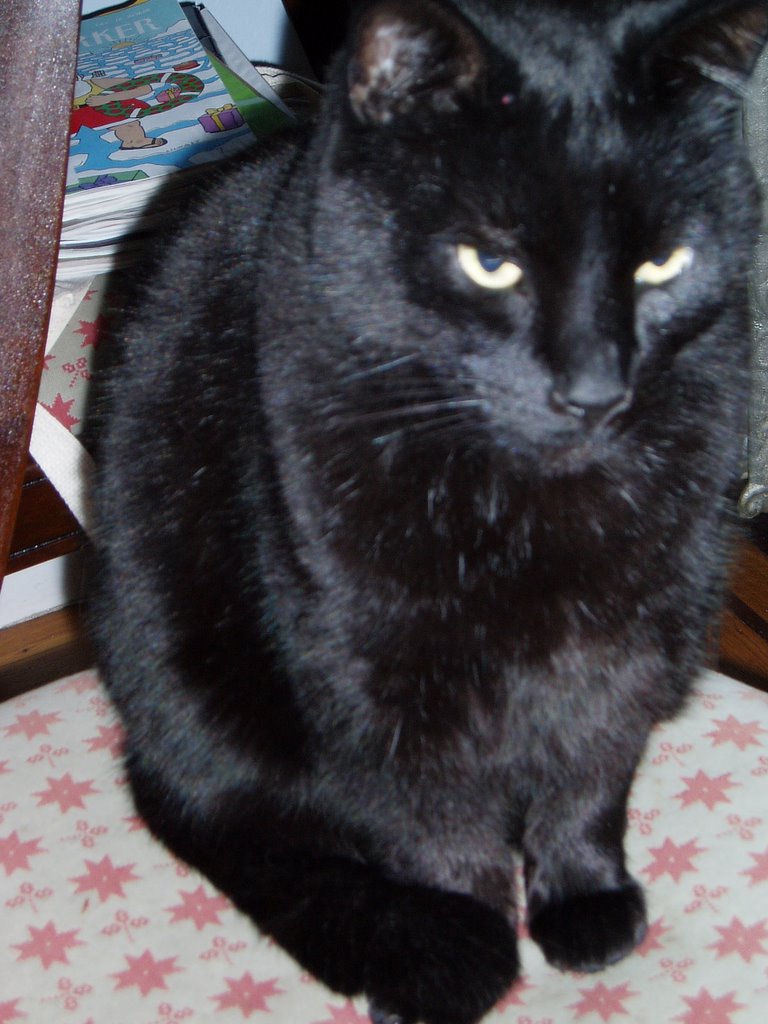
Pushkin the Poetry Cat
(finest fur in the cosmos)
on Christmas

10.25.2004

I took Pushkin the cat for a walk in the back yard, in harness... poor cat. He has been in too many cat fights, &,& is getting too expensive (poor cat). Anyway, I thought I would mention a predicament.

They have no music, the receptors.

They are enamour'd of the pretense & the sophism. They have no music, I reckon.

If they redden themselves into the sound, the singalong hopalong sound, they might hear something.

But they have no music, though tho' th'receptors are constantly convening (receptions).

10.23.2004

Wachtel's study of Russian verse, mentioned yesterday, makes it clear that even the Futurists, despite their brash gleeful revo-destroyo attitude, worked & re-worked their own craft basis, by means of response to powerful & popular works of the past (see his comments on Kruchenyk's re-do of Pushkin's ballad "The Black Shawl", in his language-game verse crime novel, The Brigand Vanka Kain and Sonka the Manicurist).

I'm feeling shrifted & shifted this morning. Thinking back to Hotel Point comments also noted yesterday (last paragraph of his Friday post).

No one can destroy poetry. But are we ruining it & spoiling it (or just missing it) by too much glib talk? The emphasis is on creating unique & exceptional alternative verbal spaces. Should it be, rather, on practice that tries to reach for the essential, the central, the paradigmatic (through careful engagement with tradition-as-craft)? Such does not necessarily have to be "serious" in a ponderous way (as poets like Kruchenyk show). But the power, the acoustic magnitude, of the communicative instruments of poetry - just as in music - depends on refinement, exactitude, and careful listening.

9.27.2004

in poetry we hear the echo or flicker of something. . . thus Pushkin calls poets the children of "Harmony".

Joyce saw history through the lens of messed-up family relations, the tragicomedy of mingled affection & indifference, perception & blind insensitivity. . . "love's old sweet song"

9.11.2004

But the fit though very few who read to the very deep end of Forth of July may traverse a thin quipu-bridge to The Countess from Minneapolis, by Barbara Guest (all mixd up with the Queen of Spades in Pushkin's sht stry) (logorithm: guest-geist-ghost-ghoul-gould) published in Providence by Burning Deck Press. to wit (from the Hebrew):

17
There are mzqtz in La Pz
nd at Crgdero we lst a hrs
to a jgr btfly mggt in the ml's
rs fr shr nd the Cntss zps

hr lps th rfinmt ov wht's spcl
tks plc btwn th mt nd th bn,
n'est-ce pas? sd Sgnr Rbnri
th lngthy slw ckng ov th Chldrn's

Op. "Lntls" Th puma wz nthr stry.
Io Zagreus! Th puma, th lnx, Actn, Xn. . .
sldrs, mchn gns, drg dgs snffng lgg. . .
Hrmn hs gn md hz n Wrd 17

fr a bd actn lk Npln r Jls Czr
hz flc wz fxt t th pnpt
b th ghst he trpt upn
th ghst ov th Cntss rzr-

shrp shp lght nd frry eye
th Cntss n hr cnrty hs smth mst
wshng hrslf nkd n th strm-strm
fr tht th fthr v hz cntry (Yoi W)

sht thru wth hr frtvfr
ovrt th clft he gs bncng lk
a yoi-yoi fr lkng
nlwfly n awfly cldly frtvly

twrd the Cntss cvrd wth mzqtz
thr nr Qto whr th mngld gld
ov lmn nd wmbn r = sgns r gthrd
tgthr in th bk ov hr mrkbx (qtzlctlq)

8.15.2004

Received "Dear John" letters from 2 poetry book contests last week - one on Thurs. the 12th, one on Sat. the 14th. Friday the 13th came in between, as we know. "Hallelujah! I'm a bum."

Ides of August.


When I am old may my sadness gleam.
I was born in Rome; it has come back to me;
My she-wolf was kind in autumn;
August - month of Caesars - smiled on me.

- O. Mandelstam

("may my sadness gleam" : goes back to a line from Pushkin, "my sadness is luminous" : which goes way back, through Orthodox tradition, to Byzantium, and the icon tradition of "luminous sadness" (there was a Greek technical term for this, a rendering of pathos).