2.29.2008

Now I need somebody to resurrect me.

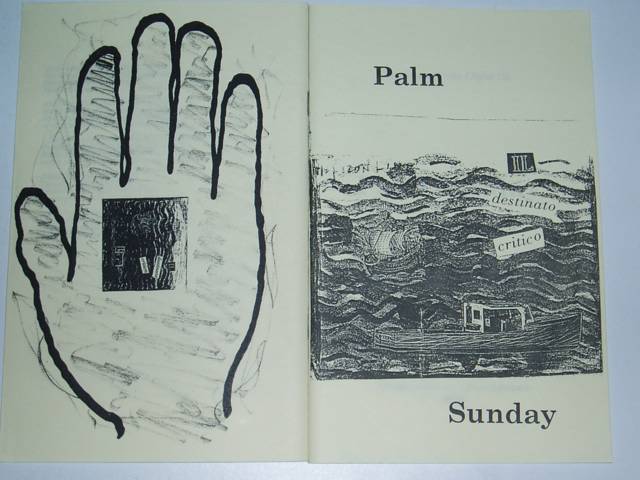
The "eye-in-hand" is one of the most ancient visual symbols in North America, from the mound-builder peoples of the Mississippi bottomlands. Here's the opening of "Palm Sunday":

1


Limping, climbing like a Lazarus
from the well of amor, you wave goodby.
Stigmatized and astigmatic, she.
Passing beyond alarums, carnivals


in the distance, Mardi Gras
in the bent mirror, marvelous,
far-off now, larmes
des choses
...


your worn shoes.
Hand waves.
Left-over
leaves.


A valentine arrives from prison:
a feather; a blue iris
enveloped in glass;
a tiny lead pellet. Anon.


The thickness of the lens slows light:
ask Lena how it's done, Einstein.
Absolute zero, swimming, sun.
Blackstone here - was all for nought.


Like an arrow like a grain of sand
through your heart, you carry it
and live (livid, limpid, lit,
littoral, ghost). Like a wave


in your hand, the eye turns inward,
a wave diving into itself; and a gnomon
recedes toward noon, toward
everyone. You keep your word.
I feel like I took a small conceptual leap of my own yesterday, with the remarks on Harriet, responding to Reginald Shepherd. The idea that the poem is only fully actualized in the "big outside" of the public stage (not necessarily a literal stage, but a performance nonetheless), in the "gray area" between art & politics.

Of course a poem can have a perennial life as a text, and be reborn every time it's read, and appear re-shaped again & again... Mandelstam's idea of the "letter in the bottle" to an unknown reader. But maybe the normative aim or trajectory of the poem is directly into the social Now of its time and place. It might be a combination of these two aspects, ie. a renovation or rebirth of a former crystallization; but I think this idea of poetic actualization on the "stage" of the present is important, as it relates to to another idea which I 've followed at various times on this blog, ie. to emphasize a distinction between prose literature, and poetry's embodiment, the human performance of language in the Now of the present, time's "pleroma". The poem's (Aristotelian) form achieves its ontological telos - it flowers - in this shared "gray area", the common verbal/social/political space of its time.

"Time flowers on the lips of whispered clay." Opening line of Forth of July.

& with what kind of "Now" might my own writing have to do? I'm thinking of the "gray area" of the great Jasper Johns show at the Met in NY, which I saw last weekend. Johns often gestures toward poets, especially Hart Crane. There are the images of the hand-print on a kind of pendulum or radius, as if reaching up from deep under water. I've thought of my own long poems as partly an attempt to perform a kind of ghost dance or resurrection ceremony, for Crane in particular - to play Hart Crane redivivus. (& did something parallel with the "Henry" of John Berryman, in the Island Road sonnets.) An illustration to one of the chapters of Grassblade Light, "Palm Sunday" (which is set in the New Orleans/Gulf area), unwittingly echoes Johns's image in this respect.

Here's an article by Thomas Epstein about Alexander Vvedensky, one of the OBERIU poets. Turns out he was interested in Nicholas Cusanus.
Happy Leap Day

2.28.2008

...another contribution to the Harriet comment-burble...

"Dear Reginald,

In the course of your argument here, you assert three points which are pretty close to truisms, but which I also agree with : 1) the NAP anthology has been credited with a political "progressivism" which was not really so advanced; 2) politics and aesthetics are not equatable, even in one & the same artist; 3) negativity for its own sake is pointless, & worse.

Nevertheless, these points don't seem to really address the crux of the position laid out by A. Mlinko and others in previous posts etc. In order to grasp what this position is, one has to be willing to acknowledge a gray area, between art and politics. Let's provisionally designate this as "cultural politics". Keeping in mind the tradiitonal notions of the role of poetry as not only an art form but also a didactic act, a form of education (cf. Milton, Dante, Sidney, etc. etc. - let's compare this role loosely to the idea of "applied science". Whenever scientific theory & discovery are applied in the real world, there are consequences in the realm of "cultural politics" (the forms of action and interaction in which a cultural engages). This same function applies, perhaps to a lesser extent, in the realm of the arts. Artistic creation has social consequences.

Here is Wallace Stevens ("Of Modern Poetry"):

It has to be living, to learn the speech of the place.
It has to face the men of the time and to meet
The women of the time. It has to think about war
And it has to find what will suffice. It has
To construct a new stage. It has to be on that stage. . .

If we take Stevens seriously, we have to think of poetry as in some respect an embodied, performative, and rhetorical art form. The aesthetic form of the poem does not, contra the New Critics, reside in a self-contained textual receptacle. The form of the poem achieves its realization, its actuality, in some form of social (& perhaps actual) "stage".

I would call this gray area, generally, the sphere of cultural politics. The space of social dialogue and shared language, where, in Stevens' words, "the imagination's latin" is compounded with "the lingua franca et jocundissima".

Using this concept of the "gray area" as context, let's look again at A. Mlinko's argument, which was, at least in part, to point up a historical contrast between the social-professional matrix of poetry today and that of 50 years ago, with the NAP anthology as emblematic of that difference.

I would, again, support that general perspective - since I think the aesthetic choices of the NAP poets did indeed put them "outside" the sphere of what was considered the normative discourse of traditional poetry at that time; and that one of the signal motives for this direction lay in the poets' desire to "learn the speech of the place", to "face the men" and "meet the women" of the time, to "construct a new stage".

And I think this does have to be contrasted with the contemporary situation, of which perhaps your own position is a pretty good exemple : the assumption is that poetry is self-sufficient and somewhat detached from politics, simply because the high level of professionalism supposedly structuring the field allows its practitioners to absorb and comprehend both social theory and all forms of technical innovation - so that such notions as "outside" or "avant-garde" become irrelevant. Stevens' position, in contrast, emphasizes a very high level of contingency in the poetic process, since the poem does not actually achieve its form, its aesthetic actuality, until it has been in some sense "enacted" in the public sphere. And we are not talking about the public sphere of the university or the profession, here, but of the sphere of "the people" of "the time". Outside, in the big outside."
In the realm of poetry (& maybe other realms) I find it difficult to balance and reconcile truth & beauty, the didactic & the aesthetic, the legislative/executive & the playful/imaginative, the prophetic & the poetic...

Look at people like Pound, Olson... ambitious-serious "alpha male" epic types. Avatars of the will-to-order, the will to govern, to dominate, to rule. (Yeats's "king of cats".) Though I don't consider myself very alpha, I feel I've muddled along in some similar deep swamps. Hence my affection for figures closer to the "artist" side of this line (Hart Crane, Stevens). Forth of July is really a playful jab toward the crystallization of a "national epic", drawing on contrary models (like Crane, Berryman, Mandelstam, etc.). [ (Will anybody ever notice what I've been doing here?) ]

from one perspective, the sane & ethical approach, as an artist, would be to maintain a strict detachment, to offer an impersonal mirror... from another perspective this seems impossible, an illusion : we are already caught up and involved emotionally & intellectually with the "materials"...

the whole issue of the poet as "unacknowledged legislator" stems from the fact that all our communal social constructs are rooted, at least to some degree, in the imagination itself... or is this an attitude (for an artist anyway) of foolish, over-reaching pride? Is the substance of reality firm & structured & prior to our conceptions about it?

(Another aspect of this is that much social, didactic, political poetry is not really very poetic. It's prose dressed up as poetry. Of course it can be very effective just like that. But it doesn't re-imagine, re-create the cosmos, the way the great epics do. It lacks the orphic fictional-poetic power of Virgil, Dante, Milton, Shakespeare... - the regal sceptre of the imagination - Mandelstam's "baton". I suppose the sceptre has been passed to the novelists, the scientists, the philosophers, the "critical theorists"...)

Old puzzles... this crux perhaps marks the difference between the medieval, the Renaissance & the modern mentalities...

Maybe that's one reason I like the philosophical writings of Nicholas of Cusa so much. For Cusanus, our knowledge reaches its limit in puzzles & paradoxes. God is "the conjunction of opposites". He acknowledges the source of all order & creation in God; at the same time he asserts that all our concepts of God are just that, human constructs, "conjectures", that in fact our whole sensible, knowable reality is a conjectural human construct, an artifice of the mind...

I thought this morning that the resolution of this puzzle or paradox lies in an understanding of the nature of divine love. If "God is Love", as the epistle of John has it, and if Love is a kind of binding embrace of the Other which is at the same time a renunciation, a self-giving to the other, a state of service or servanthood - then it's in the light of this kind of Love that we can imagine another Biblical concept, ie. "perfect freedom".

Imagine a divine nature which wants to create a cosmos of "perfect freedom", because this desire is rooted in love, and love's deepest motive is to "set free". Then this divine nature would of necessity have to withdraw, relinquish control and dominion on some level. Of course this does not necessarily entail indifference (the remote, the clockwork God). "Selfless-love-without-indifference", then, is in itself a kind of incomprehensible paradox. Incomprehensibility, even absurdity, of a kind we meet with in ordinary life (cf. the parable of the Good Samaritan).

I guess I'm simply recycling some old, old via negativa notions going back to Pseudo-Dionysius & Byzantine theology & long before (Plato on love, etc.).

But these notions seem to be essential to any integration of order & freedom, of cosmos & chance, of medieval and renaissance, of theology & humanism. A figure of paradox like Cusanus appears at the cusp of this historic shift (between medieval & modern). He has a mind fascinated with invention and creative freedom. His writings are playful intellectual-philosophical games, conceptual inventions.

But it seems to me the crux of it all is this fusion of the will-to-love ("good will") with the idea of "perfect freedom". Maybe this is the nexus where the gift of artistic detachment & inner freedom rhymes with a more "sober" concept of necessity, reality, history, fact, the moral law, governance, political & juris-prudence, etc.

2.27.2008

Poetry is embodied speech, language brought close to ordinary conversation and then spun wildly around it. Embodied, embodied, not simply collected, collated, sorted through mandarin effete distortion-filters... thus these readings/performances last night offer a kind of test - a sort of partial & preliminary measure (& not the only one, by far) - of the poetry's substance, reality... (the real test residing in the hidden performance, maybe never actually heard out loud, of the poem's composition).

Mikhail Aizenberg an architect by profession, and you see in his critical writings this constant tension between poetry and rhetoric, between poetry and mechanical, learned, imitation-discourse (the "Leningrad School" his emblem for the false turn toward the latter) - poetry having some kind of inner form, the creative/intellectual/emotional/sensible gesture - a shape, an architecture, in-forming the language.

(Thus the interest in Vvedensky & the OBERIU poets' demolition of everyday speech & literary language etc. Maybe that all goes back to the Byzantine theological crisis-complex, the tense ambivalence between iconophilia & iconoclasm, between the symbol (word) and what it represents.)

"The body is the temple of the Spirit."

For Aizenberg, it seems, ordinary speech & ordinary experience offer the paradoxical, counter-intuitive substance or acid test for the authenticity of the inner unspoken architecture of the gesture... this shared communal language-space being the place where all the human motives for composition are integrated & achieve actuality.
A lot of energy down at Tazza last night, big poetry reading (10 poets in an hour & a half) presented by Mairead Byrne. Some real talent, youngsters for the most part. John Cayley, visiting Brit, read interesting translations from contemporary Chinese. One kid read a translation of Kharms, and then his own remarkababble OBERIU-style stuff. Ran into Forrest Gander again, & spoke to Michael Magee. Told Mairead my maternal gr-gr-grandfather came from Dublin, which is true. She made a note of it. Played harmonica again with blues-guy RISD prof Mark Miloff.

Thoroughly enjoyed getting off the machine & out of the library.

2.26.2008

I'm something of a musician. I've played various instruments since age 5. I'm alert, somewhat, to the physical texture of sound, the quality of sound, and to music as physical gesture (hands & feet playing keyboards, strings).

This filters into my sense of what poetry is or should be. Not noise, not the banal, oppressive, complacent discourse, verbiage. In fact, the opposite of all that.

The dramatic moment, the entrance of measured sound. (Yeats : "Speech after long silence...") Part of the rhetoric of poetry's specific power & difference.

(responding to JL's post of today)
Also reading this great anthology of the OBERIU poets (Russia, 1920s & 30s) - which is giving me a clearer sense of what Aleksandr Skidan is up to. I will have to write some more about Skidan here.

From the little I've read so far, the OBERIU poets - Vvedensky, Kharms - are much more than comic absurdists. Vvedensky displays a near-mystical skepticism about language, which seems to have roots way back in early Byzantine-Orthodox theology (though there's nothing overtly Christian or religious about it - he's conceptually, philosophically radical - a kind of extreme iconoclast).
(the section of Fontegaia posted yesterday is in part a response to a particular poem in Mikhail Aizenberg's book, Say Thank You.)
I suppose I was being foolish (again), over at Reginald Shepherd's Harriet post announcing his new anthology (Lyric Postmodernisms). Maybe even rude, to intrude on his publication announcement. The discussion (for me) was leaching over from other posts - one by Shepherd on the term "post-avant", another by Christian Bok on contemporary experiment (in response to Shepherd). Actually it was Bok's (re)formulation of some discussion by Shepherd & Paul Hoover - in which Bok summarizes Hoover's idea of a compromise, in current poetry, between postmodern experiment & tradition - that I was criticizing. Shepherd's new anthology seems (from its title & brief descriptions) to represent or illustrate some such compromise. (Bok himself suggests the limitations of such an idea - this compromise - & proposes something else, along the lines of multifarious simultaneous experiment - the "pan-avant".)

Anyway, I was being silly & provocative, using Shepherd's post the way I did. But I get irascible when I hear the term "postmodernism" too often.

& I was registering a protest of my own against this notion that today's cutting-edge & influential poets have found a way to blend postmodern concepts of language & subjectivity etc., with more traditional modes of lyric poetry.

Because actually I think the real new & radical step right now would be a rejection of the recent compositional & stylistic formulae - those which fixate on
20th-cent. notions of language, on language per se as the sole formal, structural material of poetry. I'm saying we go back to the Cranes : R.S. Crane's (& the Chicago School's) Aristotelian concepts of poetic form; Hart Crane's sense of the poem as a mute or silent gesture toward the unsayable.

But I've already explained all this. & the attack dogs are lurking. & the machinery of professional poetry prestige (in which, for the time being, I am not a player) must roll on.

It was gauche of me to add all this to the comment thread at Shepherd's publication announcement. & I owe it to him to actually read the new anthology, which I will do.

& yet I have to be silly, stupid & out-of-sync sometimes; that's part of this loser's game I'm playing.

2.25.2008

Fontegaia moves on...

10


A tiny hunchback snail
inches forward, cased
in a spiral spinal house.
A full retreat, and final.


Simple curve, mushroom
cap, camouflaged ravine
of rugged oak. Hidden in
eye-plane, like throaty gloom


of turtle dove (grey
breast against gray evening
stone). Gradual leavening
of steady rain. Bend in the sky.


Rustle of Indian foot in forest.
Breeze, or winding flute-path.
Blurred cascade or purple casket-
flower; spectrum-honeycomb (at rest).


The bow drawn taut, a beaded
level creaks in rain. Almond
houseboat croons -
crowns - swoons (ceded


to sword). A unison
of ewe and eye, oui, one Friday
- all in a pre-dawn naval play,
a little ark of lincoln-logos. Done.


And carried on her back, a moon
gone down. Beneath the earth.
Emancipation lips come forth,
sing like humpback whale, soon, soon.

2.21.2008

I'm going to be away from the computer for a couple days. See you when.
Another comment sent into Harriet today (at Reginald Shepherd's Lyric Postmodernisms post):

"Such "comment-box interventions" as mine, here on Reginald's patient long-suffering Harriet post, are easy to dismiss.

Nevertheless I hope some poets will consider the implications of what I'm saying.

The big trends in 20th-century linguistic theory and philosophy have assumed as axiomatic that language is not only a system (either a system of order, as with the structuralists, or, as with the post-structuralists, a system of chaos or "difference"), but a system (either a logos or an a-logos) which is the actual substance & ratio of reality, identity, and literature.

And the prevailing currents in what is known as postmodernist, innovative, post-avant, and language poetries have taken up these theories and assumptions, and have made their literary consequences a hallmark of their style - that which differentiates them from the common herd of traditional poets.

Now if it's possible to think of language in a completely different way - as primarily a human creation, a tool of communication which we invented - akin to other forms of non-verbal (& non-human) gesture, signals and communication - then we have a problem with the theoretical obsession with language as self-regulating system. And we have a problem with a trend in poetics which emphasizes the dispossession of human invention, will & intent, in favor of the aleatory workings of socially- or internally-generated verbal materials.

It also strikes me as curious that 50 years ago, a group of influential literary scholars, poets & critics - the so-called Chicago School (R.S. Crane, Elder Olson & others) - had already analyzed the basic problems involved with the 20th-century fixation on language, and the concomitant notion of the poem as primarily a verbal artifact. And they outlined an Aristotelian counter-proposal to this dominant New Critical trend (which was, in effect, turned inside-out & re-applied by the Language Poets) - one which focuses on the poem as an aesthetic whole, an intellectual-emotional gesture or form, which is not reducible to its literal text, but is primarily an (aesthetic) ACTION, for which the text provides a kind of score.

I see the contemporary state of affairs (when poets & groups of poets glibly gather up such identifying markers at "postmodernist", "innovative", etc.) as somewhat similar to the situation which existed at the turn of the previous century, when Pound surveyed the landscape of versifying post-Victorians, and commented something to the effect that "they have no ground under 'em". "
Some very interesting essays by Mikhail Aizenberg, on (relatively) recent history of poetry in Russia, translated in a special issue of Russian Studies in Literature (vol. 32, spring 1996). Moscow has a special perspective on the Petersburg poets. Aizenberg has some very acute things to say about a poetry of "direct response" - really new poetry - as opposed to a poetry of Poetry (contemporaries so overshadowed and awed by the "four horsemen" - Akhmatova, Tsvetaeva, Pasternak, Mandelstam - & Brodsky). He writes how the latter actually becomes a kind of "narrative" of the Tradition itself, which differs in kind from the immediate roots of lyric poetry (no matter how impoverished, banal, ordinary). Emphasizes that the zone where everything really important happens is in the interaction between everyday experience, ordinary speech, & the lyric impulse.

I'm paraphrasing mightily. Aizenberg (unlike myself) does not go in for windy discoursing, either - he talks very specifically about the poets around him & immediately before (most of them unknown to American readers).

2.20.2008

Fontegaia, again... getting fairly wacky.

9


A ring of lakes, each lake
like a ring. Frigid, with a few
frigates. Sails full of airy
dew. What it was like.


The bond of a moon in eclipse
was guaranteed by magnets
,
according to the majestic
juryman (a Mr. Chips) -


like you or me, or more like
you, actually - like a ewe
or a vestryman, a vraie
monad
, like Eweryman - well


liked (at least until last
Friday, as far as I know).
She sobbed into the micro
after they drug him to the hill


(a friggin' no-frill spiel
or spelling bee, sez).
And a tear, a few tears...
wells from the commonweal.


So the adventures of little Frisbee
followed a rapid ripple down
to Mirror Lake, sometime round
sundoom. And for you and me


what did it mean? You-me.
Like a hybridized horseshoe,
a lonely-pastured Disk-a-Do.
Awhish, a rue, awry, awhee...


(p.s. it appears JL was also writing about the moon last night (or this morning). The eclipse brought it so close, so 3-dimensional - rounding it out, a smooth little pearly pebble or old-fashioned clasp-button in the sky. Cold silver radiance, taking earth on board, the shadow of earth. Going underground. Hanging up there, not far away, a sort of aloof tear-drop, a sort of Frigga-Pieta of close-lipped mournful restraint, looking on.)
OK, have been tweaking the set-up... comment moderation should be in place... we'll see. I won't allow abusive ad hominem comments here. It's a waste of everybody's time.
Fontegaia, again...

8


Spindly oak, feet buried in grass.
Branches tense. Elbows drawn in.
Giacometti in rustling iron.
History's hinge-bolt (rasping hasp).


The grain grows out of lightning.
Downward, jaggedly careening
leaves like leather. Evening
parting of the ways, my


dear
, they're whispering.
You don't know what it's like,
because mostly it's a weak
signal, mostly, you know.


Like a weak heartbeat. Erratic.
How we dreamed those days!
Just dream were we
. Frail
spooks, spectators, folk-


art mammals. It seeps
into the profile - the wind
mutters across its own
eye (lone cyclone). Clasps,


folded-under. Feathery flame
a-brimful of yearning -
remember how light it felt?
Like the rim of a balloon


about to burst...
and you were inside there,
a landed squire of oak and air.
Frisbee. King Whammo the First.

2.19.2008

... excerpt from a further comment, sent as addendum to Reginald Shepherd's Lyric Postmodernism post at Harriet:

"For the Chicago critics, a poem is an aesthetic SHAPE, organized primarily by plot and dramatic action, for which the language is only one of several contributing factors. I want to transpose this notion to apply to poetry in general, by positing this notion of the poet's mute GESTURE as the organizing principle of the poem's aesthetic form. Everything involved in this gesture works toward the integrity and fulfillment of Crane's "impossible" new word (which again, is not so much a verbal word, as the sum total of the aesthetic-communicative gesture).

I would say that Ashbery is the great American exemplar of the poet as de-centered self offering poetry as unaccountable discourse. This kind of practice fuses seamlessly with postmodern theoretical concepts of the status of the subject, the power of language-as-system (or language-as-differance), etc. It is this whole approach I am calling into question, with these two notions of 1) language as primarily a human invention, a tool of human agency; and 2) poetry as rooted in mime and mute communicative gesture."