12.05.2005

OK - I think I've made the last little corrections & improvements. Everything here at Lulu looks very good!
Going back over these ms. for Lulu-publication, I was surprised (once again) by the degree to which my reactions to the same passage can change, from reading to reading. Weather, time of day(?). "Subjective response." Makes me realize how complex & subtle the activity of literary criticism can be.
Tweaked the formatting for Way Stations, Island Road, Dove Street and Chapel Hill. Now they are even more beautiful (he sez).
Maybe my literary life has turned a corner (it's been a hard 5 years). Maybe American poetry has experienced an imperceptible change! I am impinging on it, slowly & unsteadily. It will never be the same!

12.03.2005
I received 2 of the new Lulu productions in the mail today. They are a big improvement over the earlier versions [sigh of relief!]. But I want to tweak the formatting a little more. Will keep interested members of my cult following (I know you are out there, fellow Rotarians!) posted.
Finished typesetting the new version of Stubborn Grew today. Huge chore. Now I can get back to other things. I want to see if I can inset the collages which were printed in the Spuyten Duyvil edition. Either way, I hope to have it up & available by next week.
Finished typesetting the new version of Stubborn Grew today. Huge chore. Now I can get back to other things. I want to see if I can inset the collages which were printed in the Spuyten Duyvil edition. Either way, I hope to have it up & available by next week.
12.02.2005
Curious evening of synchronicity. I spent all day (secretly, at work) feverishly formatting Stubborn Grew - from a scanned glob into a text-glob, in Microsoft. Took me a long time to figure it out. Took me a longer time to edit.
This afternoon I reached the halfway point, where Bluejay & Henry finally emerge, at last, from the abandoned railroad tunnel under the East Side (smelling of bat manure, etc.), beside the Carrie Tower (up the street from where I was doing this work, at the library), across from the HP Lovecraft memorial stone. The whole thing is a take-off on Dante & Virgil's descensus.
Now Sarah had been reading The Dante Club, a mystery set in 19th-cent. Boston - Longfellow & pals. It got her interested in Longfellow's translation of Divine Comedy. So I got v. 1 for her - Inferno - out of the library today.
& I got home after a long day of reliving Bluejay/Hen's catabasis, sat down with a glass of cheap chianti (from Siena) & opened up the Providence Journal. & there was this picture:

& here's how the story (by Projo reporter Mark Arsenault) opens:
"The video feed from the bottom of the shaft could have come from Fellini's most abstract and mind-numbing movie: a 30-foot gray wall of shale and sandstone that, on occasion, emitted small puffs of dust. The accompanying soundtrack was a racket like ball bearings being sucked into a Shop-Vac.
The story lay behind the wall of shale, at the bottom of a sewage overflow shaft 260 feet below Calverley Street, not far from Providence Place mall.
For more than a year, a 690-ton tunnel-boring machine had been heading toward the construction site at Calverley and Okie streets, cutting its way underground through solid bedrock from Field's Point as part of a 22-year sewer overflow control project."
Two RI senators & other luminaries were on hand to celebrate the big breakthrough. & I really felt a part of it all.

This afternoon I reached the halfway point, where Bluejay & Henry finally emerge, at last, from the abandoned railroad tunnel under the East Side (smelling of bat manure, etc.), beside the Carrie Tower (up the street from where I was doing this work, at the library), across from the HP Lovecraft memorial stone. The whole thing is a take-off on Dante & Virgil's descensus.
Now Sarah had been reading The Dante Club, a mystery set in 19th-cent. Boston - Longfellow & pals. It got her interested in Longfellow's translation of Divine Comedy. So I got v. 1 for her - Inferno - out of the library today.
& I got home after a long day of reliving Bluejay/Hen's catabasis, sat down with a glass of cheap chianti (from Siena) & opened up the Providence Journal. & there was this picture:
& here's how the story (by Projo reporter Mark Arsenault) opens:
"The video feed from the bottom of the shaft could have come from Fellini's most abstract and mind-numbing movie: a 30-foot gray wall of shale and sandstone that, on occasion, emitted small puffs of dust. The accompanying soundtrack was a racket like ball bearings being sucked into a Shop-Vac.
The story lay behind the wall of shale, at the bottom of a sewage overflow shaft 260 feet below Calverley Street, not far from Providence Place mall.
For more than a year, a 690-ton tunnel-boring machine had been heading toward the construction site at Calverley and Okie streets, cutting its way underground through solid bedrock from Field's Point as part of a 22-year sewer overflow control project."
Two RI senators & other luminaries were on hand to celebrate the big breakthrough. & I really felt a part of it all.
Working like a maniac to edit & re-format Stubborn Grew for a new Lulu edition. Had to scan it from scratch.
Good for me to see it again, in pre-book form. Struck by how monumentally silly this poem is. Especially as it warms up, in the beginning : those thumpingly obvious rhymes... the scramble for a shtick...
No wonder nobody has seen fit to review it. It's very much out of every loop I, at least, can think of. Like a James Merrill play-acting at populism, so it starts out... I mean the whole tone of the thing, the goofiness. But the tone changes in the different chapters - gets better, relaxes, settles in... then spirals out of control...
Surprised again at the internal logic - I mean the way it forecasts the future (the future of the poem, mostly).
11.30.2005
Woke up around 2 a.m. last night, was thinking about some comments in the Vico book (by Mazzotta), having to do with memory. Mazzotta writes something about the nature of memory, as the sign of a break or fracture between present & past. Memory registers the separation or distance between them.
This seems fairly obvious, but it got me thinking about my poetry ("memory, mother of the muses"), and about memory and space.
It might have something to do with having lived my adult life half a continent away from where I grew up. My sense of memory is always connected with distance in space as well as time.
I think about Proust's (heroic & mock-heroic) rendering of memory. Not that I'm a Proust expert, but I have the idea that with Proust, the action of memory is a kind of bridging & retrieval, an absorption in a past state, which sort of blossoms on its own.
My own sense of memory's action feels more like a distancing : as if one were closing one's eyes & going up in a balloon, or gaining some kind of bird's eye view of oneself, from far away, in a landscape or vast context (of time/space).
This is all rather vague, & maybe I should try to work up an essay or something. But as these notions were occurring to me last night, I also thought of Jonathan's comment of 11/26 :
"So much of reading poetry--and writing it--is ruminative and fragmented. An anxious, frustrating searching through books and magazines. The attention flags. There is not that unitary 6-hour experience of reading a novel, or the novelist's feeling of writing through a certain portion of the narrative."
I'm not sure what he means by "ruminative" here. But I understand the sense of a kind of jumpy or fragmented response to short poems & etc.
& I'm hoping that my own poetry somewhat works against or counters that kind of experience. I mean that these books & sequences of mine aim for a more sustained impression - of vastness - space & memory.
The first (& one of the only) reviews my poetry has received, was in a Brown U. student newspaper, written by an undergrad about my 1st book, Stone. I don't have it in front of me (this was almost 30 yrs ago), but she started it out with something like : "Henry Gould takes his time. He waits until the poem is ready." What she meant, I think, was that I composed slowly & quietly; the poems are sort of calm, without flash, bells & whistles.
I still like those little comments very much, & I think they relate to what I've tried to do.
[p.s. Vico himself might demur from such an individualistic notion of memory. For him memory & history & anthropology are all combined somehow.]
11.29.2005
I'm trying to stay calm about my new publications.
But it's difficult, I'm having trouble working at the desk.
We are experiencing a new poetry print culture, which is a lot like the old culture (Whitman or Donne or Dickinson, passing around their homemade pamphlets) except... except... it's massively available.
I have nothing against the regular publishing structures, nothing whatsoever. Never was very successful in those venues - but I didn't try very hard, either. Not out of laziness, though!
As with many others, with me writing poetry involves a lot of specific gravity. Plus I have something of an obsessive manic depressive oblique personality. It's all or nothing.
Moreover, the minor skills I picked up editing Nedge & Edwin Honig's mss. make it easier for me to publish meself.
I'm repeating what I wrote a few years ago, when I went into the XLibris mode... my apologies, friends. But I have the feeling this Lulu loop-de-loop is going to work : is going to be a lulu, in fact.
Giddy-up Ol' Mangy. We're a-comin' to your town.
Still reading G. Mazzotta on Giambattista Vico.
Someone could write something interesting on Chas. Olson & Vico, if they haven't already. Olson would have found him agreeable.
Vico disputed both Plato & Aristotle on the nature of poetry. For V., poetry is essentially history. Memory's recollections, imaginations & inventions are inseparable from the drives & passions of peoples, and writing (poetry) records (or adumbrates) the distance or dissociation which is memory itself.
Vico against poetry as "craft", or as something having to do with philosophy or the critical intelligence. He sounds berry much like a Longinian-sublime Romantic.
cf. Mazzotta p. 150 or so.
TWO new books up at Lulu : Dove Street and Chapel Hill.
Have books, will travel. Soon I will get Old Mangy out of the barn & start my World Tour.
Have books, will travel. Soon I will get Old Mangy out of the barn & start my World Tour.
11.28.2005
I used to feel frustrated that my poems were not available to readers, or available in not-so-good editions. But that may be a problem of the past. If you go to Lulu, you'll find new, less-expensive editions of some of my books. You can download electronic versions, or buy the paperback.
I've edited, corrected and re-formatted these books. I'm waiting to receive my own copies, and will report back on the quality, but I think they are going to be a big improvement. Here's what's up so far:
Way Stations (shorter poems, 1985-1997)
Island Road (the sonnet sequence)
The Rose (sequel to Stubborn Grew. I hope to publish a new edition of Stubborn in a few weeks)
There are also cd versions of my blog music on Go Little Sparrow. (I don't recommend buying these unless you are a real music nut. This is archival "practice" music. The sound quality is not great, and the loudness varies a lot from song to song.)
My poetry books do not come with award statements, big-name publisher logos, or blurbs. But my poems were built to last. American Po-Biz will just have to come to terms with me, sooner or later. Yup.
[p.s. Lulu's international distribution service includes a set-up fee to authors, which, unfortunately, I can't afford right now. So if you're outside the US, you may not be able to buy these directly, online. Hopefully I can add that service before too long.]
11.24.2005

little joe gould has lost his teeth and doesn't know where to find them (and found a secondhand set with a click) little gould used to amputate his appetite with bad brittle candy but just (nude eel) now little joe lives on air Harvard Brevis Est for Handkerchief read Papernapkin no laundry bills like People preferring Negroes Indians Youse n.b. ye twang of little joe (yankee) gould irketh sundry who are trying to find their minds (but never had any to lose) and a myth is as good as a smile but little joe gould's quote oral history unquote might (publishers note) be entitled a wraith's progress or mainly awash while chiefly submerged or an amoral morality sort-of-aliveing by innumerable kind-of-deaths (Amrique Je T'Aime and it may be fun to be fooled but it's more fun to be more to be fun to be little joe gould)
-- e.e. cummings
HAPPY Turnkey Day!
Sarah down with stomach bug. We watched video, Joe Gould's Secret. I had to go & read the book (by Joseph Mitchell), which we happened to have in the house, since it was a favorite of Sarah's father (born in Manhattan) (Up in the Old Hotel).
Gould is definitely a relative, though I can't seem to trace him on Google genealogy. He told Mitchell his family settled near Boston in 1635 (likewise); "the Goulds were the Goulds when the Cabots & the Lodges were clamdiggers."
Interesting Mitchell/Joyce connections (Mitchell's fascination with bars, and with Finnegans Wake, which according to the intro, he read "at least six times").
I recognize a number of personality traits. Both in Joe Gould, & in the Gould world (New England crusty) he left behind.
His phantom Oral History. Much of local Stubborn Grew grew out of, & refers to, an oral history project I did in the old Af-Am section of Providence, along Benefit St. (the first thing oral history prof. Allen Smith asked me was, "are you related to Joe Gould?")
Bluejay leads Henry there, as part of their catabasis.
& the bookends in FW, basically.
Pound mentioned Gould as an unknown "native hickory". He was a friend of EE Cummings & Aaron Siskind. Apparently Siskind's Village studio was one of the repositories for Gould's strange notebooks.
It's got me wondering whether Siskind allowed a photo of his to grace my first book (Stone) because of my name.
p.s. Is McSorley's Ale House still in business?
11.22.2005
Vico's Autobiography opens with a description of how he fell head-first onto a stone floor as a child and was unconscious for some time; how the doctor predicted he would either die or grow up "stolido" (slow, retarded). Instead he became a scholar & intellectual. Mazzotta reads this as a comment on the temptations of determinism in science.
Vico (via Mazzotta) juxtaposes science's lust for power over nature (Bacon's New Atlantis), and its mechanical determinism of causation, with the collective "wisdom" of humanities, jurisprudence, political science. Because political science is not "exact", it has to make room for human freedom & unpredictability, the dynamics of debate & consensus.
His lectures on the role of universities in fostering multi-vocal, encyclopedic conception of knowledge : sometimes countering, analyzing, criticizing (Socratic tradition) established political authority.
The self-conscious historical sense. Poetry, unlike science, does not exert control over nature, but rather, through its linguistic shapes & etymologies, unfolds history (the productions of memory).
But I'm conscious of the disconnections, the inability to engage in dialogue. Rationalist, polemical academics who don't understand or appreciate their own cultures; on the other hand, obscurantist philistines, promoting a new dark age of magic formulae & superstition.
11.21.2005
I first met John Ashbery in 1965, in a laundry room in Louisville, KY. He was short, dark, with a pronounced limp in both legs, & he spoke with a pronounced Canadian accent, probably due to his years in Saskatchewan as a member of the Canadian Mounties. It was only five years later, after I had already published my first seven books of poetry, that I learned that the John Ashbery I had known all those years was not the John Ashbery, the famous poet. My John Ashbery used to vilify the School of Quietude into the wee hours of the morning, while drinking glass after glass of strong Turkish coffee laced with creme de cacao (the only liqueur left in the storage room of the bunkhouse, located down a slope of jack pines, behind the warehouse, just before you reach the storage room). Why my JA had taken such a visceral, vivisectory attitude toward a group of poets who, in all innocence, had never become conscious of their debt to English-Continental traditional versification and social attitudes (though you wonder why the implications of the jodhpurs & smoking jackets & Sherlock Holmes-style smoking caps and longjohns & periwinkles & hobnobberies & gaiters & socks & fleabag hotels in seedy Birmingham never occurred to them) is a question I have for long striven & stroven to answer to my own satisfaction, without success. The recent developments & improvements in poetry education in America, due to the deluge of New American methods of reading (outlined in a recent New Yorker article on the other John Ashbery, and further amplified here) have fortunately put to rest a certain amiable, droll, amateurish, sacre-bleu, bon-vivant, recherche, de rigueur, dibbly-dabbly, tadpole methodology which has saturated the literary atmosphere of the world for nigh on 4 decades now, ever since Firkham Punctilious published the inaugural issue of his Littler Magazine, wherein the Old American school of poetry attempted one last stand, dressing up as Gordon Lord George at Khartoum, swords drawn, facing the rabid mob of trolls. How this brand of syncopated antiquity ever came to dominate the poetry scene of our world is a puzzle for future literary historians to unravel, I will leave it to them, but I will say : we are truly fortunate to obtain habitation in a time period of such lush growth of New American poetry, because now, as we know, reading is a very special and the toast is ready, as they say, in the School of Jumping Gophers, of which we are proudly each a member.
11.18.2005
Am reading G. Mazzotta's study of Giambattista Vico, The New Map of the World. Mazzotta emphasizes Vico's alignment with "epic wholeness" & history, vs. "irony", scepticism, & Cartesian (a-historical) subjectivity. Vico was in conflict with the Macchiavellian-Cartesian (political) science of his day.
What does this have to do with you & me.
The baroque interlinked storytelling of the long-poem streak in 20th-cent. literature. Pound, Olson, David Jones, et al. Olson's Herodotus (histor). Geography & change, development. The "middle voice", as Olson has it.
Vico puts imaginative poiesis at the center of human history.
Joyce's fascination with all this.
11.16.2005
Darwinism, "intelligent design", science, literary darwinism...
the phenomena will evolve some gripping essay-toes, I'm sure.
A poet's perspective : somewhere in between. There IS a science culture, which has non-scientific influence on thought-worlds in general, just as religious ideology has ideological, not only religious, impact.
Science now seems lighter, quicker, sexier, than it did when I was growing up (50s-70s) : then it was somehow heavy & sad, like the industrial architecture & the lab coats - more like 1984 than moon-walks for me.
My steady view on the subject is that there is a specifically poetic discourse, which represents truths of the actual as no other discourse can. (see Giuseppe Mazzotta, Dante, poet of the desert, & other books.)
& behind it is a version of Christian humanism, I guess. What is the "humanism" part? That's the part which poses a challenge for scientific positivism and scepticism, as well as for narrow religious dogmatism (really, versions of imposed superstition). It's not "secular". It's grounded in the fundamental notion of "imago Dei".
That is, to translate : our life is fundamentally personal. When we apprehend & recognize a person, an individual, in the clearest, sharpest, deepest way - we are also getting a glimpse of God. God is the invisible supra-personal Person. & life is essentially dramatic.
I link this conception to Osip Mandelstam's Acmeism. Acmeism was a kind of rough-draft poetic ideology, which he sketched out in several essays written around 1912-1920. One of Acmeism's basic tenets held that poetry, along with other arts and crafts, humanizes the earth : helps mankind feel at home on earth, gives confidence & hope. Mandelstam summed it up in a few lines :
Let the names of imperial cities
caress the ears with brief meaning.
It's not Rome the city that lives on,
it's man's place in the universe.
The project of humanizing the earth, of giving people - especially young people, perhaps - a vision of life as person-centered, and earth as metaphysical "home" : obviously, such has philosophical implications : consequences for both scientific & religious education.
11.15.2005
Various and sundry people who probably don't visit here much are having an interesting debate on the riots in France.
I don't think you need to reach as far as to Hobbes in order to dispute the romanticization of political violence. It's precisely that romanticizing - indulged in by armchair idealists, stationed at a distance from the events themselves - which crosses the boundary from necessity to disorder.
There is an exact parallel between said romanticization and the rhetorical exaggeration of "state violence".
Injustice in government is evil. Violence is evil. Neither one justifies the other. When injustice convinces people that they have no other recourse but violence toward the achievement of justice, then you have an obvious symptom of social injustice and a need for reform. There is no need to justify violence in order to address the injustice which is at its root.
11.14.2005
the beginning of July:
 1


 Gray skies on a late spring day.  A start.
 In the parking lot.  Pawtucket?  Cumberland.
 Sound of someone hammering – what?
 Iron.  Waiting for my daughter there,


 her tennis lessons.  Nowhere.  Somewhere.
 Out in the open.  Gray skies, hollow
 hammering.  A hole.  A whole
 world (of lonesome rune-moss).


 Armor.  Wheel.  Hubcap.  Sky-
 scraper.  Redmen in moccasins
 on rooftops – cashmere
 lamb's quarters and yaks –


 kayaks – stitched all around again?
 Like a lake in a corral – your
 coracle – row, row, row
 we go.  I'd like to... snag


 you, elbow room.  A Huckleberry
 getaway somewhere.  Wide grass
 where the hurt surges – surges
 like active vitamin – Buick


 in high gear.  I leaned back
 against the health club wall.
 Low sub-suburb, lawless.
 Clouds moving, carboniferous.


 Spaces for eyes.  Flag in yard
 beside white aluminum siding.
 Farmhouse hemmed inside
 clutter.  Derelict, dreary.


 But that hammering was happy.
 I was going into the meadows
 again – lose myself for good.
 So long, Julius.  So long, Pap.


                         7.15.99 (St. Henry's Day)

             *


 Upstream from Egypt or New Orleans,
 north or south.  Colors on a raft
 blend – snow, or Afro-cat.
 Coffin for Ishmael.  Snore awhile


 on board, then wake with another start
 or vociferous snort – was it a dream?
 Blackstone, with feet in cow-merde
 of New World – slow golden apple-taster –


 or Berkeley, testing all ten toes
 on reality stones – and the air so
 gentle, and the noise so seldom – soar,
 dream...  no machine, but a knotted


 meeting, under the apple trees and
 sweet grape vines.  Arbor day behind
 the cottage where LaFarge, Degas
 hibernated – downstream, tender


 colors merging, a harmony
 of many at the brown delta, singing.
 A Niger of negritude,
 or tunes of an old rhyme nomad –


 tapping feet while they waited there
 for the beginning and the end.
 Laden ship in the Nile den-
 mouth – moon-moth wreath –


 so diaphanous, yet overlaid
 like a tablet of the future law
 or tables carven in the wall
 of every hut.  Love-dreidle,


 homespun doodle.  A shadow
 gouache from treelimbs all at once:
 a see-saw operation of the sun
 or evening ocean on a beachhead.


                         7.16.99

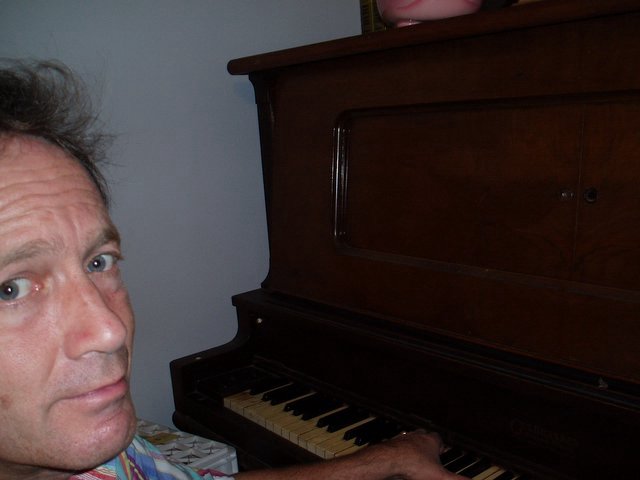
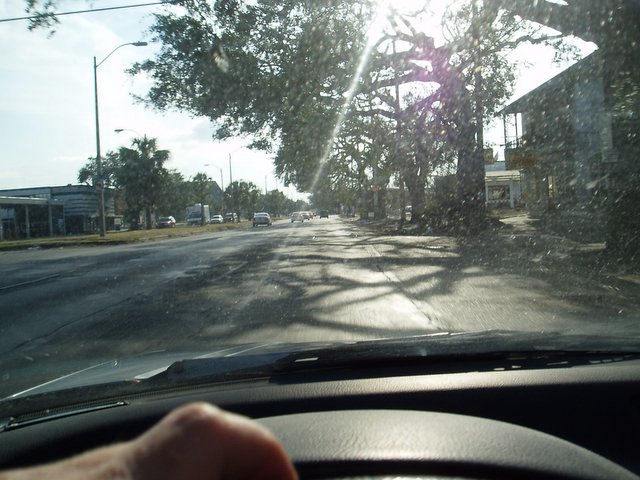
The house sported an old saloon-style (nail-hammer) piano, very dirty but amazingly in tune. Late at night, after the others had gone back to Baton Rouge & I was there by myself, I played the famous song "Can It Be"


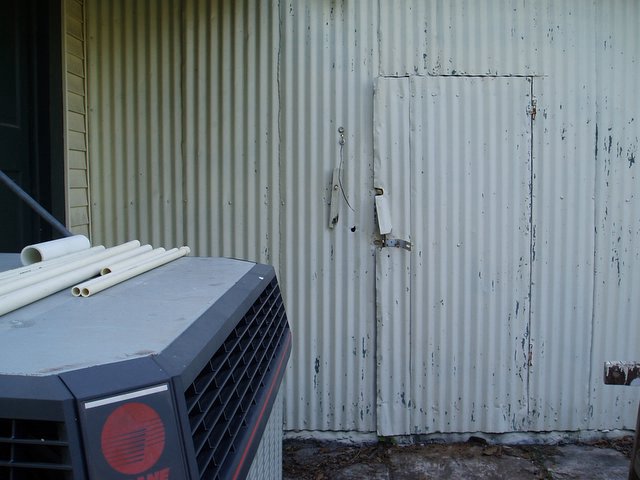

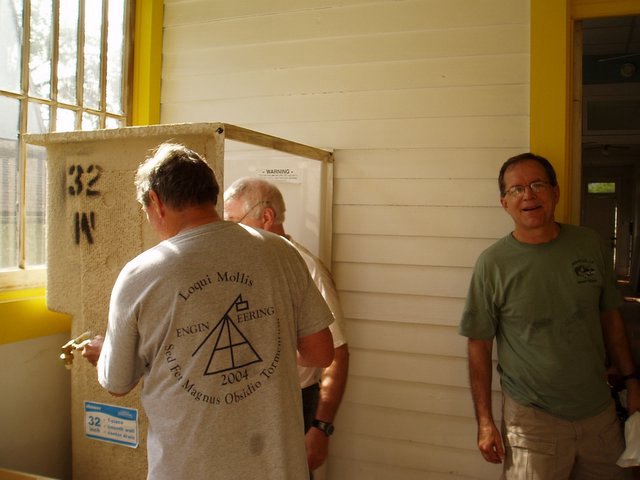
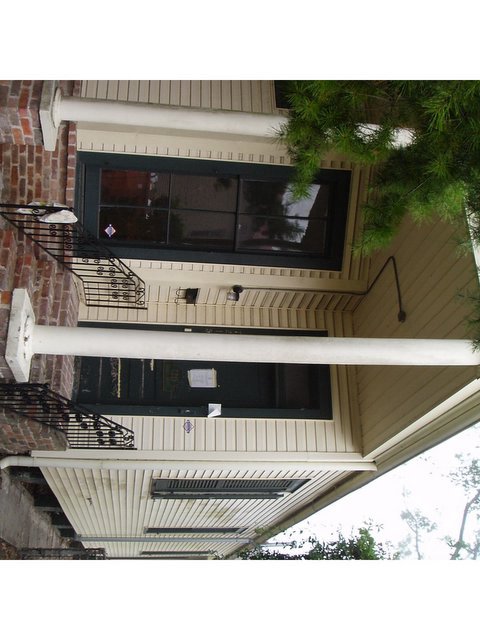
Bill & Micky, my heroes. Carpentry, plumbing, gas & electric, spiritual renewal : they can do it all. They brought so many tools that you could barely see the floor. We spent most of the week in the crawl space under the house. Before climbing under, Bill would yell : "Go on, snakes!" (water moccasins). But the only animals I saw all week were two cats.




11.03.2005
The profile on John Ashbery in this week's New Yorker.
I've said a lot of mean things about Ashbery, because he annoys me.
He looks so much like TS Eliot. Same bird type.
But I'll probably write a good essay on him one of these days, because his poetry had a mesmerizing effect on me, once upon a time, & I'm still intrigued by it all.
I note a lot of nostalgia in his writing, but maybe it's just my projection. I have a theory that the dialect of ordinariness, the overheard lingo, is actually a childhood memory of listening to his parents & grandparents talking.
Ashbery is doing a kind of sleep-prophecy, akin to Edgar Cayce. Purifying the mots of the tribu by channeling it through his tenderizer-hypno-voice.
Mississippi is to the Nile as New Orleans is to Alexandria.
This will be my first [physical] trip to Louisiana.
from The Grassblade Light:
This will be my first [physical] trip to Louisiana.
from The Grassblade Light:
 6


 Hallowed, evened out, Henry in the distance now,
 a mote in the delta.  Audacious love triangle
 twirls, treeless, on its own, an RI tangle –
 as dry leaves (spare delight) toward Salem go.


 Autumn lightning, hurricanes.  Then thunder.
 A Micmac, shadowy (through wormhole t-t-tuba)
 flows upstream – toward a salty spiral
 in the rubber barrel.  The spine goes under


 (buried sunflower).  Whose action is
 no stranger... pours forth from a window
 parallax – against complacency, woe,
 and violent paralysis.  Melchiz


 out of nowhere's whereabouts.  Stone
 vaults from mossy Mississippi lair –
 arrowheaded air headed your
 way, Hotspur Harry – your own


 land grant, swami saint – victorious
 viscous vapor eye!  Yours, the rube!
 Uppity now, mistletoed (up, stone tub!)
 Prance Petriarchy Pizzicat Nevarious,


 and regale them!  – all them,
 constant operator!  All them all together,
 veteran!  For the least fool measures
 the greeter amongst her – Miriam!


 Miracoloco!  Since Abraham Lincoln
 conned he was an Indian (check,
 by Jove) that showy Melchizedek
 has fibrillated nature's joy, my son –


 and though you rum from-toward the swine
 your pain of shame – run home again now!
 Earth hath need against this rage slow
 lights – lights, ghost!  For from brine


 of Superior comes your native wrestler,
 Jacob – as I sack your situation for a mini-
 millennial secular thanksdiver, honey:
 Massa saw!  A real Ur way trestler!


                          3.3.99
11.02.2005
Josh stands up for weak poems against all comers.
As a perpetrator/survivor of the bruising listserve wars (Buffalo, Buffalo!) I can agree that online "critique" could get very warped. It probably shares the nervous testo-frenzy of internet behavior in general.
I also think that "micro" criticism could easily get very glib & superficial. Sometimes it takes many many readings (& side-research) to appreciate a poem.
Nevertheless, I think Josh is over-reacting. For one thing, it seems to me that Jeff Bahr is exaggerating the method in order to show how it works. But more importantly, I think this kind of analysis - hopefully offered in a sympathetic & generous manner - is very useful & necessary, if it comes from someone who knows what they're talking about.
How much bad writing gets high marks from supposed mentors - for certain strategic reasons, reasons which benefit the mentor, rather than the poet? (ie. trotting through a large percentage of mediocre & bad poems actually pays the bills for MFA teachers. & you don't want to make the students feel too bad; you don't want them to lose hope for their future niche in the industry, or even drop out of the program...)
But I don't want to turn this into a slam of CW teachers, not at all. As I say - if they know what they're doing, they're actually doing a service to literature.
"Poetry should be written fairly well." - Wm. Shakespeare
Have been gleaning a little more intelligence about my trip to N'Awlins, day after tomorrow. The house I'll be helping rehab is near Tulane U. It's off by itself. It has cracked doors, windows & floors. That's about the extent of my knowledge at this point. Hoping to learn more before I hit the road.
The Triptik I got from AAA has a little note : "I-10 and I-610 through New Orleans metro area are open, but only local residents with proper identification are allowed to exit." Sounds like they REALLY value their volunteers. If you don't hear from me after the 15th, I may be a Prisoner of Big Easy.
The Triptik I got from AAA has a little note : "I-10 and I-610 through New Orleans metro area are open, but only local residents with proper identification are allowed to exit." Sounds like they REALLY value their volunteers. If you don't hear from me after the 15th, I may be a Prisoner of Big Easy.
Sitemeter tells me that HG Poetics just passed Ron Silliman on total "hits" from domestic animals. 4 legs are better than 2 (sz Mr. Ed).
Blog-grazing has become increasingly popular among farm livestock & cattle drives, according to Melba the Cow. "Visits" can last anywhere from .25 seconds (called "nips") to all-night cud-chew contests.
Blog-grazing has become increasingly popular among farm livestock & cattle drives, according to Melba the Cow. "Visits" can last anywhere from .25 seconds (called "nips") to all-night cud-chew contests.
11.01.2005
10.31.2005
Looks like I'll be driving down to the Big Easy on Fri. I've been in touch with some Episcopal church relief people down there since Katrina.
Going to spend a week or so getting a building repaired/cleaned up, to house other volunteers in New Orleans. Should be an adventure - maybe I'll come back with some pictures.
Going to spend a week or so getting a building repaired/cleaned up, to house other volunteers in New Orleans. Should be an adventure - maybe I'll come back with some pictures.
10.30.2005
10.28.2005
10.26.2005
This I like.
*
The new issue of Poetry arrived yesterday, always some kind of education.
The poetry in it, some of it quite sharp & talented. Makes me feel like a slowpoke yokel. The feeling, reading it, of an oscillation - between bright devotion to brilliant language & inventive, clever thought, on one hand, and then, on the other hand, an impression of spoiled green suburban rich kids & preppies, showing off their pseudo-experience, pseudo-profundity, pseudo-sophistication.
Poems on meditative themes : bats. wildflowers. so serious, so careful, so polished. "Life, friends, is boring."
Mr. Bones, you juss jealous maybe.
Kind of skimmed the essay by Mary Karr, on being a poet/neo-Catholic, may read it later. But I really liked the Milosz poem she quotes at the end.
10.25.2005
Jack Kimball notes amazing fact of new publication of some poems by Samuel Greenberg, very obscure New York poet, who died in 1917, at age 23, of TB, and whose work influenced Hart Crane (Crane actually stole some of his lines in the poem "Emblems of Conduct").
I have a copy of an early edition of Greenberg's poems. Once, back in the 70s, I was walking down Hope St (here in Prov.), wearing a pair of paint-spattered jeans (I had just been painting my apartment). An elderly gent, in passing, suddenly said : "A painter, I presume?" I said, "well, no, I'm a poet." He asked, "Who's your favorite poet?" Just for fun, I said "Samuel Greenberg." The fellow did a double-take. He turned out to be another Jack - Jack Birss, retired Cornell(?) english prof, rare book collector, Hart Crane aficionado (I noticed years later that he had donated a small privately-printed vol. of a couple of Crane's letters to the Brown library.) Birss knew all about Samuel Greenberg. We were both struck by the coincidence.
I have a copy of an early edition of Greenberg's poems. Once, back in the 70s, I was walking down Hope St (here in Prov.), wearing a pair of paint-spattered jeans (I had just been painting my apartment). An elderly gent, in passing, suddenly said : "A painter, I presume?" I said, "well, no, I'm a poet." He asked, "Who's your favorite poet?" Just for fun, I said "Samuel Greenberg." The fellow did a double-take. He turned out to be another Jack - Jack Birss, retired Cornell(?) english prof, rare book collector, Hart Crane aficionado (I noticed years later that he had donated a small privately-printed vol. of a couple of Crane's letters to the Brown library.) Birss knew all about Samuel Greenberg. We were both struck by the coincidence.
10.24.2005
I guess my previous post by two tends toward a sense of the poet as some kind of Suprematist/Genius/Original. But let's not over-emphasize all that (nothing new there). What I'd like to express, instead, with this notion of anomaly or originality, is the sense of, for lack of a better phrase,
some irreducible subjectivity : like the blind spot we can't see through. & art & originality emerge from that subjective area of experience, & of necessity come out original & different - because they do indeed flow from that anomaly, that uncertainty situation, that never-before-known because never before realized or existent... shadowy region, Amazon jungle, unknown...
place of creativity & poems - of chasms & leaps -
& a GPS grid simply cannot place this particular but essential aspect of the whole deal.
In order to improve on the Silliman Bi-Focal Theory of Contemporary Poetry, Robert Archambeau looks to an essay by David Kellogg.
Based on Robert's summary, however, I can't see how this is any improvement. The structure of the grid is the same, although Kellogg has added a dimension.
Poetry is assumed to be this product which flows out of culture in measurable quantities. You can establish fixed criteria for assigning individual pieces of the product to a grid : ie., "tradition" and "innovation" are already known & defined, "self" and "community" are items you can abstract without too much difficulty from any particular portion of the GNPP (Gross National Poetry Product). Voila : your poet is assigned a critical niche in the Standard Schema.
But what if the patterns of formative imitation which poets utilize are exactly the same - whether you're in either of the so-called camps? Innovators are imitating their 20th-century models; traditionalists are doing likewise. Both are claiming the mantle of tradition (the traditions of new & old, respectively). Add a further twist : what if the innovators claim to be new by going back to older models (epics, Native American songs, collective poetics, performance art, etc.) in order to be "new"? What if the models of the so-called traditionalists (rhymed iambic couplets, say) are of more recent provenance than those of the innovators (say, free-verse anaphoric lines)?
The fact of the matter is that originality is not informed by the artist's attitude toward stylistic change. In other words, there is no "new" model for imitation : every model - by virtue of being a model - is already traditional. Who is more traditional today than the poets who imitate the 20th-century avant garde?
[p.s. this statement needs refinement. Let me say this : actually, the original, inventive poet will pay very close attention to stylistic developments and what they might mean. But what makes for originality is not their capacity for consistency - ie. the consistent allegiance to whatever is considered the trend of the moment. Original poetry is invariably anomalous : it is original precisely because the poet does not "follow" any particular trend. Thus critical schemas which emphasize such trends, based on abstract invariables such as Kellogg proposes, inevitably distort the un-paraphrasable, empirically-complex literary reality.]
The issue of "self" & "community" is perhaps even more vexed, but I'm not going to get into that here.
I object to the abstract, generic quality of the grid approach to criticism. It's lazy thinking : pigeonholing, card filing. The uniqueness of interesting poetry swallows up every proposed schema : the talent of the great & gifted poet takes a certain essential aspect of poetry - its capacity for obliterating and transcending our habitual mental & philosophical categories - and multiplies it exponentially. Individual poets are always contradicting so-called trends & traditions : & then the new supposed traditions are established in their wake, by their imitators; & then, running a distant third, the critics come along with their cute little diagrams.
Even those poets who seem so middlebrow, mediocre, unable to escape the cliches and paradigms of their period styles - say, Longfellow, considered from the usual 20th-century perspective - if looked at closely and carefully, suddenly begin to reveal their inimitable qualities, their uniqueness. & then it's time for "reconsideration" : critics, prepare your outlines!!!!
10.23.2005
More drafty drafts. I hope it lasts.
1


The dogwood leaves, suspended in the rain.
Clumps of drooping flesh-tones - treeflesh
(muted green, vermilion, purple, rust).
I'm whispering toward you again.


                  *


In the silence of his study, Lazarus
Posthumous leans close to the windowpane.
The glass harbors a cool gray sheen
from autumn sky (a harbor's emptiness).


His body is the dogwood's double.  And
the window only grows more destitute as
winter draws nigh - cold, dark.  It is
the entrance to a tunnel.  Its command


a stark inscription : Here Descend.


2


The last bumblebee totters unevenly
through backyard jungle grass.
The little garden is a tangled mess
of dried-up stalks, vines, leaves


where sodden rags of an absent-minded
hurricane (the last of the cloud outriders)
spit their loads again, soaking the weirs
to the flood-brim.  The storm never intended


to hurt anyone - the storm never intended
anything at all.  And now the bumblebee
has vanished into his green and tiny
Amazon.  Only starlings chortle overhead,


settling in crappy treetops, ratcheting
their raspy, cackling complaints, then
moving on.  The homesteaders gone too -
summer's yodelers, warblers, who sing


themselves a cozy territory (comfortable,
responsive, mild).  Lazarus faces cold.
The mellow season's growing old
and gray.  Wind coils through the stubble.


3


The rainsoaked ground, the windswept sky, heaven
and earth exact their retributions.  The grass
withers with a whisper across vast prairies
of catastrophe.  Yet what has not begun


is yet to begin - even tonight, maybe.
The gift for which you did not dare to ask,
the phone call in the night (from Alaska,
say - Saskatchewan), the whorl of a stormy-


tender fingerprint.  The human trace
a network penetrating to the roots
of time, space... where love waits
in a threadbare lair (for your embrace).


4


There once was a man, whose bones
were never found, collected in a lead-
lined box, a box that was lost when the dead
man's grave was exhumed : Blackstone,


William Blackstone.  Whose bones in a box
were dug up for a shopping center
(the first American shopping center)
and lost somewhere (bones among rocks).


And Lazarus Posthumous found them;
found them in the dead of winter, in a cave,
in a mirror, in his mind.  When you have
a lead box full of whitened bones, Sachem -


a whited sepulchre, O Chief - you have
November coming in a costly casket,
autumn encapsulated, life's biscuit
in a basket - ocean in a wave (goodby).
10.21.2005
I have a lot of trouble telling the difference between Professionals & Careerists in this picture. Most of the hype is generated by professional careerists, whether they have MFA-type academic jobs or not.
Both need very much to get published, because they've been writing very hard for many years. Best of luck to them, I say. A lovely tree awaits your sees n' saws.
What this tells you about the quality of their poetry is not much, one way or the other.
Kind of similar situation with the SoQ/Post-Avant descriptor. Basically, it gives acquisitive collectors a handy cubbyhole for their collections, and loud trumpeteers a special key to punch on their polemic-horns.
10.20.2005
I'd hate to give the soggy impression or do the saggy impression of some neo-bowtie stuffed shirt pseudo-critic. Hey, no way. It ain't me. Please you gotta believe me!!!
What I meaneth to suggesteth, ladies & goons, is that :
1. despite the fact that good art always transcends simple categories & critical abstractions & nostrums & such : even if & as it hews most faithfully to the generic requirements of certain traditional forms;
2. and despite the fact that our unprofessional off-the-cuff impressionistic personal insights & comments are of far greater practical & humane & spiritual value, generally, & usually, than systematic critical werke, generally;
3. nevertheless, there is a place for calling things by their right names, according to an open & explicit set of premises & postulates, designed by the professional critic, to establish differentiae of judgement : because such creative critical labor has its own proper sphere & center of gravity; & because, paradoxically, establishing such differentiae can help us to see, sometimes, how individual works & artists are part of larger ongoing communal projects & traditions.
Thus indie-crit, as I useta call it, is one way to comprehend (through one critic's sense of taste within a partially-perceived scale of universal aesthetic & ethical values) the equality & kinship of something we sense as the Beautiful - across vast variations of style & cultural background.
very interesting article on poet/conservative thinker Peter Viereck in this week's New Yorker.
*
Mark Scroggins on the old-style divide. One aim of the mini-essays I've been writing is to underline the difference between opinion (personal likes/dislikes, lacking any apparent principle of judgement) and criticism (in which ethical & aesthetic principles are somewhat clarified).
*
Mark Scroggins on the old-style divide. One aim of the mini-essays I've been writing is to underline the difference between opinion (personal likes/dislikes, lacking any apparent principle of judgement) and criticism (in which ethical & aesthetic principles are somewhat clarified).
10.17.2005
10.14.2005
In the twists & turns of the argument of Whittling, Whistling, I'm actually trying (among other things) to make room in the "theory" for modes of didactic, satiric poetry. Discursiveness, direct address. It may not seem that way... I may not have been very clear.
The idea is that these particular forms of poetry (along with all the other forms & modes) reflect the theatricality of poetry in general. I'm saying poetry & poets are inherently dramatic (hence the emphasis on those attributes noted by Aristophanes). That's why I call poetic language itself the main character, the protagonist : an exaggeration, meant to underline how the medium shapes the message.
The idea is that these particular forms of poetry (along with all the other forms & modes) reflect the theatricality of poetry in general. I'm saying poetry & poets are inherently dramatic (hence the emphasis on those attributes noted by Aristophanes). That's why I call poetic language itself the main character, the protagonist : an exaggeration, meant to underline how the medium shapes the message.
10.13.2005
Added an old review of Edwin Honig's collected poems over here. My apologies to those who have read this before. The thread of thinking about poetry's dramatic aspect brought the review to mind.
10.12.2005
10.11.2005
What's an essay for? asks Jordan.
I'd like to write them in order to precipitate out some of the jumbled thoughts I have on these poetry/poetics conundra. & by putting them in more formal language, make them more accessible to those outside the day-to-day po-blog conversations.
For example, with regard to the string of rambling comments I made earlier here on the issue of poetry & its ideological/critical paraphrasement. It's possible the Andrew Ford book will provide me with a sort of background with which to come to terms with all that.
Ie., perhaps poetry's janus face - 1. self-standing art-form, craft; 2. social/civic performance, political occasion - can be re-interpreted, without favoring one side by dismissing the other. Perhaps its a more complicated, interesting symbiosis. That would be a topic to "essay".
Reading more in the Andrew Ford book. The tension between literacy/text and oral poetry, back in old Greece. A lot of curious poems about statuary & funerary inscriptions (Simonides, Pindar...).
Funny when I think of my own recurrent floundering over the years, between writing & music, poetry & rockn'roll.
Funny when I think of my own recurrent floundering over the years, between writing & music, poetry & rockn'roll.
10.10.2005
the curious thing here, for me, is again RS Crane's insight : that Aristotle's notion of such "self-standing" aesthetic form is not really text-based, but follows from an idea of the "poem" as an amalgam - a whole (which is not the same as its text) made out of time, action, suspense, character, spectacle, music, diction - all combined.
I'm reading Ford et al. to explore how other genres & modes of poetry relate to, stem from, this same action-performance nexus.
I'm reading Ford et al. to explore how other genres & modes of poetry relate to, stem from, this same action-performance nexus.
Following along on my Chicago School sea-lurches. Came upon another study - The Origins of Criticism, by Andrew Ford (Princeton UP, 2002).
RS Crane & the Chi-towners pointed to a dissonance between Aristotle's sense of dramatic form in poetry, and what came a little later, in the text/rhetorical emphasis of Alexandrians, Horace, et al.
What I'm getting from the Ford book (just on intro chapter now) is that the formal approach of Aristotle was a sort of culmination of a much earlier trend out of archaic times : moving from strictly oral performance and in situ, collective critique (in festive symposia - dinner & drinking feasts - verbal contests - early "slams"), toward literacy, reading & texts (when song & speech become "poems").
Aristotle's Poetics, while being as I mentioned the summation & foremost example of that new trend, still exhibits the traces of the earlier cultural situation.
Ford is interested in the difference between the later textual criticism's sole focus on aesthetics, and the traditional-archaic focus on the moral & social fitness of the speech. We can see this same dynamic (aesthetic autonomy, social relevance) playing out in debates about contemporary poetry.
The focus on the interior rightness of a text began early - Plato has a famous passage in the Gorgias in which "speakers are urged to follow painters, builders, shipwrights and other craftsmen who construct self-standing objects by 'compelling one part to suit & fit with another'" [Ford, p. 20].
self-standing objects. the advent of writing - & shipwrighting.
10.07.2005
at one extreme, the solitary hermit/visionary/prophet. the scholar, the scientist, the sage. the light of contemplation.
at the other extreme, the song & dance, the give & take of communal festivals. the physical embodiments of harmonious nature. earthly delight & fellowship. music.
the poet's word occupies a middle ground, mediating between the two. the pleasure involved in surmounting aesthetic difficulties, meeting artistic challenges, solving puzzles & problems. bringing order to chaos and freedom to order; uniting contraries; taking pleasure in judgement & necessity (tragic mimesis).
Pindar, for example. or Sophocles.
Checking into some books about sources of poetry & criticism in ancient Greece. Andrew Ford, Origins of Criticism. In the intro he discusses the oral performance/communal culture out of which "professional" criticism evolved : song recitals were social gatherings, & criticism & comment were part of the occasion itself. Shows examples of this from Homer & early literature.
Aristotle was at the beginning of one era, but at the end of another, too. The archaic one shows some fleeting similarities with contemporary poetry culture (cd's, music, reading jaunts, tribes, etc.).
& perhaps Aristotle's structural analysis of mimetic, performative poetry reflects that earlier culture in a way which the (cf. R.S. Crane) Alexandrian, text-based, rhetorical mode of criticism does not.
I've started a new blog spinoff, called HG Essays+Reviews. The first entry in what I hope will be an ongoing series is titled A Note on R.S. Crane.
10.06.2005
Needless to say, you gotta read da book to get da full treatmemt.
RS Crane quietly, succinctly surveys the last few many hundred yrs of poetry criticism, & finds that, despite all the excellencies, dey most of em summat missed the point.
Poetry remains an undiscovered moon.
Here's the conclusion to the section I quoted earlier:
"It is easy to see, therefore, why the critic who uses this language is necessarily restricted, in his selection of attributes for poetry or individual poems, to such characteristics as have clear counterparts or logical contraries in the non-poetic discourse which he takes as the other term of his comparison. This is not to say that the method is incapable of differentiating poetry, as poetry, from other things or of serving as a basis for practical criticism of a highly particularized and perceptive sort. It is, however, to say that the discriminations it permits between poetry and other forms of writing or between the various kinds of poetry are such - and such alone - as can be arrived at by asking what characteristics among those possible in discourse are here present and in what special modifications and combinations. It is not a method, in other words, that allows the critic, as Aristotle's method does, to consider poems in their peculiar aspect as distinct kinds of concrete wholes, of which the special character, as poetic wholes, is determined by internal principles of construction that have, at least as far as imitative poetry is concerned, no strict parallels in philosophy, science, rhetoric, or history." [pp.93-94]
"Jane" has some current thoughts related to this stuff.
Poetry certainly provides food for thought. What a criticism along the lines I'm mulling over here would do, though, is investigate & evaluate the poem as food-source rather than meal : the poem as many-sided living something. As evocative, resonant art-action-work.
Aristotle, according to RS Crane et al. anyway, offers some neglected tools for doing that. Neglected in part because of the critical assumptions (blinders) he outlines in the chapter I just quoted.
Here is a long quote from one of the summary-transition paragraphs of RS Crane's book. I think even without the examples & evidence he offers, you can see how the kind of a priori -theoretical "discourse-application" method he describes, sounds very familiar to us. This relates very much, I think, to what A. Mlinko was getting at, with regard to the problem of reading poems as extrapolated "arguments".
On the other hand, Aristotle's notion of [& method of investigating] an intrinsic, special structure & form of poetry, as "imitation" rather than as verbal discourse, holds, as I have been saying, some serious potential for the reception & interpretation of present-day poetry.
RS Crane, The Languages of Criticism and the Structure of Poetry (U. Toronto Press, 1953), pp. 88-89:
"It is thus correct to say of these other critics, as not of Aristotle, that poetry exists for them primarily in a "verbal universe." And this fact has consequences of the greatest importance with respect both to the principles on which their criticism is based and to the method by which these principles are discovered and applied. The principles of poetics, for Aristotle, we have seen to be principles peculiar to the art of poetry, as the distinctive art of "making" or "imitating" human actions and other experiences in words, or to one or another of the various poetic species; they are identical with the necessary and sufficient internal causes, or principles of construction, that must operate in the writing of a given poem if it is to be a beautiful whole of the particular form desired; they vary accordingly from species to species; and they can be discovered only by reasoning a posteriori from the inductively known nature of any given kind of existing poems to the conditions of artistic success or failure in poems of that sort. For the critics in the second tradition, on the other hand, the principles of poetic criticism are necessarily specifications of principles operative throughout the field of writing as a whole. The basic principles of poetry are therefore identical with the principles basic to all varieties of verbal composition; and of these the most basic, as Quintilian long ago remarked, are the two elements without which purposive speech of any kind could not exist - res and verba, things and language, a subject and the words in which it is expressed, a content and a verbal form; after which the next most important, in any discourse that goes beyond a single utterance, is arrangement. If poetry is to be studied in terms of its character as discourse, in a context of other modes of verbal statement, these are indeed the primary elements to which the critic must refer and upon which he must build - as the modern critics I have quoted clearly do - in his efforts to say what poetry is as a special mode of speech, to discriminate its possible kinds, or to determine the standards upon which it is to be judged.
"They are, it will be noted, the elements which Aristotle distinguished for rhetoric rather than for poetics, and hence, as principles of poetry, they are essentially reductive, in the sense that, unlike the distinction of object, means, manner, and "power", which applies only to imitative poems, they tend to assimilate the structure of poetry to the structure of any discourse, however "unpoetic", in which we can discriminate aspects of content, language, and arrangement. It is necessary therefore to look for other principles through which the meanings of these basic terms (and especially of the first two) can be so specified as to give us a distinctive subject-matter for the criticism of poetry; and this is what the definitions of poetry I have quoted and the many others like them in this tradition are designed to do. They are based on the assumption that poetry has no intrinsic nature such as can be known sufficiently by an induction of the conditions essential to the production of poems as special kinds of wholes but is something that participates, with a difference, in the nature of discourse in general, or rather what is taken, hypothetically, as the characteristic of discourse in general which appears to illuminate most satisfactorily for the critic the problems and values of poetry. This characteristic once selected, the next step is the determination of appropriate differentiae; and from the hypothesis thus formed the critic can then derive, by dialectical necessity... all the more particular terms he needs for the discussion of poetry and poems."
Crane & Olson. But a different C & O.
(As I've noted before here someplace...) I was reading a monograph on Aristotle when I started Stubborn Grew.
Helped me add sort of an introductory echo effect (talking, in the poem, about what the poem was going to do).
(As I've noted before here someplace...) I was reading a monograph on Aristotle when I started Stubborn Grew.
Helped me add sort of an introductory echo effect (talking, in the poem, about what the poem was going to do).
Looked again (on coffee break) into RS Crane, Languages of criticism and the structure of poetry (U. Toronto, 1953). This is the real deal, esp. the third essay ("The languages of contemporary criticism").
Seriously, this will change your way of seeing things.
If I have time to quote some passages, I will.
Aristotle saw things differently.
Crane shows how the standard method of 20th-cent. criticism was so pervasive, you couldn't se that there were other approaches.
The standard method assumed "poetry" is one big thing, a kind of discourse, and you defined "it" by differentiating it from other kinds of discourse (but all these kinds are still cousins : all "discourse", "language-usage").
Aristotle saw these very unique & specific activities which people did which came to be called "poetry". Tragic, comic, epic were sharply differentiated from one another, & from other genres. They weren't "modes of discourse" : they were forms of an art of imitation.
Then he investigates their structure & shape, to discover how they create that specific power & beauty he calls "imitation".
I'm really not succeeding here in transmitting Crane's very valuable insights.
The "art of imitation" (in dramatic/epic poetry) is structured, not with discourse, but upon the armature of plot.
[I know I'm repeating some things I tried to describe a few months ago. I'm just going back in that direction.]
Sorry for the long-windedness yesterday. Looks now like a hodge-podge proto-essay, which somebody else will write if I don't get crackin'.
& the "list of paradigms" is not very gripping, much less complete. I'm going back to RS Crane's book Languages of Criticism and the Structure of Poetry.
As I was taking my shower this morning, was thinking that the real focus of interest for me here, what woke me up at 3 a.m. the other day, was this :
By going back to Aristotle, the Chicago people found a way to re-frame a formalist criticism (ie. one that focused on what & how the poem does what it does - as opposed to thematic or other kinds of readings). Instead of reifying the poem in isolation - a la New Criticism - this framework creates a holistic sense of poetic form : not only text, but performance; not only an internally-balanced aesthetic object of beauty, but a dramatic shape, which has specific techniques for creating particular rhetorical effects and evoking particular responses in its audience (emotional, interpretive).
Not only text, but living expression - an offshoot of the living poet & his or her dramatis personae. (Goes back to places in this blog's archive where I thought about the difference between prose fiction & poetry.)
This is not really new : Horace developed a practical criticism which analyzed the poem's rhetoric. But Aristotle seems more fully-rounded : he can distinguish these rhetorical effects, yet in symbiosis with the analysis of the poem as a formal shape, a kind of verbal sculpture.
What I'm thinking is that a framework which includes both text & performance - both objective shape, and its effects, its resonance - could be generated as kind of a general platform for developing a new critical vocabulary to apply to contemporary work.
When you look less to the model of New Critical "close reading" of the internal texture of the diction, and more to the meanings and effects projected in the dramatic action which is the poem, you might find a more capacious fit between meaning & expression, style & its effects.
With some such framework, you might be able to talk about the seemingly odd & baroque expressive techniques of contemporary poets, in a way which shows their affinities, differences, inheritances from past poetries.
& it might give poets more confidence in the motivations which impel them to offer their artistic activities as some kind of contribution to society at large. If poems are art works - not texts to be "processed" into their ideological paraphrases; not exercises in some dys-Platonic scriptorium, but forms which absorb text, in order to unite writing with dramatic presence - we might have a new sense of the symbiotic relationship between style & theme, between diction & Aristotle's trio of powers (ethos, pathos, logos).
10.05.2005

Here's a paragraph from the conclusion of Olson's "An Outline of Poetic Theory":
"Thus far we have proceeded on the supposition that the imitative poetic arts have as their ends certain pleasures, produced through their play upon our emotions. Certainly, these are ends of art and such as any consideration of art must embrace; but to suppose that art has no further effect and that it may have no further ends relative to these is vastly to underestimate the powers of art. It exercises, for example, a compelling influence upon human action - individual, social, or political - for among the causes of the misdirection of human action are the failure to conceive vividly and the failure to conceive apart from self-interest; and these are failures which art above all other things is potent to avert, since it vivifies, and since in art we must view man on his merits and not in relation to our private interests. It is not that art teaches by precept, as older generations thought, not that it moves to action; but clearly it inculcates moral attitudes; it determines our feelings toward characters of a certain kind for no other reason than that they are such characters. The ethical function of art, therefore, is never in opposition to the purely artistic end; on the contrary, it is best achieved when the artistic end is best accomplished, for it is only a further consequence of the powers of art. The same is true of any political or social ends of art, provided that the state be a good state or the society a moral society. To reflect on these things is to realize the importance and value of art, which, excellent in itself, becomes ever more excellent as we view it in ever more general relations."
"Thus far we have proceeded on the supposition that the imitative poetic arts have as their ends certain pleasures, produced through their play upon our emotions. Certainly, these are ends of art and such as any consideration of art must embrace; but to suppose that art has no further effect and that it may have no further ends relative to these is vastly to underestimate the powers of art. It exercises, for example, a compelling influence upon human action - individual, social, or political - for among the causes of the misdirection of human action are the failure to conceive vividly and the failure to conceive apart from self-interest; and these are failures which art above all other things is potent to avert, since it vivifies, and since in art we must view man on his merits and not in relation to our private interests. It is not that art teaches by precept, as older generations thought, not that it moves to action; but clearly it inculcates moral attitudes; it determines our feelings toward characters of a certain kind for no other reason than that they are such characters. The ethical function of art, therefore, is never in opposition to the purely artistic end; on the contrary, it is best achieved when the artistic end is best accomplished, for it is only a further consequence of the powers of art. The same is true of any political or social ends of art, provided that the state be a good state or the society a moral society. To reflect on these things is to realize the importance and value of art, which, excellent in itself, becomes ever more excellent as we view it in ever more general relations."
So let's cut to the chase here, Hank - what's it all about, this rambular delving amongst the Chicago School tie?
As my better Ange is choristering over there today, in the same key with my squawks - it has to do with a search for a descriptive language for what poets are doing (today). A context.
Poetry reviewers do this naturally - improvising, more or less. But how to picture the wide-screen hysterical landscape?
Rather than put the poem in a bottle of battling-balancing textual forces (New Critics), or read poetry in terms of some other (non-poetic) level of critical discourse (everybody since 1975, more or less), the Chicago critics developed a formalist criticism : the formal terms of which, however, open out toward the wider, deeper connotations and consequences of art.
The history of American poetry/poetics for the last century takes an hourglass shape. The early moderns blew the top off the bottle of style, diction, form, et al. Eliot, Pound, Cummings, Stein, etc. etc.
Toward mid-century, the bottle narrowed into the methodological funnel of the New Criticism : poem as self-contained object.
Just at mid-point, the glass began to bulge out again : Projectivists, Beats, Life Studies, translations, free verse, & so on toward the open-ended flarfy fin-de-siecle.
When Elder Olson, RS Crane & the other Chicago critics began (toward mid-century) to differentiate themselves from the New Criticism, I think they discovered a useful set of "paradigms" (my very partial unofficial paraphrase/list) :
1. Critical pluralism allows many approaches & methods equal validity : walk in fear of over-extended critical universals (misapplied abstractions & categories of judgement).
2. Poetry is not described or defined simply by an analysis of diction or verbal texture. The words are not the form, but the material : the wood which takes the form of the toy ship.
3. Said form includes the cognitive and emotional resonances felt by the poem's readers & audience (ie. the "action" of the poem is not merely autotelic, self-contained, self-reflexive. It has measurable aesthetic consequences & contexts).
4. It's possible to distinguish aesthetic methods and effects, in the process of responding to & interpreting a poem's meaning(s), purpose, motive, impact, etc. & this seems like a sensible place to begin, since a poem is, first of all, a work of art.
2 essays which focus most directly on these issues are by Elder Olson (in the volume Critics and Criticism, ed. by RS Crane):
"An Outline of Poetic Theory"
"William Empson, Contemporary Criticism, and Poetic Diction"
another interesting background find in my digging around the Chicago School.
The trouble with this argument is that the aesthetic is simply evaporated or absorbed by the ethical.
Sure, criticism should investigate & evaluate the ethical aspect of works of art - no doubt about that! But a work of art sheds light on moral issues by means which are aesthetic. Our response, & its purpose, are an indivisible synthesis of the two (aesthetics & ethics). Yet, by the same token, the aesthetic criteria of beauty are not measurable using ethical categories (wouldn't 'Arrystotle agree?).
In order to forestall some objections to previous post:
Simply to name something a symptom rather than a cause is only a beginning, obviously; otherwise, we're just playing with words, setting up another supposed defensive barrier for our aestheticism.
Social conditions are in part the result of political platforms & programs, which themselves project from ideologies & worldviews. When you see suffering & injustice & social pathology, the moral thing is to seek the right name for the problem & take positive political steps to correct it.
The 20th century was, for one thing, a worldwide laboratory for testing policies and programs at all levels of government; for every problem there's a program (except in many cases the right idea & the right action have not been invented yet). If you believe in government control of the market, you can advocate for that; if you believe in dog-eat-dog Darwinism and the inevitable failure of all public problem-solving initiatives, you can advocate for that; if you believe in a symbiotic balance between government policy and private initiatives, you can work for that; if you see consistent oppression of the poor & exploitation by the rich, if you see multifarious attacks on public governmental authority on behalf of powerful private interests, if you see egregious fraud & greed in high places, you can take action, participate in the political process.
No one is inhibited from political activity of some kind. But it's not the same thing as artistic work. Again, in the last century, we witness the swings in critical (& artistic) attitudes, from attacking art (for its indifference to social problems) to defending art (for its unique values) - like a constant pendulum channeling the inherent outrage & frustration with exigent reality. The consequences range from blaming the victim (artists themselves) to defensive camouflage ("political" artists) to aggressive indifference ("art for art's sake").
"Political" artists make poetry out of theoretical-systemic solutions - verbal abstractions - applied to ornery, many-sided, complex, intractable problems. (cf. Ange Mlinko's comments about the tendency to interpret poems as paraphrases of political arguments.) For the ideological poet, everything is grist for the mill : there's such heroic poetry in Utopia!
But just as our experience is a many-layered reality of symptomatic fault lines & corrosive chaos (not always amenable to simple "translation" into verbal signs & systemic solutions) - so the complex pleasure/insight amalgam of the art work offers pathways to draw closer to it : offers an image of it which we recognize as authentic.
I think Ange Mlinko is thinking along an adjacent meander this morning (see her comments on political reactivity-response).
"If there's a solution to this quandary, it lies in treating poetry
other than as a vehicle for argument. Matisse was not a decorator
of living rooms; he was a painter solving painters' problems. What are
poets' problems -- that is, ours alone?"
"If there's a solution to this quandary, it lies in treating poetry
other than as a vehicle for argument. Matisse was not a decorator
of living rooms; he was a painter solving painters' problems. What are
poets' problems -- that is, ours alone?"
Digging around for more background on the Chicago critics, came upon this excerpt from Richard Ohmann (1976).
I can't pretend to be much of a lit historian, but this essay seems to appear toward the beginning of another generation of radical critique, based on a Marxist interpretation of culture. Ohmann seems even-handed & careful about New Critics, interesting overview here of the mid-century theories about nature & purpose of poetry.
Have trouble accepting the underlying premise, however, which seems to be: that social injustices are systemic in nature; that we understand what that system does; that the intellectual classes, the bourgeoisie in general, create their own self-protective ideologies which blind them to reality, etc. etc. [Here we note the parochial bias against business, entrepreneurialism, individual & family enterprise - all those economic activities which structure much of past & present world social economy.]
I don't deny the pervasive & insidious presence of injustice & evil. Nor the forces of conformity & exploitation which structure & process the social reality we inhabit. But I question whether the appropriate interpretation of this reality is a purely econo-political one. That is I think of injustice and inequality - & the seemingly entrenched patterns of oppression which they assume - as symptoms, rather than causes.
Taken as causes, the logic leads to the denunciation of bourgeois property rights, capitalism, the rule of law, democratic institutions, private enterprise, and so on; it leads to the moral disenfranchisement of independent cultural activity (academia, art, literature) - its chastisement for complicity in the "system" (cf. Ohmann's analysis).
If taken as symptoms, the entrenched injustices and inequalities of various nations & societies may have very different systemic shapes & developments; there may be no simple "answer" (Marxist, socialist, nationalist, ethnic, religious, etc.) which provides utopian solutions to the underlying causes : ie. the greed, selfishness, bigotry, aggression, malice, hatred, cowardice, fraudulence, intellectual/moral blindness of human beings, persons, individuals.
Understood this way, we might recognize the ethical value which sometimes accompanies (& enhances) those independent (semi-guilty) aesthetic pleasures & enjoyments (of various degrees of intellectual insight & innocence) which we give & take - in the midst of social corruption, injustice & cruelty. It's a value contained in the moral representation of realities for which we have no simple, abstract, systemic solution, no bureaucratic assignment of moral duties. This is a value in addition to the natural & inherent values offered by beauty in general.
10.04.2005
more floodwaters from July:
 2


 Gray clouds like a heavy wave across the sky.
 Washing over the last of the reddish-gold
 maple leaves.  Mysterious, water-logged
 Thanksgiving – quiet, solitary.  Aches


 it, perpetual.  Slowly.  Slow mist of soul –
 almost medieval, out the cool window.
 Distant sound of Flemish dancing, down-
 wind.  (Through the mirror's modest pulse.)


 (Blurring.  Astigmatism.)  The distance...
 in Louisiana... in a wide flat space,
 uttering joyous leaves...  it seeps
 like a woodland scent.  Standish?


 John?  Speaking for yourself?  Or maybe
 turpentine, or linseed oil?  Solitary
 Harry the Minnesota turkey rattles
 pardoned neck-whiskers a-beam


 the Presidential podium, today.  Today.
 Heavy roasting odor hangs in the quiet air
 of empty streets.  A green spar, or sprig
 in the lonely room of one gray doting


 solitaire, uttering a different scent
 (oak sap?  Sperm oil?).  Today, knave –
 in an old house in Paris, covered with vines.
 Taste and see, crumblette.  River-nets


 and trawlers – nascent Crescent.
 City.  Rio del Espiritu Santo.  Flows
 one Mardi Gras, 300 years ago – wolfs
 down your flood of tears – one tessera or


 tesseract.  One cataract.  One dome
 petrified, and buried in your muddy delta
 being born, borne upside-down – an addled
 ark, ancestral crossroad – mode


 of darkened prairie – storming sky
 gone black.  Pitch-black.  And winded.
 In your mother's living room – painted node
 of bent grass, purple air, skewed sticks


 of weathered telephone poles, still standing.
 Empty meeting of two roads – three –
 in the presence of the wind only – earth
 droning, murmuring – under a distended


 whining, whistling – call put through too late
 to nobody – bent vertical, invisible there
 in the frozen painting, at the vortex – ether
 calling – switchback – rattler's tale.


 Where the serpent curls in the headwaters.
 Where the alligator opens wide the gates
 of ivory, and all the mistaken messages – Tagus,
 Thames – Neva, Yangtse – the whole tawdry mess


 merges – emerges – spread and disappear...
 bobbing, soaking, sinking – papers, cigarettes,
 summer nightloads of confederate rags,
 money... toiletries and crockery-of-paradise,


 the whole production... handicraft, hand-painted...
 as though the scattered basketry of breezy
 implausibilities – mere silverfish zebra-
 script – tongued a J2 temperate


 perfected buoyancy – your oh and ah
 along a London flank – Finnish, complete
 and seaworthy – a curious token temple
 of adhesive animale compagnevole –


 the cup or crown of long-forsaken Baptistry.
 Longing through the serpentine meanderings
 to the spread-wide grand finale of a Mardi Gras
 out of Lenten snowfall, backward, forward – stippled


 beast, graven, to apple-pied, applied
 beatitude – Jonah to Joan in
 an arc or surge of stone-dislodged
 desire, afloat now, Archimedean –


 you reckon, Huck?  – you see-saw, Jim?
 Acrest to the brim of your Shakespearean
 deluge-dodged mad-hatter's reaper's
 close-shaved bardic midget's


 gunnelled whaler's rim-rhymed absoluted
 Absalom, my boy!  And they whispered
 under the hanging moss, among the wide-spaced
 live-oaks, drifting with the curving tumbles


 of the banks, rafted and bound together,
 logging the current and the depth
 with little stones – their pithy thud
 sounding token icons, registers


 of greater gulfs – further up ahead, downstream.
 Mica and aluminum, pings in the soil –
 bubbles in the level.  Gneiss loss -
 binoculars (measuring a missing distance).


 Just the words, the symbols, the shapes themselves,
 shadowy inscrutable and serene, against
 that turgid background of a... bloody
 mischancing of human affairs.  Vikings and


 Dallas Cowboys...  Lincoln saw ahead,
 LaFarge, Degas (fils de New Orleans) –
 beyond the blue-gray looming snarl:  blagodar-
 nost (mingling with blood and oil).  Anointed


 stonemason geysers from the throat
 with nadezhda – all across black
 44.  Odessa jail – pale in a cab
 in Brooklyn - theater of troth


 bonded with a bondsman's muscled arm:
 yea, though I walk through the valley of death
 – psalm, solemn love-bubble, thread
 of overflowing burst from Roman


 candle's bronzen breast-coccoon:  another
 fluttering monarch of my soul (meek
 Indian summer colors – merged akme –
 Sumerian marks and crane bone theremin).


 Oswald fingered a Cuban .44, scrawled
 limply, languorous.  Sport of nature (sick, ef-
 feminate f.m.c., flushed under a doctored kiss).
 Democracy (grand seeming, scheming:  reckless


 gamblers:  emboldened lambs).  In Creole
 haunts, headwaters mingle with the ghosts
 borne slowly (through a muddy All Souls'
 mist) into the gulf... one live-oak leaf.


                              11.25.99 (Thanksgiving)
just got back from Kent Johnson & K. Silem Mohammad reading, downtown. should have hung around to say hello to Kent, at least, but was feeling shy & unsociable. spoke to poet Karen Donovan there, & CD Wright, briefly (we talked about Angola prison, near New Orleans). shook hands with friendly Michael Gizzi.
enjoyed hearing them - maybe write more about it tomorrow.
Kent's poetry projects a lot of heart & emotion - but at a slant, in a game. His clear unaffected writing style is a good vehicle for the larger set of weird rhetorical fun & games. but people miss the heart part, perhaps.
sometimes he does understatement very effectively : other times he could use it more - like when he (unfortunately) hammed up the Jaime Saenz translation he read. that should have been done in understatement.
the broad strokes, the hammer-blows - say in the Abu Graibh poem - might be looked at as coming out of Hispanic rhetorical tradition he's familiar with, but we're not so used to. but it was appropriate to the situation (ie. the prisoner abuse)
Kent has a real inventiveness, a particular scene-setting talent, that blends so well with the directness, the simplicity of his sentences, his style. it makes for dramatic poetry. unusual in the arch atmosphere of post-avantism. he can write political poems.
(nevertheless the recurrent obsessional object - insider po-biz culture - is not really worth the excessive obsessiveness - tho it makes a nice target for satire sometimes, I guess)
I liked Kasey's "Forest Ranger" poem best, tho even in that the comic persona was a bit derivative. It was very funny though, I was laughing away.
Otherwise the poetry didn't interest me too much, the flarf in-your-face too baroque for my taste.
I like quite a bit of the new Poetry issue. Don't have it in front of me, so can't say what.
the Don Paterson "aphorisms" - clever, but tending toward the painfully sour.
enjoyed Garry Wills essay on translation of Grks & Rmns.
liked some of the poems -
Amit Majmudar (featured poet) : have to say I skimmed them. didn't like much.
Patty Seyburn - FUNNY - but unfortunately the 1st 2-3 stanzas were the best.
Mike White - haven't read yet
Rachel Hadas - a very nice poem, though I feel like the set-up has been done before (the plot). Liked it though
Gillian Allnutt - very interesting, impressive, terse. Unusual phonics, syntax shifts. but a little derivative (Celan, G. Hill)
Wilmer Mills - I think I liked this one a lot but can't remember it now (read them last night). (helpful, aren't I??)
John Surowiecki - OK, maybe a little facile
Frederick Feirstein - nice : but kind of a genre poem. You have to do something very unusual with this for it not to sound like previous poems
Elise Partridge - original, confident, unusual. sets up situation & plays with it -very accomplished, quick. Too bad both poems have exactly same structure (imperative address to poems' protagonists at the conclusion)
Robert Wrigley - funny! good poem. again, though, it weakens toward the end, sort of fizzles
Robin Ekiss - haven't read yet. (sorry, bored with any titles that go : " [fill in the blank] In Love"
Mark Halliday - this guy has his chops down COLD. rueful fun - pieces of fluff
JD Whitney - haven't read yet
Daisy Fried - review of Camille Paglia's book of poetry crit. Nicely done, funny.
Garry Wills - worth re-reading
******
are we in a sort of Jazz Age??? the period style is witty, clever, comic, light, sharp, hard, ironic, anti-ironic ironic.
younger readers perhaps don't realize - or they realize much better than we old-timers do - how different this sounds from 25 yrs ago. the days of the wistful-stentorian laid-back free-verse rambles.
I know, I'm way behind the times. this probably started happening about 20 yrs ago, right???
Back in town. Woke up at 3 am this morning, with ideas for essay on Chicago School critics (Elder Olson, RS Crane et al.). I should get away more often.
Plan was triggered by a letter in the new issue of Poetry, from Stephen Stepanchev, in which he describes a class he took with RS Crane back in 60s, & advocates for "Chicago" approach. Exciting! That's what I been talkin' about! (Even though he doesn't get it quite right - the Chi School was not a branch of New Criticism, by any means. It was a critique of that trend.)
Plan was triggered by a letter in the new issue of Poetry, from Stephen Stepanchev, in which he describes a class he took with RS Crane back in 60s, & advocates for "Chicago" approach. Exciting! That's what I been talkin' about! (Even though he doesn't get it quite right - the Chi School was not a branch of New Criticism, by any means. It was a critique of that trend.)
Subscribe to:
Posts (Atom)


