26


There was a voice whispering in the jungle.
Beneath fitful circles of mosquitoes.
A circuiting, a hum.  Longueurs of river-
moss, a silvery cirque - one angle-vector,


ivory.  Gray wave-splash in the backwash,
tidal gravity - where ingots of gold repent
to silver minae, copper mites; a stream-
bent parallax (Mammon to mimosa's


spectrum crown).  Summer's looming
honey locust.  Beside babbling brook
within Babylon book, cornered Acorn
John (gold oueil of Pequod-flummery).


A cold profession shipped sail
from paint-filled windy coin,
whirligig realm (your own);
Caesar's wilderness, or Israel?


Rome was not built in a dhou
nor moon pent in a milkweed-
pod, my friend - its cresting mead
dandled bumblebee's black-yellow


elephant-flight (copper periplus).
From such minimal rock lifted
bright wave of Abraham (soft
aching moss cribbed in papyrus


hippo-pot).  Archimedean Medusa
levers each flock with a simple kiss.
Its longing-latitude equals this -
hers be the heartache.  Hers the pieta.
3.16.2008
Some more Font-mumble.

3.14.2008
25


We abide beside you, swept the mournful pines;
we abide.  Shade of a modest mother's
radiant moss, lichen (forest floor).
A steadfast, windswept point.  Shine, shine.


A pair of humble shoulders, sloping, strong
lift from an upright spine of sweet
mercurial water-spray.  Pivot
of a leaky dome - a swivel-spire among


the vineyard hills.  Whose shadow
hefts a globe at last?  Antea's lambkin?
Atlas, Sinai, onyx, obsidian?  Slight kingpin-
hobo, fallen into milk... just presque vue.


Wheels within wheels gird the mappamundo
in the tower.  The Campo's curvature
capitulates a horserace calendar.
Her walls reiterate the green hills' O


and disappear into the teeming earth,
its tender dream, its true beginning
(sprung from tight-wound ring).  An
India in you, dear - see her shine forth.


And who is the painful knower there
(inept) in frigid billows, bald gray sea?
Whose hand impressed a sailor's sympathy
(radius of descending bathysphere)


upon a cavernous echo-design
of hollow vault, inconsolable pine?
I know the name.  Where wells begin.
Where moss grows over runes; jasmine.
3.13.2008
Roll on, Fonty...

(note: obscure references, Vigo etc... Several years ago, I was in NYC, at Lincoln Center, watching old Vigo movie, L'Atalante. Suddenly the film stopped, started to burn a hole on the screen.... had to leave. Stepped outside - & there was Susan Sontag.)
23


That dusklight through a southern window
(massive stone Palazzo Pubblico).
Like tawny wine upon an ancient fresco.
Time slows there; oaken beams begin to glow.


There easeful Pax (relaxing) yet lifts firm
her salient olive branch.  Leans back against
some sloughed-off armor.  Shoots a glance
(out of that solid scene) toward you - her charm


begins to work - such casual circumference
as planets wrinkle star.  Unfathomable
gentleness (as touch of air upon mobile
swings).  Complete silence.


In such a pause, a mantic oracle
cracks wide the secret caverns
of the earth - Antea's green
armful slips off, a catenary coracle


(homeward, by all the Circes of the Nile
at once).  As when a brittle film
breaks down - Atlantis turns him
back (around a horsetrack).  Infantile


sun-tag, dorsal dormitory murmur.
Myrrh left on a moor, lost in Vigo-
miroir.  Melchior-guy.  Your
zaddik travail (toward Sheba-star).


The ziggurat of moonlight.  It is near
and far, it is here and there...
it is Andromeda, Medusa's double
M - a paw in the waltz-race (purr, purr).
(note: obscure references, Vigo etc... Several years ago, I was in NYC, at Lincoln Center, watching old Vigo movie, L'Atalante. Suddenly the film stopped, started to burn a hole on the screen.... had to leave. Stepped outside - & there was Susan Sontag.)
24


A silver light whispers along a vine
like tippling water.  There I retrace
my steps, across harried pacing
of pavement cop (a raptor's whine).


Lightning smacks the merry-go-round.
Wooden ponies fractured in mid-
canter-prance; a pinwheel calved
into hungry horseshoes.  Under


flame, a copper stream broke free;
upon its back, Atalante bobbed
(your lost Frisbee, Henry).  Mosquitoes
sobbed like violins in Finland (balsa


sibilance, fey forest ambience).
Formal ship's papers flit through cold
frost breeze - midnight aurora-mold's
brief lofty affidavit (MLK of Paradise).


Only a ribbon of riven quaternion
(near Babylon).  Hear ye yon horses
nigh?  Where wind hilltop-discourses.
Where a font's pluperfect ratio is born


aloft (ringed by grenadine
repose).  Green vines.  A wheel
of labile husbandry.  You feel
it flex beside a treason-


scene - odd strains of being,
fortified (by seasoned oak).
Electrified folk?
or some Kush-pinon thing...
Reading fantastic book : Antipodes of the Mind, by Benny Shanon, an Israeli research psychologist. About ayahuasca, the unusual psychoactive potion used by shamans & religious cults in various regions of upper Amazon. Burroughs' & Ginsberg's "yage".
3.12.2008
Have to try to pull myself together & write a real essay on this issue of "poetry as gesture", and its actualization in the public sphere of "cultural politics" - stuff I was ranting about over at Harriet. Because I have the feeling I'm really onto something. Want to get there before somebody else does. The idea that the Chicago Critics' Aristotelian approach to the definition of poetry - based on the sense of form as trans-verbal gesture, which achieves its actualization in reception - really has something to say to us.
Too bad I have a tendency to polemic, sledgehammer, oversimplifying. It's a question for fencing (the sport - I don't know the term). A counter-jab against verbiage & theory.
The fact is Elena Corrigan, in Mandelshtam's Poetics : a Challenge to Postmodernism devotes a lot of attention to this issue, in relation to M's argument (in "Conversation about Dante") that poetry is always the interweaving of two strands : the verbal material and the poetic impulse.
I'm trying, I guess, to get at something which involves not only poetics per se, but some kind of "reception theory" of aesthetics. Maybe I will try a review of Corrigan's book.
Of course it's the quality (or values) of the "verbal material" which draws our attention in the first place (cf. John Latta's variable responses to the various writers in the Grand Piano project). A set of subtle signals, to which we respond just as distinctively. But what is the context for these phenomena? Is there a single context? No.... yet I'm drawn to the idea that a culture "canonizes" certain works - takes them to its (relatively) common heart - in very elusive, unforeseen ways. There's a politics of social change involved, of course - yet I would also posit a basis in common humanity, to which some great literature gains access - something like Arnold's "touchstones", maybe (sorry)...
Every type of human art & science has its pride, its proprieties, its vast reserves of in-house craft & knowledge... all those things which set it apart from the uninstructed or uninterested multitudes. Yet just as a surgeon's knowledge is only validated in its application, & the proof is in the pudding, etc.... so the vast piles of literary works and their producers & keepers perhaps find their real justification in actual performance, in the sharing & transfer of aesthetic value. & this fact sometimes gets obscured by the pedantic emphasis on texts alone. Because the dramatic aspect of poetry finds its echo and counterweight in the dramatic substance of current events - Shakespeare's (moral) "form and pressure of the time". The poet fences with the cultural politics - and sometimes the immediate politics per se - of the moment.
& I may have said this before somewhere, but I also think this Chi-Critical concept of form offers a way to get past the sort of simplistic, superficial notions of same, represented on the traditionalist-imitative end by New Formalism, and on the nouveau-mumble end by Language Poetry & its postmodernist affiliates.
Too bad I have a tendency to polemic, sledgehammer, oversimplifying. It's a question for fencing (the sport - I don't know the term). A counter-jab against verbiage & theory.
The fact is Elena Corrigan, in Mandelshtam's Poetics : a Challenge to Postmodernism devotes a lot of attention to this issue, in relation to M's argument (in "Conversation about Dante") that poetry is always the interweaving of two strands : the verbal material and the poetic impulse.
I'm trying, I guess, to get at something which involves not only poetics per se, but some kind of "reception theory" of aesthetics. Maybe I will try a review of Corrigan's book.
Of course it's the quality (or values) of the "verbal material" which draws our attention in the first place (cf. John Latta's variable responses to the various writers in the Grand Piano project). A set of subtle signals, to which we respond just as distinctively. But what is the context for these phenomena? Is there a single context? No.... yet I'm drawn to the idea that a culture "canonizes" certain works - takes them to its (relatively) common heart - in very elusive, unforeseen ways. There's a politics of social change involved, of course - yet I would also posit a basis in common humanity, to which some great literature gains access - something like Arnold's "touchstones", maybe (sorry)...
Every type of human art & science has its pride, its proprieties, its vast reserves of in-house craft & knowledge... all those things which set it apart from the uninstructed or uninterested multitudes. Yet just as a surgeon's knowledge is only validated in its application, & the proof is in the pudding, etc.... so the vast piles of literary works and their producers & keepers perhaps find their real justification in actual performance, in the sharing & transfer of aesthetic value. & this fact sometimes gets obscured by the pedantic emphasis on texts alone. Because the dramatic aspect of poetry finds its echo and counterweight in the dramatic substance of current events - Shakespeare's (moral) "form and pressure of the time". The poet fences with the cultural politics - and sometimes the immediate politics per se - of the moment.
& I may have said this before somewhere, but I also think this Chi-Critical concept of form offers a way to get past the sort of simplistic, superficial notions of same, represented on the traditionalist-imitative end by New Formalism, and on the nouveau-mumble end by Language Poetry & its postmodernist affiliates.
3.11.2008
Fontegaia chapt. 3 heads homeward now.

22


It was summer.  Little Henry went looking
for Frisbee the paper hat-boat, down
a rainstream in Mendelssohn Lane.
The morning moon like a leftover something


(wedding ring or silver dollar) in the plains
bright blue.  A shadow of the Great State
Seal, the coin that everyone had helped
create - river, horse, Indian, plowman,


star.  It was all there.  And Mendelssohn
your secret crown, alchemical quintessence,
infant font of fond infinity.  A vague, dense
matrix of remote wells - comet kingdom.


Evening fireflies, country weeds... sealed
in the hold.  Minute meow-mn in copper moon,
mild Negus-riddle of your own Nile-rune.
Where's Frisbee gone?  It's not revealed.


Little Henry, you must go
to the antipodes of your old slough
where strange mosquitoes dangle dew
above an Amazon... past Mexico.


There is an ink-path to a sky-redoubt
above three knotted quipu threads -
yourself, your friend, your enemy.  Triad
of pain, renunciation and reprieve - scout's


honor, civic vow.  For the slow fast,
for the sobornost, for the solid air
of winged, flighty joy.  For the plowshare
of that watcher there - her willow-mast.
In the course of ridin' along with Fontegaia poem, I'm suddenly deep into Ecuador jungle, secret sacred plant-vision ceremonies, the famous Orson Welles' Martian hoax remake in Quito (1949), which cost many lives, &&&... some of this stuff doesn't seem to have been touched since Burroughs & Ginsberg & the Yage Letters (1961?). Which is pretty odd (that it's me, I mean).
How I got here... not sure, exactly. But it may all go back to that gold doubloon from Quito, nailed to the mast of the Pequod (in Moby Dick). & Viola Sachs's interpretation of that. & the mosquitos over the cemetery on the 4th page or so of Stubborn Grew.
Vision, vision... the psychoactive something. I seem to just get further & further way out of the American poetry box, which hath been belabored together by so many cozy literary ants & uncles.
How I got here... not sure, exactly. But it may all go back to that gold doubloon from Quito, nailed to the mast of the Pequod (in Moby Dick). & Viola Sachs's interpretation of that. & the mosquitos over the cemetery on the 4th page or so of Stubborn Grew.
Vision, vision... the psychoactive something. I seem to just get further & further way out of the American poetry box, which hath been belabored together by so many cozy literary ants & uncles.
3.10.2008
Fontegaia on my mind...
20


It has to be this morsel of sky, an acorn
in the corner (tumbled crown).  Violent
combines (narrow blades) deflect bent
furze (X furrows Y) - a stormy


gust across your breast, Robin.
So in the Palio, the slowest nag
will snag a cobblestone, lug that
snail's house to the Campenone,


let go the ring.  They'll burn her for it.
Try to understand - the winning hand's
your own.  As when a mumbling pigeon
in a frame reverberates through infinite


honeycomb.  Somebody's polyglot upstairs.
If bookish Homer would sail home to her
Penelope must pen like a geographer.
Sparrow Hills will number every hair.


I've forgotten the word I was trying to say
(blind swallow, dive...).  As if harness
shook horse, as if the inexpressible
were simple fate.  Whack! raloo, raleye, ralay...


Note how in frostbound forest pools, a red moon
gallops.  Mere shuffle of thunder shakes
oaks, earth - a muttered drum takes
up a thousand tents, shrouds them in word


balloons of fire, smoke.  They will follow him
through the mirror (sire of Pegasus, blood-
shield) - be raveled up in clouds of
silver rain.  Your copper penny pays the requiem.


21


The hasty serpent of the warring worlds
had double-crossed himself there
in a radar room in Ecuador.
His exoskeleton reduplicated curling


spirit vines - dim trees at forest mouth,
vivid lincoln logs (all 212 of them).
The Martians are not coming, Clem.
Antea's little jaguar fur slipped south,


so smooth, so chthonic - preternatural.
A forest black and green, invariable.
Anticipate her Great Eye, man!  Sable
glamor in an almond brow - earth poetry!


The tumult faded like a hosted hoax.
Only a nauseating hollow vortex
where a snakeskin dangled.  Latex
apparition.  Ghastly mist of Ahab-Rex.


And then the sound of the mosquitoes.
A mossy blur - ten thousand feet
above Quito.  A summer sound
complete with firefly-stars (gold Moses-


mites) - a thrum of give me, give,
heartbitten.  And the stretched ripple-
chord (where toiling eyes rim hopefully)
goes taut.  Plowman looks up - rivers


emerge, merge, murmuring.
A ghostrider tracks that marge
on pegleg steed.  Unwritten charger,
prescient, humorous.  Pure purring.
A DEFENSE OF (MY) POETRY
Lately I've been in something of a combative mood (in blogland - at Harriet, etc).
I'm in a lonely spot. Non-participating in journals, magazines. Publishing my own books. Indifferent &/or opposed to 1) poetry academia; 2) mainstream poetry; 3) "progressive" poetry networks. Ignored & dismissed by them, in turn. Arguing with other poets on the web.
Yet I've been at it for a long time. Since the 60s, actually. Whereas the web sometimes gives the impression that time & history don't really exist, or count for much.
Poetry in my understanding, is the human (sometimes singing) voice, pushing back against time, violence, emptiness, chaos. The voice of living particularity and experience - the irreducible, the solid quiddity of things, the vivid, the vital truth, the actuality.
Critics, historians & theorists try to recruit poetry for their own ideological and intellectual agendas. I try to think & speak about poetry as a poet.
Not that poetry is necessarily one thing only. But one of my allegiances, I like to believe, is to Joyce's early re-working of Aristotle & Aquinas, where he focuses on the notion of the literary epiphany : when the aesthetic qualities of claritas, consonantia and integritas - brightness, proportion and wholeness - produce a flash of truth or verification about the whatness, the quiddity of things.
This emphasis, from my perspective, must be applied in turn by way of a sense of history as sub specie aeternitatis - ie., the temporal, the historical, as folded within the eternal, the perennial, the everlasting, the infinite.
This is not an easy thing to grasp or assent to in this day & age, I reckon - & it sets me at odds, it seems, with the intellectual zeitgeist.
History, for me, remains informed by salvation history. I am closer to the historical (if not always the social) thinking of Pope Benedict, than to any of the literary theorists or philosophers in the West. The prophetic poetry of Isaiah or Ezekiel regarding the "return from your graves", the return to the promised land, embodies the speech of a people & its strange long destiny - in a poetic way : and makes its ineluctable imprint on the history of the world. & the apocalyptic "play" of the New Testament, the message of the apostle Paul, re-frames this into the cosmic-human drama of the "Son of Man". This is still the uppity, unplaceable human singing voice, piping all the way to Celan.
(Nor would I ever desire to impose my (wavering, unknowing) faith. I am ecumenical. I am a disciple of Roger Williams. Forth of July is as much a "ghost dance" as a Bible remake. But there is that powerful mathematical-philosophical knot, tied by Parmenides way back when... something about "the One". The One as inescapable. & the related question about universality and human nature.)
Let's say the Ancient World ended with the conversion of Constantine. & the Middle Ages ended with the voyage of Columbus. & the Modern age ended in 1945. Then we have the intermission of the "post". But what, really, will be the "new" age?
If we think of medieval & modern as somewhat Hegelian, & mutually dialectical, divagations from the ancient, then perhaps the "new" age will be some kind of return to "the Same" - to the Ancient. (I'm thinking here, in terms of poetry, of both Hart Crane's Atlantis, and Mandelstam's Acmeism - "domestic hellenism".)
& now I'm thinking about how my own interest in the historical particularities, the quiddities, in the poetics of Joyce, Pound, WC Williams, Olson - has led me in various ways to re-frame that same impulse into the para-Biblical "chronicle" of In RI, the airy-windy transcend-a-national epic, Forth of July. & all the other poems, short & long... making a kind of rocky quiddity out of "Henry" & "Providence".
My little bit of wild-mustardy granular iconoclasm is very itchingly, gratingly inconvenient for hikers in the big hiking boots of Americana Poetry Industry, I know, I know.
Lately I've been in something of a combative mood (in blogland - at Harriet, etc).
I'm in a lonely spot. Non-participating in journals, magazines. Publishing my own books. Indifferent &/or opposed to 1) poetry academia; 2) mainstream poetry; 3) "progressive" poetry networks. Ignored & dismissed by them, in turn. Arguing with other poets on the web.
Yet I've been at it for a long time. Since the 60s, actually. Whereas the web sometimes gives the impression that time & history don't really exist, or count for much.
Poetry in my understanding, is the human (sometimes singing) voice, pushing back against time, violence, emptiness, chaos. The voice of living particularity and experience - the irreducible, the solid quiddity of things, the vivid, the vital truth, the actuality.
Critics, historians & theorists try to recruit poetry for their own ideological and intellectual agendas. I try to think & speak about poetry as a poet.
Not that poetry is necessarily one thing only. But one of my allegiances, I like to believe, is to Joyce's early re-working of Aristotle & Aquinas, where he focuses on the notion of the literary epiphany : when the aesthetic qualities of claritas, consonantia and integritas - brightness, proportion and wholeness - produce a flash of truth or verification about the whatness, the quiddity of things.
This emphasis, from my perspective, must be applied in turn by way of a sense of history as sub specie aeternitatis - ie., the temporal, the historical, as folded within the eternal, the perennial, the everlasting, the infinite.
This is not an easy thing to grasp or assent to in this day & age, I reckon - & it sets me at odds, it seems, with the intellectual zeitgeist.
History, for me, remains informed by salvation history. I am closer to the historical (if not always the social) thinking of Pope Benedict, than to any of the literary theorists or philosophers in the West. The prophetic poetry of Isaiah or Ezekiel regarding the "return from your graves", the return to the promised land, embodies the speech of a people & its strange long destiny - in a poetic way : and makes its ineluctable imprint on the history of the world. & the apocalyptic "play" of the New Testament, the message of the apostle Paul, re-frames this into the cosmic-human drama of the "Son of Man". This is still the uppity, unplaceable human singing voice, piping all the way to Celan.
(Nor would I ever desire to impose my (wavering, unknowing) faith. I am ecumenical. I am a disciple of Roger Williams. Forth of July is as much a "ghost dance" as a Bible remake. But there is that powerful mathematical-philosophical knot, tied by Parmenides way back when... something about "the One". The One as inescapable. & the related question about universality and human nature.)
Let's say the Ancient World ended with the conversion of Constantine. & the Middle Ages ended with the voyage of Columbus. & the Modern age ended in 1945. Then we have the intermission of the "post". But what, really, will be the "new" age?
If we think of medieval & modern as somewhat Hegelian, & mutually dialectical, divagations from the ancient, then perhaps the "new" age will be some kind of return to "the Same" - to the Ancient. (I'm thinking here, in terms of poetry, of both Hart Crane's Atlantis, and Mandelstam's Acmeism - "domestic hellenism".)
& now I'm thinking about how my own interest in the historical particularities, the quiddities, in the poetics of Joyce, Pound, WC Williams, Olson - has led me in various ways to re-frame that same impulse into the para-Biblical "chronicle" of In RI, the airy-windy transcend-a-national epic, Forth of July. & all the other poems, short & long... making a kind of rocky quiddity out of "Henry" & "Providence".
My little bit of wild-mustardy granular iconoclasm is very itchingly, gratingly inconvenient for hikers in the big hiking boots of Americana Poetry Industry, I know, I know.
3.08.2008
A Fontegaia Saturday.
19


A gray March-rainy day in Providence.
Everything evens out at last.  Moist
pelt of willow-bud releases drops as if lost
in thought, slowly, deliberate.  Immense


canvas of peregrine sketch-boy, hobo...
his reigning Rainy River, gushing spring.
He pencils in concentric ovals, circling
ripples, primary shades - strange rainbow


anchors, fountains.  A stream like one vast
branching oak (from Dina Miss. to Moonlight
Minn.).  A candelabra, rotating (ultimate
height to bottomland - pt.A to last stop, pt.


Z).  A curious Mayan-Sanskrit outrider
stands upright as pin-oak, at the center
of a rain-washed flagstone target, there.
Mast of O Democracy - an Everynobody,


rampant.  Submariner, engulfed in brain
amnesia... one palm outstretched (to bind
a piece of string from pier to pier).  Kind
span... muffled sound of omnipresence...


you are that murmur camouflaged in concrete
blocks, an undertone to every unslaked heart.
Archimedean shark lure, dangling disinterred
from sky.  Curve where all the moorings meet.


Just willow tree.  A silver chandelier.
With myriad arms outstretched to grasp
a simple moonlit bend.  So one slight hasp
widens an April (wafer-thin) mandala-door.
3.06.2008
18


Up in the quiet municipal chamber
over the burlesque of the Palio - just
a paint-smear, where the mappamundo
disappeared (gray-blue, jasper


radius).  And the magnetic knight
bedecked in yellow-black, astride his
massive steed, over an empty space.
Meek shall inherit mournful moonlight.


They go out weeping to the fields...
and hardship children to the prisons.
Meanwhile, Vienna's life-size figurines
above Town Hall emerge (on wheels)


from their great cuckoo-clock (the king,
the queen).  And someone must ransom
Richard Lionheart again.  That noble bum
hobo'd it to the Holy Land, a-signifying


furiously (nothing serious).  Foggy bottom-
land, swamp delta spring, plump Danube
Willendorf for gypsy caravans (rubes,
minnesquitos).   In the rotundum,


a gauzy cosmograph, a veil (with tears)
where once a year one designated hand
pulls back the curtain... scents the land
with winter petals, acorns, empty choirs.


Broken lilac.  In a trance, they guide
that sleepy limb toward its elaborate
ground zero (prime rib, immaculate).
Swamplight irradiates the jewel-weed.
3.05.2008
17


We want the sound of equilibrium.
We want the rusty iron gate to creak
again (back, forth).  For the sake of
old heartache, we want the pendulum


to swing.  Over there, over the last
grassy knoll, up on the bluffs above
St. Paul - a pantomime of puppy love
plum forgotten until now (gently cast


from Highland Park).  Continuum-
dream - sound muffled, mollified
by atmosphere - the hurdy-gurdy
fairground, bells of heifers, hums


of farmers... tinkle of the carousel.
There there's a lowing going round
set to its quaint somnolent sound.
And the hand of the hired hand - well,


it's part of an old diurnal masquerade -
the workingman's deus ex machina,
red with a reddish light-patina
shed by his blue-ribbon shed.


Obscurely the painter's fingers trace
a radius beneath the horsehair panoply.
Locked in the pigment, ineluctably
a lamp is poured into the sky's dark face.


You will behold her, limpid countryman,
her priest of evanescence... mottled
ingenue inside a moss-green bottle-
ship from Ecuador (mosquito'd master plan).
A response to my friend Kent Johnson over in the comment-stream at Reginald Shepherd's blog :
"Kent, I don't think you've read my posts carefully. I know it's not easy to do in these comment-box streams.
I'm sorry if my tone seemed cantankerous here.
It seems to me that Reginald, in his closing paragraphs above, misreads the substance of some of the arguments which were made in those comments. And then he personalized it with a psychologizing attack on those who questioned his position.
The point was not being made that we are still living in the atmosphere of the 50s & 60s. In fact the point being made was just the opposite.
I never claimed that the work of the Chicago Critics was my own invention. I don't care what kind of shirts they wore, either. I'm claiming that their insights into poetic form are relevant to the issues raised, having to do with the current and future developments in poetic style.
How do the Chi School ideas relate to the NAP poets? I already went over that in my comment posts. My argument was that poetry, in relation to "the big outside" (outside academia, outside in-house solipsism, etc.), should be thought of as a form of action or gesture, which is not really "actualized", as an aesthetic form, until it is "performed", in some sense, in the "gray area" of the common world, the general public sphere. Aesthetic form is not reducible to the verbal construct alone, or the text alone, contra both the New Critics & the post-structuralists.
The NAP poets, as standing somewhat outside the New Critical academic consensus about literary form, were making, to some degree anyway, such a public "gesture".
I never liked Robert Duncan's poetry."
"Kent, I don't think you've read my posts carefully. I know it's not easy to do in these comment-box streams.
I'm sorry if my tone seemed cantankerous here.
It seems to me that Reginald, in his closing paragraphs above, misreads the substance of some of the arguments which were made in those comments. And then he personalized it with a psychologizing attack on those who questioned his position.
The point was not being made that we are still living in the atmosphere of the 50s & 60s. In fact the point being made was just the opposite.
I never claimed that the work of the Chicago Critics was my own invention. I don't care what kind of shirts they wore, either. I'm claiming that their insights into poetic form are relevant to the issues raised, having to do with the current and future developments in poetic style.
How do the Chi School ideas relate to the NAP poets? I already went over that in my comment posts. My argument was that poetry, in relation to "the big outside" (outside academia, outside in-house solipsism, etc.), should be thought of as a form of action or gesture, which is not really "actualized", as an aesthetic form, until it is "performed", in some sense, in the "gray area" of the common world, the general public sphere. Aesthetic form is not reducible to the verbal construct alone, or the text alone, contra both the New Critics & the post-structuralists.
The NAP poets, as standing somewhat outside the New Critical academic consensus about literary form, were making, to some degree anyway, such a public "gesture".
I never liked Robert Duncan's poetry."
3.04.2008
Andiamo, Fontegaia...
16


Steadfast in the furnace they were dancing
sparks, undaunted motes.  Within gray
cloud formations, heavyweight
metals, ultraviolet rays.  Pong, ping.


The amorphous force bent the almond
limbs, the chestnut candelabra;
the view took on some abracadabra
tincture, primed by spectral wand-


baton.  Its name was long,
irreducible, infinite.
Hurt palpable, sweetness
close by - long was its name,


prevailing its mark.
The span of one brave arm
across your shoulders - come
and go with me... here we embark,


camerado, Jeanne-ma-soeur.
That beacon flickered through the brain-fog,
lastingly - your kaleidocosmic mystagogue
bent toward one ray, revolving, sure.


And lifted toward dawn.  Beyond
tumult of sawing, sighing pines,
toward an ordinary roaming-round -
toward a morning dome in Trebizond,


a walk downtown in Providence.
How explain yon salty commonweal?
It were a sea-bred constancy, the feel
for aslant, a-deck.  Longing-experience.
SELF-INTERVIEW
A few days ago, on the Poetry Foundation's Harriet blog, you declared, "Postmodernism is over." What was that all about?
I guess I was being silly. I tend to have a knee-jerk reaction to that term. Actually I was focusing on a rather narrow & specific aspect of the whole postmodernity/postmodernism zeitgeist. That is, on the effect(s) of postmodernist theory, discourse, etc. on contemporary poetic style. In this case, I was reacting to the title of Reginald Shepherd's new poetry anthology, Lyric Postmodernisms. I was also responding to some of the commentary by him & others about the general strategy or focus of that anthology. I haven't actually read it yet, though I'm familiar with several of the poets he listed as contributors to it.
So, why the animus? What is your concept of the postmodern - in general, and in relation to poetry?
I'd like to read more about it, actually. Most of my information comes 2nd-hand, by way of monographs & studies I've read on contemporary poets. The theories get filtered to me through those applications.
In regard to the general historical epoch which has come to be called "the postmodern era", I'm skeptical about neatly-bordered historical periods. It seems obvious, though, that world history is in a period of radical transition, after the huge wars of the 20th century, the Holocaust & other mass massacres, the advent & use of nuclear weapons, the vast & rapid changes in technology, in social, political & economic life. But speaking very sketchily, I would say I align myself neither with the "classical" theorists of Enlightenment modernity & progress (Habermas), nor with the theorists of Postmodernity who posit a radical change in consciousness, epistemology, reason, etc. (Lyotard, the post-structuralists).
Science is advancing exponentially. Traditional social & political structures are rapidly changing, being shaken. Near- (or actual, I should say) apocalyptic forces threaten life on earth. Our concepts of human nature itself are drastically changing. Yet I seem most interested in the curious presence & persistence of the past. Maybe I have a Bergsonian (Nietzschean?) interest in the phenomenon of "recurrence", of memory. This influences my notions of metaphysics, & "subjectivity"....
& how could I really be either a Modernist or a Postmodernist? I'm a 70s Jesus freak, to tell the truth. Shakespeare & the Bible got in touch with me personally. I'm someone who was snagged by the scruff of my neck by the Holy Ghost. I belong somewhere between Ancient & Medieval eras, back in Byzantine/Hellenistic times. I think both art and science require reason, analysis, intuition and creative imagination - but while the aim of science is to produce a consistent explanation of phenomena, the aim of art is to produce a holistic image or mimetic representation of actual (or conceptual) reality. The language of art allows for the subjective, the personal, the vital - in ways that sometimes leap beyond the evidentiary and the strictly "explicable" (subject to discursive reason).
So I guess these allegiances of mine probably define me as some kind of neo-Romantic : one who juxtaposes, in Blakean fashion, artistic vision to secular rationality, skepticism. Not that I am opposed to their synthesis, by any means. I'm an early Renaissance humanist, short on the Greek & Latin; a protege of Nicholas of Cusa.
I haven't really answered your question. But I find myself (often vehemently) opposed to trends in poetry which deny (or qualify) reason, subjectivity, realism, history, etc. I understand about the inter-personal and inter-subjective, social & historical complexity involved with any grounding of the "self". Nevertheless I would strongly affirm a notion of wholeness, which includes & enfolds : personality & personhood; historical actuality; creative imagination; artistic making. In fact for me the "prophetic" and uncanny quality of poetry is tied very closely with a belief in subjective, spiritual & psychic wholeness and vitality - a belief in some kind(s) of consciousness which transcend or stand beyond our mundane experience (or suffering-through) of time, history, mortality. I believe in metaphysical Personhood.
& I believe in the idiosyncratic, unaccountable character of the artistic gift, as manifested in poetry. I identify with poetry as, sometimes, a kind of prophetic behavior : a flighty speech-performance, which breaks through the structures & customs which tend to tame and channel it into functional & practical prose. This is the kind of "act", in the American context, which I identify with Whitman & Dickinson, & a few others. & this stance, I like to think anyway, relates to my interest in some of the Chicago School poetics theorists (R.S. Crane et al.). It's the gesture, the holistic action, which underwrites the form of poetry - & not simply the verbal material. Thus there is no way I could accept either a New Critical or a Deconstructive (post-structural) theory of poetics. Reality is not a fiction created by our own verbal constellations. And poetry is not actualized in the text; rather, the text is a score, or an aspect, a facet, of its actualization in mimetic gesture. In the poem, words become deeds.
A few days ago, on the Poetry Foundation's Harriet blog, you declared, "Postmodernism is over." What was that all about?
I guess I was being silly. I tend to have a knee-jerk reaction to that term. Actually I was focusing on a rather narrow & specific aspect of the whole postmodernity/postmodernism zeitgeist. That is, on the effect(s) of postmodernist theory, discourse, etc. on contemporary poetic style. In this case, I was reacting to the title of Reginald Shepherd's new poetry anthology, Lyric Postmodernisms. I was also responding to some of the commentary by him & others about the general strategy or focus of that anthology. I haven't actually read it yet, though I'm familiar with several of the poets he listed as contributors to it.
So, why the animus? What is your concept of the postmodern - in general, and in relation to poetry?
I'd like to read more about it, actually. Most of my information comes 2nd-hand, by way of monographs & studies I've read on contemporary poets. The theories get filtered to me through those applications.
In regard to the general historical epoch which has come to be called "the postmodern era", I'm skeptical about neatly-bordered historical periods. It seems obvious, though, that world history is in a period of radical transition, after the huge wars of the 20th century, the Holocaust & other mass massacres, the advent & use of nuclear weapons, the vast & rapid changes in technology, in social, political & economic life. But speaking very sketchily, I would say I align myself neither with the "classical" theorists of Enlightenment modernity & progress (Habermas), nor with the theorists of Postmodernity who posit a radical change in consciousness, epistemology, reason, etc. (Lyotard, the post-structuralists).
Science is advancing exponentially. Traditional social & political structures are rapidly changing, being shaken. Near- (or actual, I should say) apocalyptic forces threaten life on earth. Our concepts of human nature itself are drastically changing. Yet I seem most interested in the curious presence & persistence of the past. Maybe I have a Bergsonian (Nietzschean?) interest in the phenomenon of "recurrence", of memory. This influences my notions of metaphysics, & "subjectivity"....
& how could I really be either a Modernist or a Postmodernist? I'm a 70s Jesus freak, to tell the truth. Shakespeare & the Bible got in touch with me personally. I'm someone who was snagged by the scruff of my neck by the Holy Ghost. I belong somewhere between Ancient & Medieval eras, back in Byzantine/Hellenistic times. I think both art and science require reason, analysis, intuition and creative imagination - but while the aim of science is to produce a consistent explanation of phenomena, the aim of art is to produce a holistic image or mimetic representation of actual (or conceptual) reality. The language of art allows for the subjective, the personal, the vital - in ways that sometimes leap beyond the evidentiary and the strictly "explicable" (subject to discursive reason).
So I guess these allegiances of mine probably define me as some kind of neo-Romantic : one who juxtaposes, in Blakean fashion, artistic vision to secular rationality, skepticism. Not that I am opposed to their synthesis, by any means. I'm an early Renaissance humanist, short on the Greek & Latin; a protege of Nicholas of Cusa.
I haven't really answered your question. But I find myself (often vehemently) opposed to trends in poetry which deny (or qualify) reason, subjectivity, realism, history, etc. I understand about the inter-personal and inter-subjective, social & historical complexity involved with any grounding of the "self". Nevertheless I would strongly affirm a notion of wholeness, which includes & enfolds : personality & personhood; historical actuality; creative imagination; artistic making. In fact for me the "prophetic" and uncanny quality of poetry is tied very closely with a belief in subjective, spiritual & psychic wholeness and vitality - a belief in some kind(s) of consciousness which transcend or stand beyond our mundane experience (or suffering-through) of time, history, mortality. I believe in metaphysical Personhood.
& I believe in the idiosyncratic, unaccountable character of the artistic gift, as manifested in poetry. I identify with poetry as, sometimes, a kind of prophetic behavior : a flighty speech-performance, which breaks through the structures & customs which tend to tame and channel it into functional & practical prose. This is the kind of "act", in the American context, which I identify with Whitman & Dickinson, & a few others. & this stance, I like to think anyway, relates to my interest in some of the Chicago School poetics theorists (R.S. Crane et al.). It's the gesture, the holistic action, which underwrites the form of poetry - & not simply the verbal material. Thus there is no way I could accept either a New Critical or a Deconstructive (post-structural) theory of poetics. Reality is not a fiction created by our own verbal constellations. And poetry is not actualized in the text; rather, the text is a score, or an aspect, a facet, of its actualization in mimetic gesture. In the poem, words become deeds.
3.03.2008
Fontegaia has inched along to a certain perihelio-pivot-point...
15


To think it was there all along,
in the penumbra of an eclipse
run backward.  Time-warps
in super-8s.  Ping-pong


tournaments in the driveway.
Frisbee trials in a reed canoe
tracing rainwater U-turns
across Mendelssohn.  Someday


will compile an anthem
(first mosey to last
jaunt, red moon-mist
to fountain-columbarium) -


the magnetic smile of the wave
of your hand athwart the crib
(hoist in an oscillating jib
of mobile sails) shall save


that glancing moonlit fleet
(typing a reel above temblors
rumbling beneath your tumbled
bed) for a peculiar mirror-feat.


Where the weary mutter of an unknown
Everyworm touches the catenary arc
of suspended charity... O sparkling
triple-ballet turn - blue ozone


flame!  The furious horserace here
meets end to end, in a carousel
for a pigeon's talisman - wells
from a homing throat (All Clear).
3.02.2008
Last weekend I happened to be in New York, & went over to the Frick Museum to see the mesmerizing "Antea" portrait by Parmigiano (of "Portrait in a Convex Mirror" fame). This weekend I read about the "Miss Outdoors" contest, held for the last 50 yrs in the Maryland swamplands, near DC.
Hmm. OK...


Hmm. OK...
Fontegaia in the woods...
11


I would be opening my
wooden paint books
of oaken smoke
for a fair, or a ferrous


account.  A round gray
ring (protective shield
or target) welded
to sky.  Wispy


the Pillow-Sailor
curls back always
to Mendelssohn, his
wet bow.  Figgy, where


are you?  In Washington?
My Gnashington?  Weep
not, me jipper-babe,
jailbird.  We's dumb.


Clatter of rusty book-ends,
raucous dead-end clamor.
How tinder that armor-
tender, Hortense


the Orchid!  Sheep
in the burns blent
as birds on cement
or wand of Bo-Peep


- yet we No-See-Um,
Commodore Popsicle!
People am fickle, fever
petal - and then some!


12


The moon went under thundercloud,
shrunk to a pipsqueak at bowsprit
of shadow-ship.  A weak
ray.  Bark of Gypsy guard-dog.


Good Friday cried.  You OK,
cruiser?  Trailing his guide
he relayed sad rude charade.
Fiasco, sure, seems that way.


Waves riffled the deckhand,
the king faced the fishes,
waterlogged hobo peep
sunk for a tense sec


into iron fern orchard.
His pearls, aye, they, they
were wormed in her treasure -
chested, O, Miriam, immured.


Foreign, forlorn was the moon then.
And as if the stiff boards of the stage-
coach creaked with everybody in a rage.
You tried to pull the rough wood open


of stubborn doors, of golden hours,
to peel back layers of burnt Siena
scenery, the hulled mulberry of Captain
Tom's morbid planetarium, Shakespeare's


chariot... there was no need.
Beneath limpid pale-green willows
of the cemetery, odd mosquitoes
bobbed and dove into folded reeds.


13


It were a tense hour or two for Man
aft the merry mirror sang at the ford.
I meant at the door to the wood,
where Pop's vassal in a sickle-moon


contraption.  Kind of meta-Jack, bro.
Smokin pills.  Blurred sign for fire,
possibly.  But where was Effie?
Left her beside the hot tea silo?


Solo maven?  We stumped...
Figured her for a frigidaire,
a Polish nightcap (arctic her
curled back against lunar


sump pump)...  Meanwhile, wan moon.
We was mean, I guess.  She was
- let's not discuss it.  Cuz.
There will be a countdown very soon.


The horologic of drumboots
preceded to elude and bust us there
in the forest.  We stumbled, sure -
it was like walking through gauze quilts...


There were my Palio pals on poles
in a fairy-wheel, and there were pale
rainbows tailing us, like the smell
on a snail, like the ghost of a - us...


A - moose?  The sickle masqued a little
Moor, lampshaded - a Roman musket-bull.
Dilated to vet you, Sal, Sol.
He'd hatchet every volt, each vessel.


14


There was a pile of silver-gray fog
all right, in the gray matter.
Wandering with a wand of wonder
in the woods.  And did you keep a log?


No.  Memory of fleet shades
fled, spread sail (forgot one
frigate there).  Only tentative
reach of bare willow branchlets


setting off on chilly early march
prompted a plywheel of outflung
batons, feelers... a sheepish string
of pussy-buds, cat-tails.  You watch


from your homesick L-shaped hideaway,
unpopular, forgotten and forgetting.
Through incipient gray-green netting
bedspread with magazines.  A whisper-ray.


From the longest arm of the oak
hung the horseshoe swing.
Just a wooden board, dividing
infant heart from sky.  Okay?


Strung with serpentwine halyards, and
a kid with a golden oar of some kind
encircling.  So that the blindest
of the blind kin find (in homeward


stretch) the baby glimmer ring
above the carousel.  It was only fair
after hairy sparky circuits, nightmare
signs.  A kind of grippling embrace.
2.29.2008
Now I need somebody to resurrect me.
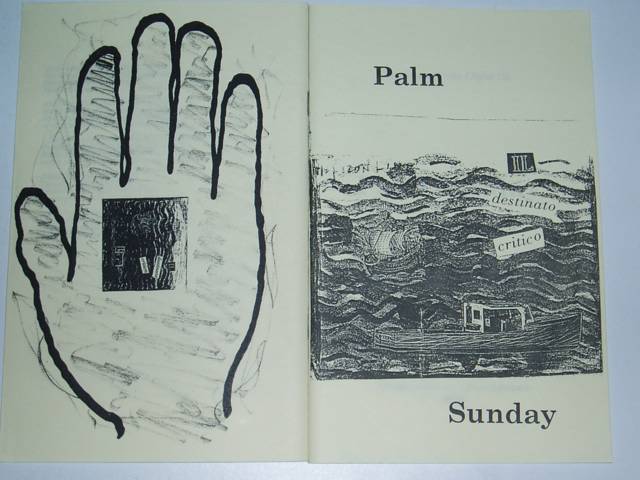
The "eye-in-hand" is one of the most ancient visual symbols in North America, from the mound-builder peoples of the Mississippi bottomlands. Here's the opening of "Palm Sunday":
The "eye-in-hand" is one of the most ancient visual symbols in North America, from the mound-builder peoples of the Mississippi bottomlands. Here's the opening of "Palm Sunday":
1


Limping, climbing like a Lazarus
from the well of amor, you wave goodby.
Stigmatized and astigmatic, she.
Passing beyond alarums, carnivals


in the distance, Mardi Gras
in the bent mirror, marvelous,
far-off now, larmes
des choses...


your worn shoes.
Hand waves.
Left-over
leaves.


A valentine arrives from prison:
a feather; a blue iris
enveloped in glass;
a tiny lead pellet.  Anon.


The thickness of the lens slows light:
ask Lena how it's done, Einstein.
Absolute zero, swimming, sun.
Blackstone here - was all for nought.


Like an arrow like a grain of sand
through your heart, you carry it
and live (livid, limpid, lit,
littoral, ghost).  Like a wave


in your hand, the eye turns inward,
a wave diving into itself; and a gnomon
recedes toward noon, toward
everyone.  You keep your word.
I feel like I took a small conceptual leap of my own yesterday, with the remarks on Harriet, responding to Reginald Shepherd. The idea that the poem is only fully actualized in the "big outside" of the public stage (not necessarily a literal stage, but a performance nonetheless), in the "gray area" between art & politics.
Of course a poem can have a perennial life as a text, and be reborn every time it's read, and appear re-shaped again & again... Mandelstam's idea of the "letter in the bottle" to an unknown reader. But maybe the normative aim or trajectory of the poem is directly into the social Now of its time and place. It might be a combination of these two aspects, ie. a renovation or rebirth of a former crystallization; but I think this idea of poetic actualization on the "stage" of the present is important, as it relates to to another idea which I 've followed at various times on this blog, ie. to emphasize a distinction between prose literature, and poetry's embodiment, the human performance of language in the Now of the present, time's "pleroma". The poem's (Aristotelian) form achieves its ontological telos - it flowers - in this shared "gray area", the common verbal/social/political space of its time.
"Time flowers on the lips of whispered clay." Opening line of Forth of July.
& with what kind of "Now" might my own writing have to do? I'm thinking of the "gray area" of the great Jasper Johns show at the Met in NY, which I saw last weekend. Johns often gestures toward poets, especially Hart Crane. There are the images of the hand-print on a kind of pendulum or radius, as if reaching up from deep under water. I've thought of my own long poems as partly an attempt to perform a kind of ghost dance or resurrection ceremony, for Crane in particular - to play Hart Crane redivivus. (& did something parallel with the "Henry" of John Berryman, in the Island Road sonnets.) An illustration to one of the chapters of Grassblade Light, "Palm Sunday" (which is set in the New Orleans/Gulf area), unwittingly echoes Johns's image in this respect.
Of course a poem can have a perennial life as a text, and be reborn every time it's read, and appear re-shaped again & again... Mandelstam's idea of the "letter in the bottle" to an unknown reader. But maybe the normative aim or trajectory of the poem is directly into the social Now of its time and place. It might be a combination of these two aspects, ie. a renovation or rebirth of a former crystallization; but I think this idea of poetic actualization on the "stage" of the present is important, as it relates to to another idea which I 've followed at various times on this blog, ie. to emphasize a distinction between prose literature, and poetry's embodiment, the human performance of language in the Now of the present, time's "pleroma". The poem's (Aristotelian) form achieves its ontological telos - it flowers - in this shared "gray area", the common verbal/social/political space of its time.
"Time flowers on the lips of whispered clay." Opening line of Forth of July.
& with what kind of "Now" might my own writing have to do? I'm thinking of the "gray area" of the great Jasper Johns show at the Met in NY, which I saw last weekend. Johns often gestures toward poets, especially Hart Crane. There are the images of the hand-print on a kind of pendulum or radius, as if reaching up from deep under water. I've thought of my own long poems as partly an attempt to perform a kind of ghost dance or resurrection ceremony, for Crane in particular - to play Hart Crane redivivus. (& did something parallel with the "Henry" of John Berryman, in the Island Road sonnets.) An illustration to one of the chapters of Grassblade Light, "Palm Sunday" (which is set in the New Orleans/Gulf area), unwittingly echoes Johns's image in this respect.
Here's an article by Thomas Epstein about Alexander Vvedensky, one of the OBERIU poets. Turns out he was interested in Nicholas Cusanus.
2.28.2008
...another contribution to the Harriet comment-burble...
"Dear Reginald,
In the course of your argument here, you assert three points which are pretty close to truisms, but which I also agree with : 1) the NAP anthology has been credited with a political "progressivism" which was not really so advanced; 2) politics and aesthetics are not equatable, even in one & the same artist; 3) negativity for its own sake is pointless, & worse.
Nevertheless, these points don't seem to really address the crux of the position laid out by A. Mlinko and others in previous posts etc. In order to grasp what this position is, one has to be willing to acknowledge a gray area, between art and politics. Let's provisionally designate this as "cultural politics". Keeping in mind the tradiitonal notions of the role of poetry as not only an art form but also a didactic act, a form of education (cf. Milton, Dante, Sidney, etc. etc. - let's compare this role loosely to the idea of "applied science". Whenever scientific theory & discovery are applied in the real world, there are consequences in the realm of "cultural politics" (the forms of action and interaction in which a cultural engages). This same function applies, perhaps to a lesser extent, in the realm of the arts. Artistic creation has social consequences.
Here is Wallace Stevens ("Of Modern Poetry"):
It has to be living, to learn the speech of the place.
It has to face the men of the time and to meet
The women of the time. It has to think about war
And it has to find what will suffice. It has
To construct a new stage. It has to be on that stage. . .
If we take Stevens seriously, we have to think of poetry as in some respect an embodied, performative, and rhetorical art form. The aesthetic form of the poem does not, contra the New Critics, reside in a self-contained textual receptacle. The form of the poem achieves its realization, its actuality, in some form of social (& perhaps actual) "stage".
I would call this gray area, generally, the sphere of cultural politics. The space of social dialogue and shared language, where, in Stevens' words, "the imagination's latin" is compounded with "the lingua franca et jocundissima".
Using this concept of the "gray area" as context, let's look again at A. Mlinko's argument, which was, at least in part, to point up a historical contrast between the social-professional matrix of poetry today and that of 50 years ago, with the NAP anthology as emblematic of that difference.
I would, again, support that general perspective - since I think the aesthetic choices of the NAP poets did indeed put them "outside" the sphere of what was considered the normative discourse of traditional poetry at that time; and that one of the signal motives for this direction lay in the poets' desire to "learn the speech of the place", to "face the men" and "meet the women" of the time, to "construct a new stage".
And I think this does have to be contrasted with the contemporary situation, of which perhaps your own position is a pretty good exemple : the assumption is that poetry is self-sufficient and somewhat detached from politics, simply because the high level of professionalism supposedly structuring the field allows its practitioners to absorb and comprehend both social theory and all forms of technical innovation - so that such notions as "outside" or "avant-garde" become irrelevant. Stevens' position, in contrast, emphasizes a very high level of contingency in the poetic process, since the poem does not actually achieve its form, its aesthetic actuality, until it has been in some sense "enacted" in the public sphere. And we are not talking about the public sphere of the university or the profession, here, but of the sphere of "the people" of "the time". Outside, in the big outside."
"Dear Reginald,
In the course of your argument here, you assert three points which are pretty close to truisms, but which I also agree with : 1) the NAP anthology has been credited with a political "progressivism" which was not really so advanced; 2) politics and aesthetics are not equatable, even in one & the same artist; 3) negativity for its own sake is pointless, & worse.
Nevertheless, these points don't seem to really address the crux of the position laid out by A. Mlinko and others in previous posts etc. In order to grasp what this position is, one has to be willing to acknowledge a gray area, between art and politics. Let's provisionally designate this as "cultural politics". Keeping in mind the tradiitonal notions of the role of poetry as not only an art form but also a didactic act, a form of education (cf. Milton, Dante, Sidney, etc. etc. - let's compare this role loosely to the idea of "applied science". Whenever scientific theory & discovery are applied in the real world, there are consequences in the realm of "cultural politics" (the forms of action and interaction in which a cultural engages). This same function applies, perhaps to a lesser extent, in the realm of the arts. Artistic creation has social consequences.
Here is Wallace Stevens ("Of Modern Poetry"):
It has to be living, to learn the speech of the place.
It has to face the men of the time and to meet
The women of the time. It has to think about war
And it has to find what will suffice. It has
To construct a new stage. It has to be on that stage. . .
If we take Stevens seriously, we have to think of poetry as in some respect an embodied, performative, and rhetorical art form. The aesthetic form of the poem does not, contra the New Critics, reside in a self-contained textual receptacle. The form of the poem achieves its realization, its actuality, in some form of social (& perhaps actual) "stage".
I would call this gray area, generally, the sphere of cultural politics. The space of social dialogue and shared language, where, in Stevens' words, "the imagination's latin" is compounded with "the lingua franca et jocundissima".
Using this concept of the "gray area" as context, let's look again at A. Mlinko's argument, which was, at least in part, to point up a historical contrast between the social-professional matrix of poetry today and that of 50 years ago, with the NAP anthology as emblematic of that difference.
I would, again, support that general perspective - since I think the aesthetic choices of the NAP poets did indeed put them "outside" the sphere of what was considered the normative discourse of traditional poetry at that time; and that one of the signal motives for this direction lay in the poets' desire to "learn the speech of the place", to "face the men" and "meet the women" of the time, to "construct a new stage".
And I think this does have to be contrasted with the contemporary situation, of which perhaps your own position is a pretty good exemple : the assumption is that poetry is self-sufficient and somewhat detached from politics, simply because the high level of professionalism supposedly structuring the field allows its practitioners to absorb and comprehend both social theory and all forms of technical innovation - so that such notions as "outside" or "avant-garde" become irrelevant. Stevens' position, in contrast, emphasizes a very high level of contingency in the poetic process, since the poem does not actually achieve its form, its aesthetic actuality, until it has been in some sense "enacted" in the public sphere. And we are not talking about the public sphere of the university or the profession, here, but of the sphere of "the people" of "the time". Outside, in the big outside."
In the realm of poetry (& maybe other realms) I find it difficult to balance and reconcile truth & beauty, the didactic & the aesthetic, the legislative/executive & the playful/imaginative, the prophetic & the poetic...
Look at people like Pound, Olson... ambitious-serious "alpha male" epic types. Avatars of the will-to-order, the will to govern, to dominate, to rule. (Yeats's "king of cats".) Though I don't consider myself very alpha, I feel I've muddled along in some similar deep swamps. Hence my affection for figures closer to the "artist" side of this line (Hart Crane, Stevens). Forth of July is really a playful jab toward the crystallization of a "national epic", drawing on contrary models (like Crane, Berryman, Mandelstam, etc.). [ (Will anybody ever notice what I've been doing here?) ]
from one perspective, the sane & ethical approach, as an artist, would be to maintain a strict detachment, to offer an impersonal mirror... from another perspective this seems impossible, an illusion : we are already caught up and involved emotionally & intellectually with the "materials"...
the whole issue of the poet as "unacknowledged legislator" stems from the fact that all our communal social constructs are rooted, at least to some degree, in the imagination itself... or is this an attitude (for an artist anyway) of foolish, over-reaching pride? Is the substance of reality firm & structured & prior to our conceptions about it?
(Another aspect of this is that much social, didactic, political poetry is not really very poetic. It's prose dressed up as poetry. Of course it can be very effective just like that. But it doesn't re-imagine, re-create the cosmos, the way the great epics do. It lacks the orphic fictional-poetic power of Virgil, Dante, Milton, Shakespeare... - the regal sceptre of the imagination - Mandelstam's "baton". I suppose the sceptre has been passed to the novelists, the scientists, the philosophers, the "critical theorists"...)
Old puzzles... this crux perhaps marks the difference between the medieval, the Renaissance & the modern mentalities...
Maybe that's one reason I like the philosophical writings of Nicholas of Cusa so much. For Cusanus, our knowledge reaches its limit in puzzles & paradoxes. God is "the conjunction of opposites". He acknowledges the source of all order & creation in God; at the same time he asserts that all our concepts of God are just that, human constructs, "conjectures", that in fact our whole sensible, knowable reality is a conjectural human construct, an artifice of the mind...
I thought this morning that the resolution of this puzzle or paradox lies in an understanding of the nature of divine love. If "God is Love", as the epistle of John has it, and if Love is a kind of binding embrace of the Other which is at the same time a renunciation, a self-giving to the other, a state of service or servanthood - then it's in the light of this kind of Love that we can imagine another Biblical concept, ie. "perfect freedom".
Imagine a divine nature which wants to create a cosmos of "perfect freedom", because this desire is rooted in love, and love's deepest motive is to "set free". Then this divine nature would of necessity have to withdraw, relinquish control and dominion on some level. Of course this does not necessarily entail indifference (the remote, the clockwork God). "Selfless-love-without-indifference", then, is in itself a kind of incomprehensible paradox. Incomprehensibility, even absurdity, of a kind we meet with in ordinary life (cf. the parable of the Good Samaritan).
I guess I'm simply recycling some old, old via negativa notions going back to Pseudo-Dionysius & Byzantine theology & long before (Plato on love, etc.).
But these notions seem to be essential to any integration of order & freedom, of cosmos & chance, of medieval and renaissance, of theology & humanism. A figure of paradox like Cusanus appears at the cusp of this historic shift (between medieval & modern). He has a mind fascinated with invention and creative freedom. His writings are playful intellectual-philosophical games, conceptual inventions.
But it seems to me the crux of it all is this fusion of the will-to-love ("good will") with the idea of "perfect freedom". Maybe this is the nexus where the gift of artistic detachment & inner freedom rhymes with a more "sober" concept of necessity, reality, history, fact, the moral law, governance, political & juris-prudence, etc.

Look at people like Pound, Olson... ambitious-serious "alpha male" epic types. Avatars of the will-to-order, the will to govern, to dominate, to rule. (Yeats's "king of cats".) Though I don't consider myself very alpha, I feel I've muddled along in some similar deep swamps. Hence my affection for figures closer to the "artist" side of this line (Hart Crane, Stevens). Forth of July is really a playful jab toward the crystallization of a "national epic", drawing on contrary models (like Crane, Berryman, Mandelstam, etc.). [ (Will anybody ever notice what I've been doing here?) ]
from one perspective, the sane & ethical approach, as an artist, would be to maintain a strict detachment, to offer an impersonal mirror... from another perspective this seems impossible, an illusion : we are already caught up and involved emotionally & intellectually with the "materials"...
the whole issue of the poet as "unacknowledged legislator" stems from the fact that all our communal social constructs are rooted, at least to some degree, in the imagination itself... or is this an attitude (for an artist anyway) of foolish, over-reaching pride? Is the substance of reality firm & structured & prior to our conceptions about it?
(Another aspect of this is that much social, didactic, political poetry is not really very poetic. It's prose dressed up as poetry. Of course it can be very effective just like that. But it doesn't re-imagine, re-create the cosmos, the way the great epics do. It lacks the orphic fictional-poetic power of Virgil, Dante, Milton, Shakespeare... - the regal sceptre of the imagination - Mandelstam's "baton". I suppose the sceptre has been passed to the novelists, the scientists, the philosophers, the "critical theorists"...)
Old puzzles... this crux perhaps marks the difference between the medieval, the Renaissance & the modern mentalities...
Maybe that's one reason I like the philosophical writings of Nicholas of Cusa so much. For Cusanus, our knowledge reaches its limit in puzzles & paradoxes. God is "the conjunction of opposites". He acknowledges the source of all order & creation in God; at the same time he asserts that all our concepts of God are just that, human constructs, "conjectures", that in fact our whole sensible, knowable reality is a conjectural human construct, an artifice of the mind...
I thought this morning that the resolution of this puzzle or paradox lies in an understanding of the nature of divine love. If "God is Love", as the epistle of John has it, and if Love is a kind of binding embrace of the Other which is at the same time a renunciation, a self-giving to the other, a state of service or servanthood - then it's in the light of this kind of Love that we can imagine another Biblical concept, ie. "perfect freedom".
Imagine a divine nature which wants to create a cosmos of "perfect freedom", because this desire is rooted in love, and love's deepest motive is to "set free". Then this divine nature would of necessity have to withdraw, relinquish control and dominion on some level. Of course this does not necessarily entail indifference (the remote, the clockwork God). "Selfless-love-without-indifference", then, is in itself a kind of incomprehensible paradox. Incomprehensibility, even absurdity, of a kind we meet with in ordinary life (cf. the parable of the Good Samaritan).
I guess I'm simply recycling some old, old via negativa notions going back to Pseudo-Dionysius & Byzantine theology & long before (Plato on love, etc.).
But these notions seem to be essential to any integration of order & freedom, of cosmos & chance, of medieval and renaissance, of theology & humanism. A figure of paradox like Cusanus appears at the cusp of this historic shift (between medieval & modern). He has a mind fascinated with invention and creative freedom. His writings are playful intellectual-philosophical games, conceptual inventions.
But it seems to me the crux of it all is this fusion of the will-to-love ("good will") with the idea of "perfect freedom". Maybe this is the nexus where the gift of artistic detachment & inner freedom rhymes with a more "sober" concept of necessity, reality, history, fact, the moral law, governance, political & juris-prudence, etc.
2.27.2008
Poetry is embodied speech, language brought close to ordinary conversation and then spun wildly around it. Embodied, embodied, not simply collected, collated, sorted through mandarin effete distortion-filters... thus these readings/performances last night offer a kind of test - a sort of partial & preliminary measure (& not the only one, by far) - of the poetry's substance, reality... (the real test residing in the hidden performance, maybe never actually heard out loud, of the poem's composition).
Mikhail Aizenberg an architect by profession, and you see in his critical writings this constant tension between poetry and rhetoric, between poetry and mechanical, learned, imitation-discourse (the "Leningrad School" his emblem for the false turn toward the latter) - poetry having some kind of inner form, the creative/intellectual/emotional/sensible gesture - a shape, an architecture, in-forming the language.
(Thus the interest in Vvedensky & the OBERIU poets' demolition of everyday speech & literary language etc. Maybe that all goes back to the Byzantine theological crisis-complex, the tense ambivalence between iconophilia & iconoclasm, between the symbol (word) and what it represents.)
"The body is the temple of the Spirit."
For Aizenberg, it seems, ordinary speech & ordinary experience offer the paradoxical, counter-intuitive substance or acid test for the authenticity of the inner unspoken architecture of the gesture... this shared communal language-space being the place where all the human motives for composition are integrated & achieve actuality.
Mikhail Aizenberg an architect by profession, and you see in his critical writings this constant tension between poetry and rhetoric, between poetry and mechanical, learned, imitation-discourse (the "Leningrad School" his emblem for the false turn toward the latter) - poetry having some kind of inner form, the creative/intellectual/emotional/sensible gesture - a shape, an architecture, in-forming the language.
(Thus the interest in Vvedensky & the OBERIU poets' demolition of everyday speech & literary language etc. Maybe that all goes back to the Byzantine theological crisis-complex, the tense ambivalence between iconophilia & iconoclasm, between the symbol (word) and what it represents.)
"The body is the temple of the Spirit."
For Aizenberg, it seems, ordinary speech & ordinary experience offer the paradoxical, counter-intuitive substance or acid test for the authenticity of the inner unspoken architecture of the gesture... this shared communal language-space being the place where all the human motives for composition are integrated & achieve actuality.
A lot of energy down at Tazza last night, big poetry reading (10 poets in an hour & a half) presented by Mairead Byrne. Some real talent, youngsters for the most part. John Cayley, visiting Brit, read interesting translations from contemporary Chinese. One kid read a translation of Kharms, and then his own remarkababble OBERIU-style stuff. Ran into Forrest Gander again, & spoke to Michael Magee. Told Mairead my maternal gr-gr-grandfather came from Dublin, which is true. She made a note of it. Played harmonica again with blues-guy RISD prof Mark Miloff.
Thoroughly enjoyed getting off the machine & out of the library.
Thoroughly enjoyed getting off the machine & out of the library.
2.26.2008
I'm something of a musician. I've played various instruments since age 5. I'm alert, somewhat, to the physical texture of sound, the quality of sound, and to music as physical gesture (hands & feet playing keyboards, strings).
This filters into my sense of what poetry is or should be. Not noise, not the banal, oppressive, complacent discourse, verbiage. In fact, the opposite of all that.
The dramatic moment, the entrance of measured sound. (Yeats : "Speech after long silence...") Part of the rhetoric of poetry's specific power & difference.
(responding to JL's post of today)
This filters into my sense of what poetry is or should be. Not noise, not the banal, oppressive, complacent discourse, verbiage. In fact, the opposite of all that.
The dramatic moment, the entrance of measured sound. (Yeats : "Speech after long silence...") Part of the rhetoric of poetry's specific power & difference.
(responding to JL's post of today)
Also reading this great anthology of the OBERIU poets (Russia, 1920s & 30s) - which is giving me a clearer sense of what Aleksandr Skidan is up to. I will have to write some more about Skidan here.
From the little I've read so far, the OBERIU poets - Vvedensky, Kharms - are much more than comic absurdists. Vvedensky displays a near-mystical skepticism about language, which seems to have roots way back in early Byzantine-Orthodox theology (though there's nothing overtly Christian or religious about it - he's conceptually, philosophically radical - a kind of extreme iconoclast).
From the little I've read so far, the OBERIU poets - Vvedensky, Kharms - are much more than comic absurdists. Vvedensky displays a near-mystical skepticism about language, which seems to have roots way back in early Byzantine-Orthodox theology (though there's nothing overtly Christian or religious about it - he's conceptually, philosophically radical - a kind of extreme iconoclast).
I suppose I was being foolish (again), over at Reginald Shepherd's Harriet post announcing his new anthology (Lyric Postmodernisms). Maybe even rude, to intrude on his publication announcement. The discussion (for me) was leaching over from other posts - one by Shepherd on the term "post-avant", another by Christian Bok on contemporary experiment (in response to Shepherd). Actually it was Bok's (re)formulation of some discussion by Shepherd & Paul Hoover - in which Bok summarizes Hoover's idea of a compromise, in current poetry, between postmodern experiment & tradition - that I was criticizing. Shepherd's new anthology seems (from its title & brief descriptions) to represent or illustrate some such compromise. (Bok himself suggests the limitations of such an idea - this compromise - & proposes something else, along the lines of multifarious simultaneous experiment - the "pan-avant".)
Anyway, I was being silly & provocative, using Shepherd's post the way I did. But I get irascible when I hear the term "postmodernism" too often.
& I was registering a protest of my own against this notion that today's cutting-edge & influential poets have found a way to blend postmodern concepts of language & subjectivity etc., with more traditional modes of lyric poetry.
Because actually I think the real new & radical step right now would be a rejection of the recent compositional & stylistic formulae - those which fixate on
20th-cent. notions of language, on language per se as the sole formal, structural material of poetry. I'm saying we go back to the Cranes : R.S. Crane's (& the Chicago School's) Aristotelian concepts of poetic form; Hart Crane's sense of the poem as a mute or silent gesture toward the unsayable.
But I've already explained all this. & the attack dogs are lurking. & the machinery of professional poetry prestige (in which, for the time being, I am not a player) must roll on.
It was gauche of me to add all this to the comment thread at Shepherd's publication announcement. & I owe it to him to actually read the new anthology, which I will do.
& yet I have to be silly, stupid & out-of-sync sometimes; that's part of this loser's game I'm playing.
Anyway, I was being silly & provocative, using Shepherd's post the way I did. But I get irascible when I hear the term "postmodernism" too often.
& I was registering a protest of my own against this notion that today's cutting-edge & influential poets have found a way to blend postmodern concepts of language & subjectivity etc., with more traditional modes of lyric poetry.
Because actually I think the real new & radical step right now would be a rejection of the recent compositional & stylistic formulae - those which fixate on
20th-cent. notions of language, on language per se as the sole formal, structural material of poetry. I'm saying we go back to the Cranes : R.S. Crane's (& the Chicago School's) Aristotelian concepts of poetic form; Hart Crane's sense of the poem as a mute or silent gesture toward the unsayable.
But I've already explained all this. & the attack dogs are lurking. & the machinery of professional poetry prestige (in which, for the time being, I am not a player) must roll on.
It was gauche of me to add all this to the comment thread at Shepherd's publication announcement. & I owe it to him to actually read the new anthology, which I will do.
& yet I have to be silly, stupid & out-of-sync sometimes; that's part of this loser's game I'm playing.
2.25.2008
Fontegaia moves on...
10


A tiny hunchback snail
inches forward, cased
in a spiral spinal house.
A full retreat, and final.


Simple curve, mushroom
cap, camouflaged ravine
of rugged oak.  Hidden in
eye-plane, like throaty gloom


of turtle dove (grey
breast against gray evening
stone).  Gradual leavening
of steady rain.  Bend in the sky.


Rustle of Indian foot in forest.
Breeze, or winding flute-path.
Blurred cascade or purple casket-
flower; spectrum-honeycomb (at rest).


The bow drawn taut, a beaded
level creaks in rain.  Almond
houseboat croons -
crowns - swoons (ceded


to sword).  A unison
of ewe and eye, oui, one Friday
- all in a pre-dawn naval play,
a little ark of lincoln-logos.  Done.


And carried on her back, a moon
gone down.  Beneath the earth.
Emancipation lips come forth,
sing like humpback whale, soon, soon.
2.21.2008
Another comment sent into Harriet today (at Reginald Shepherd's Lyric Postmodernisms post):
"Such "comment-box interventions" as mine, here on Reginald's patient long-suffering Harriet post, are easy to dismiss.
Nevertheless I hope some poets will consider the implications of what I'm saying.
The big trends in 20th-century linguistic theory and philosophy have assumed as axiomatic that language is not only a system (either a system of order, as with the structuralists, or, as with the post-structuralists, a system of chaos or "difference"), but a system (either a logos or an a-logos) which is the actual substance & ratio of reality, identity, and literature.
And the prevailing currents in what is known as postmodernist, innovative, post-avant, and language poetries have taken up these theories and assumptions, and have made their literary consequences a hallmark of their style - that which differentiates them from the common herd of traditional poets.
Now if it's possible to think of language in a completely different way - as primarily a human creation, a tool of communication which we invented - akin to other forms of non-verbal (& non-human) gesture, signals and communication - then we have a problem with the theoretical obsession with language as self-regulating system. And we have a problem with a trend in poetics which emphasizes the dispossession of human invention, will & intent, in favor of the aleatory workings of socially- or internally-generated verbal materials.
It also strikes me as curious that 50 years ago, a group of influential literary scholars, poets & critics - the so-called Chicago School (R.S. Crane, Elder Olson & others) - had already analyzed the basic problems involved with the 20th-century fixation on language, and the concomitant notion of the poem as primarily a verbal artifact. And they outlined an Aristotelian counter-proposal to this dominant New Critical trend (which was, in effect, turned inside-out & re-applied by the Language Poets) - one which focuses on the poem as an aesthetic whole, an intellectual-emotional gesture or form, which is not reducible to its literal text, but is primarily an (aesthetic) ACTION, for which the text provides a kind of score.
I see the contemporary state of affairs (when poets & groups of poets glibly gather up such identifying markers at "postmodernist", "innovative", etc.) as somewhat similar to the situation which existed at the turn of the previous century, when Pound surveyed the landscape of versifying post-Victorians, and commented something to the effect that "they have no ground under 'em". "
"Such "comment-box interventions" as mine, here on Reginald's patient long-suffering Harriet post, are easy to dismiss.
Nevertheless I hope some poets will consider the implications of what I'm saying.
The big trends in 20th-century linguistic theory and philosophy have assumed as axiomatic that language is not only a system (either a system of order, as with the structuralists, or, as with the post-structuralists, a system of chaos or "difference"), but a system (either a logos or an a-logos) which is the actual substance & ratio of reality, identity, and literature.
And the prevailing currents in what is known as postmodernist, innovative, post-avant, and language poetries have taken up these theories and assumptions, and have made their literary consequences a hallmark of their style - that which differentiates them from the common herd of traditional poets.
Now if it's possible to think of language in a completely different way - as primarily a human creation, a tool of communication which we invented - akin to other forms of non-verbal (& non-human) gesture, signals and communication - then we have a problem with the theoretical obsession with language as self-regulating system. And we have a problem with a trend in poetics which emphasizes the dispossession of human invention, will & intent, in favor of the aleatory workings of socially- or internally-generated verbal materials.
It also strikes me as curious that 50 years ago, a group of influential literary scholars, poets & critics - the so-called Chicago School (R.S. Crane, Elder Olson & others) - had already analyzed the basic problems involved with the 20th-century fixation on language, and the concomitant notion of the poem as primarily a verbal artifact. And they outlined an Aristotelian counter-proposal to this dominant New Critical trend (which was, in effect, turned inside-out & re-applied by the Language Poets) - one which focuses on the poem as an aesthetic whole, an intellectual-emotional gesture or form, which is not reducible to its literal text, but is primarily an (aesthetic) ACTION, for which the text provides a kind of score.
I see the contemporary state of affairs (when poets & groups of poets glibly gather up such identifying markers at "postmodernist", "innovative", etc.) as somewhat similar to the situation which existed at the turn of the previous century, when Pound surveyed the landscape of versifying post-Victorians, and commented something to the effect that "they have no ground under 'em". "
Some very interesting essays by Mikhail Aizenberg, on (relatively) recent history of poetry in Russia, translated in a special issue of Russian Studies in Literature (vol. 32, spring 1996). Moscow has a special perspective on the Petersburg poets. Aizenberg has some very acute things to say about a poetry of "direct response" - really new poetry - as opposed to a poetry of Poetry (contemporaries so overshadowed and awed by the "four horsemen" - Akhmatova, Tsvetaeva, Pasternak, Mandelstam - & Brodsky). He writes how the latter actually becomes a kind of "narrative" of the Tradition itself, which differs in kind from the immediate roots of lyric poetry (no matter how impoverished, banal, ordinary). Emphasizes that the zone where everything really important happens is in the interaction between everyday experience, ordinary speech, & the lyric impulse.
I'm paraphrasing mightily. Aizenberg (unlike myself) does not go in for windy discoursing, either - he talks very specifically about the poets around him & immediately before (most of them unknown to American readers).
I'm paraphrasing mightily. Aizenberg (unlike myself) does not go in for windy discoursing, either - he talks very specifically about the poets around him & immediately before (most of them unknown to American readers).
2.20.2008
Fontegaia, again... getting fairly wacky.
(p.s. it appears JL was also writing about the moon last night (or this morning). The eclipse brought it so close, so 3-dimensional - rounding it out, a smooth little pearly pebble or old-fashioned clasp-button in the sky. Cold silver radiance, taking earth on board, the shadow of earth. Going underground. Hanging up there, not far away, a sort of aloof tear-drop, a sort of Frigga-Pieta of close-lipped mournful restraint, looking on.)
9


A ring of lakes, each lake
like a ring.  Frigid, with a few
frigates.  Sails full of airy
dew.  What it was like.


The bond of a moon in eclipse
was guaranteed by magnets,
according to the majestic
juryman (a Mr. Chips) -


like you or me, or more like
you, actually - like a ewe
or a vestryman, a vraie
monad, like Eweryman - well


liked (at least until last
Friday, as far as I know).
She sobbed into the micro
after they drug him to the hill


(a friggin' no-frill spiel
or spelling bee, sez).
And a tear, a few tears...
wells from the commonweal.


So the adventures of little Frisbee
followed a rapid ripple down
to Mirror Lake, sometime round
sundoom.  And for you and me


what did it mean?  You-me.
Like a hybridized horseshoe,
a lonely-pastured Disk-a-Do.
Awhish, a rue, awry, awhee...
(p.s. it appears JL was also writing about the moon last night (or this morning). The eclipse brought it so close, so 3-dimensional - rounding it out, a smooth little pearly pebble or old-fashioned clasp-button in the sky. Cold silver radiance, taking earth on board, the shadow of earth. Going underground. Hanging up there, not far away, a sort of aloof tear-drop, a sort of Frigga-Pieta of close-lipped mournful restraint, looking on.)
Fontegaia, again...
8


Spindly oak, feet buried in grass.
Branches tense.  Elbows drawn in.
Giacometti in rustling iron.
History's hinge-bolt (rasping hasp).


The grain grows out of lightning.
Downward, jaggedly careening
leaves like leather.  Evening
parting of the ways, my


dear, they're whispering.
You don't know what it's like,
because mostly it's a weak
signal, mostly, you know.


Like a weak heartbeat.  Erratic.
How we dreamed those days!
Just dream were we.  Frail
spooks, spectators, folk-


art mammals.  It seeps
into the profile - the wind
mutters across its own
eye (lone cyclone).  Clasps,


folded-under.  Feathery flame
a-brimful of yearning -
remember how light it felt?
Like the rim of a balloon


about to burst...
and you were inside there,
a landed squire of oak and air.
Frisbee.  King Whammo the First.
2.19.2008
... excerpt from a further comment, sent as addendum to Reginald Shepherd's Lyric Postmodernism post at Harriet:
"For the Chicago critics, a poem is an aesthetic SHAPE, organized primarily by plot and dramatic action, for which the language is only one of several contributing factors. I want to transpose this notion to apply to poetry in general, by positing this notion of the poet's mute GESTURE as the organizing principle of the poem's aesthetic form. Everything involved in this gesture works toward the integrity and fulfillment of Crane's "impossible" new word (which again, is not so much a verbal word, as the sum total of the aesthetic-communicative gesture).
I would say that Ashbery is the great American exemplar of the poet as de-centered self offering poetry as unaccountable discourse. This kind of practice fuses seamlessly with postmodern theoretical concepts of the status of the subject, the power of language-as-system (or language-as-differance), etc. It is this whole approach I am calling into question, with these two notions of 1) language as primarily a human invention, a tool of human agency; and 2) poetry as rooted in mime and mute communicative gesture."
"For the Chicago critics, a poem is an aesthetic SHAPE, organized primarily by plot and dramatic action, for which the language is only one of several contributing factors. I want to transpose this notion to apply to poetry in general, by positing this notion of the poet's mute GESTURE as the organizing principle of the poem's aesthetic form. Everything involved in this gesture works toward the integrity and fulfillment of Crane's "impossible" new word (which again, is not so much a verbal word, as the sum total of the aesthetic-communicative gesture).
I would say that Ashbery is the great American exemplar of the poet as de-centered self offering poetry as unaccountable discourse. This kind of practice fuses seamlessly with postmodern theoretical concepts of the status of the subject, the power of language-as-system (or language-as-differance), etc. It is this whole approach I am calling into question, with these two notions of 1) language as primarily a human invention, a tool of human agency; and 2) poetry as rooted in mime and mute communicative gesture."
2.18.2008
Robert Archambeau writes a thoughtful extended response to the blither-blather on "post-avant" over at the Harriet site (Reginald Shepherd's posts).
I tend to see the negative side of what Robert's calling "negative legislation" (the contemporary poet's refusal to judge and emphasis on the ambivalence & waywardness of language). To me it often feels like a cop-out, to the extent of denying human agency in the creation and use of language. That's one reason I'm being provocative myself (see the comment on Shepherd's anthology Lyric Postmodernisms).
But I'm not merely being negative about the negative. I'd like to replace the ubiquitous 20th-cent. fixation on "language" (as system : as the currency, the substance, the organizing matrix, of poetry) with an emphasis on silence, gesture, mime. Hart Crane's statement should be its motto: the poem is
"a single, new word, never before spoken, and impossible to actually enunciate".
A poem is, in this sense, the sum of the poet's strategic gestures toward something never-before-said or -sayable. It is absolutely uncategorizable according to any prior linguistic grid, and the poet bears complete responsibility for - is the human agent of - the final & efficient cause of - all its meanings and reverberations.
I tend to see the negative side of what Robert's calling "negative legislation" (the contemporary poet's refusal to judge and emphasis on the ambivalence & waywardness of language). To me it often feels like a cop-out, to the extent of denying human agency in the creation and use of language. That's one reason I'm being provocative myself (see the comment on Shepherd's anthology Lyric Postmodernisms).
But I'm not merely being negative about the negative. I'd like to replace the ubiquitous 20th-cent. fixation on "language" (as system : as the currency, the substance, the organizing matrix, of poetry) with an emphasis on silence, gesture, mime. Hart Crane's statement should be its motto: the poem is
"a single, new word, never before spoken, and impossible to actually enunciate".
A poem is, in this sense, the sum of the poet's strategic gestures toward something never-before-said or -sayable. It is absolutely uncategorizable according to any prior linguistic grid, and the poet bears complete responsibility for - is the human agent of - the final & efficient cause of - all its meanings and reverberations.
2.15.2008
JL on the Harriet Blog Lot, where I have been squawking. Get ready for the sea-change, sez St. George HG.
Reading Mikhail Aizenberg's Say Thank You. Like it a lot. Intriguing Mandelstamian under-overtones.

Reading Mikhail Aizenberg's Say Thank You. Like it a lot. Intriguing Mandelstamian under-overtones.

A great American exemplar of the sense of poetry I tried to outline in previous post is, of course, that valentine friend of George Henry Gould - whom Crane apostrophizes here as the "Silencer":
To Emily Dickinson


You who desired so much - in vain to ask -
Yet fed you hunger like an endless task,
Dared dignify the labor, bless the quest -
Achieved that stillness ultimately best,


Being, of all, least sought for: Emily, hear!
O sweet, dead Silencer, most suddenly clear
When singing that Eternity possessed
And plundered momently in every breast;


- Truly no flower yet withers in your hand.
The harvest you descried and understand
Needs more than wit to gather, love to bind.
Some reconcilement of remotest mind -


Leaves Ormus rubyless, and Ophir chill.
Else tears heap all within one clay-cold hill.
Here's another comment sent to Harriet (this one to Reginald Shepherd's post on his new anthology):
"Postmodernism is over.
It's time to move on.
The era of the de-centered self, of the self as a function of language, of reality as a product of language, of the poem as an intervention or crossing of language processes, of the poem as a compromise between lyric and alterity, of language as objective material substance, of the poem as language experiment, etc. ....... - all these things are over and done with.
The low-brow opposition to these formations - ie. the movement for poetry as oral expression, the poem as performance, the poem as rebellion & anarchy against language & culture, the poem as joke, scandal, obscenity, debasement, etc ...... - these phenomena will always be with us, among young people who aren't very much interested in learning how to read or write.
The future of poetry is represented by something happening in between these two tendencies. This something occurs wherever poets remove themselves from the grid of 20th-century philosophy and linguistic theory and poetics. Neither human identity and subjectivity, nor the art of poetry, are simply equatable with language or discourse. The new poetic humanism insists that language is a product of a human creative act - language is a tool invented by human beings. Rather than being mysterious functions of language itself, humans are the makers of language. Language itself is part of the larger realm of gesture and communication. Art is the mute human gesture toward reality and feeling. Poetry is grounded in mime - muteness - mimesis. This muteness envelops the substance of both human subjectivity and objective actuality. Art and poetry are not a swerve away from identity and actuality, not a confession of language's inability to mean anything; instead poetry and art are a human gesture toward the substance of actuality and meaning and feeling. The best poets are focused very intently on the details of this situation (actuality), rather than eliding and sliding away from it based on deluded 20th-cent. notions of language."
"Postmodernism is over.
It's time to move on.
The era of the de-centered self, of the self as a function of language, of reality as a product of language, of the poem as an intervention or crossing of language processes, of the poem as a compromise between lyric and alterity, of language as objective material substance, of the poem as language experiment, etc. ....... - all these things are over and done with.
The low-brow opposition to these formations - ie. the movement for poetry as oral expression, the poem as performance, the poem as rebellion & anarchy against language & culture, the poem as joke, scandal, obscenity, debasement, etc ...... - these phenomena will always be with us, among young people who aren't very much interested in learning how to read or write.
The future of poetry is represented by something happening in between these two tendencies. This something occurs wherever poets remove themselves from the grid of 20th-century philosophy and linguistic theory and poetics. Neither human identity and subjectivity, nor the art of poetry, are simply equatable with language or discourse. The new poetic humanism insists that language is a product of a human creative act - language is a tool invented by human beings. Rather than being mysterious functions of language itself, humans are the makers of language. Language itself is part of the larger realm of gesture and communication. Art is the mute human gesture toward reality and feeling. Poetry is grounded in mime - muteness - mimesis. This muteness envelops the substance of both human subjectivity and objective actuality. Art and poetry are not a swerve away from identity and actuality, not a confession of language's inability to mean anything; instead poetry and art are a human gesture toward the substance of actuality and meaning and feeling. The best poets are focused very intently on the details of this situation (actuality), rather than eliding and sliding away from it based on deluded 20th-cent. notions of language."
Another bit from the comment stream over at Harriet. This one sent to Christian Bok's recent entry ("Late Past the Post").
"R.S. Crane's re-presentation of Aristotle argues that the 20th-cent. critical focus on poem-as-linguistic-discourse is misplaced. Christian Bok's emphasis, on the poem as linguistic research and language game, seems to be an example of that focus carried to a logical conclusion.
I am suggesting, to the contrary, that the language of the poem is always the shadow or carapace of a larger, unspoken (because literally unspeakable) aesthetic form or impression - something like the conceptual/affective impression harbored by people returning home from the theater. We receive a similar impression, an image of completeness, from lyric poems, albeit on a smaller scale. The lasting effect of the work of art is not simply the experimental result of the language per se, but is an effect of this unspoken gesture - toward or away from meaning, toward or away from feeling, toward or away from the reader in person.
It seems to me that poetic language, curiously, makes an inward turn toward this state of muteness or mime (mimesis), toward the inexplicable - and this turning itself is what radiates poetry's uncanny magnetism."
"R.S. Crane's re-presentation of Aristotle argues that the 20th-cent. critical focus on poem-as-linguistic-discourse is misplaced. Christian Bok's emphasis, on the poem as linguistic research and language game, seems to be an example of that focus carried to a logical conclusion.
I am suggesting, to the contrary, that the language of the poem is always the shadow or carapace of a larger, unspoken (because literally unspeakable) aesthetic form or impression - something like the conceptual/affective impression harbored by people returning home from the theater. We receive a similar impression, an image of completeness, from lyric poems, albeit on a smaller scale. The lasting effect of the work of art is not simply the experimental result of the language per se, but is an effect of this unspoken gesture - toward or away from meaning, toward or away from feeling, toward or away from the reader in person.
It seems to me that poetic language, curiously, makes an inward turn toward this state of muteness or mime (mimesis), toward the inexplicable - and this turning itself is what radiates poetry's uncanny magnetism."
2.14.2008
Have been inching my way through Nabokov's short novel, The Eye, in Russian & English.
There is an Alp of yelping scholarship on Nabokov's pyrotechnical high-lit brew-haha. But I'd bet there are more layers to be uncovered. Like his political side. You note how, in his various introductions, he'll assert vociferously how disinterested he is in social & political problems; then, often in the same paragraph if not sentence, he'll make some acid comment about the Soviet regime, or about Freudianism, which he considers the Grand Poohbah of Western narcissism. Methinks he doth protest too much - usually a sign there's something going on.
He spent 15-20 years in the little exile-emigre communities in Germany etc. The Eye & other novels portray that milieu, mixing starry-eyed idealists with low Gogolesque comic schemers and cads. Much is made of ghosts, Ouija boards, spiritualism, life-in-death, death-in-life, dreams & reality... the stuff of frustrated culture cut off from its roots. Someone could do a curious cross-cultural comparison between Nabokov & the Native American Ghost Dance societies. There is a suffocating atmosphere, in Nabokov, of a mirror-world, drained of its vital connection to reality. It's possible that the reality Nabokov is representing as missing, is the dream of a reborn Russia. Both his spooky fictions, and the Ghost Dance ceremonies, are haunted vigils - full of spiritual hangings-about, possible (messianic) return.
(Don't forget : VN's birthday was April 23rd. St. George's Day. St. George, the slayer of red dragons - patron saint of both England and Russia. His own father was a prominent liberal politician, assassinated while giving a speech.)
There is an Alp of yelping scholarship on Nabokov's pyrotechnical high-lit brew-haha. But I'd bet there are more layers to be uncovered. Like his political side. You note how, in his various introductions, he'll assert vociferously how disinterested he is in social & political problems; then, often in the same paragraph if not sentence, he'll make some acid comment about the Soviet regime, or about Freudianism, which he considers the Grand Poohbah of Western narcissism. Methinks he doth protest too much - usually a sign there's something going on.
He spent 15-20 years in the little exile-emigre communities in Germany etc. The Eye & other novels portray that milieu, mixing starry-eyed idealists with low Gogolesque comic schemers and cads. Much is made of ghosts, Ouija boards, spiritualism, life-in-death, death-in-life, dreams & reality... the stuff of frustrated culture cut off from its roots. Someone could do a curious cross-cultural comparison between Nabokov & the Native American Ghost Dance societies. There is a suffocating atmosphere, in Nabokov, of a mirror-world, drained of its vital connection to reality. It's possible that the reality Nabokov is representing as missing, is the dream of a reborn Russia. Both his spooky fictions, and the Ghost Dance ceremonies, are haunted vigils - full of spiritual hangings-about, possible (messianic) return.
(Don't forget : VN's birthday was April 23rd. St. George's Day. St. George, the slayer of red dragons - patron saint of both England and Russia. His own father was a prominent liberal politician, assassinated while giving a speech.)
2.13.2008
Written in a comment string over at Harriet (under Christian Bok's post of today):
"I have a problem with the substitution of "experiment", to designate what a poet is up to, for the more modest "art" or "craft" (or "goofing around").
Also, I disagree with what seems to be a very classic Modern/Saussurian objectification and fetishization of "language" as both the means and end of the poet's task. To follow this road - as both the New Critics and the Language Poets did - tends to lead poetry into a sort of Russian-doll labyrinth of solipsism.
Aristotle - and the Chicago Critics - suggest, on the other hand, that poetry is an art of affective/intellectual GESTURE : and that the verbal texture itself is only one part of a larger, & more (critically) elusive, aesthetic whole."
& this was written in the comment string of another recent post (by Reginald Shepherd) :
"I see the "battle" in contemporary poetry as primarily a theoretical dispute among poets, not really political. This is MY battle, anyway.
I think poets took a wrong turn when they bought into the whole stream of philological theory, beginning with Saussure, I guess, down through Deconstruction - which posits language as a kind of objective phenomenon, entity, thing, ambience, system of differences, etc. etc. & what have you - rather than primarily a tool with which human beings do specific things (like pointing & communicating & describing).
The trend to identify poetry itself with language-as-system or -entity is the basic wrong turn, taken by New Critics, Postmods & Language Poets. Poetry, as I see it, is a human art, primarily involving intellectual/affective GESTURE (as I posted over on C. Bok's latest entry on this site). Language per se is only one element of a larger aesthetic whole, as Aristotle and the Chicago Critics, among others, have emphasized. I've written essays about this.
I've been "battling" for a long time in favor of a sense of poetry which underlines PARTICULARITY, SPECIFICITY, HISTORICAL ACTUALITY, HUMANISM, EMBODIMENT, PERSONAL IDENTITY, REALISM, REFERENTIALITY, DEFINITIVE ACCOUNTABILITY.... all those actual consequences of an art of indication and gesture - which tend to be "elided" when art is subsumed to some framing epistemological-linguistic "system"."
"I have a problem with the substitution of "experiment", to designate what a poet is up to, for the more modest "art" or "craft" (or "goofing around").
Also, I disagree with what seems to be a very classic Modern/Saussurian objectification and fetishization of "language" as both the means and end of the poet's task. To follow this road - as both the New Critics and the Language Poets did - tends to lead poetry into a sort of Russian-doll labyrinth of solipsism.
Aristotle - and the Chicago Critics - suggest, on the other hand, that poetry is an art of affective/intellectual GESTURE : and that the verbal texture itself is only one part of a larger, & more (critically) elusive, aesthetic whole."
& this was written in the comment string of another recent post (by Reginald Shepherd) :
"I see the "battle" in contemporary poetry as primarily a theoretical dispute among poets, not really political. This is MY battle, anyway.
I think poets took a wrong turn when they bought into the whole stream of philological theory, beginning with Saussure, I guess, down through Deconstruction - which posits language as a kind of objective phenomenon, entity, thing, ambience, system of differences, etc. etc. & what have you - rather than primarily a tool with which human beings do specific things (like pointing & communicating & describing).
The trend to identify poetry itself with language-as-system or -entity is the basic wrong turn, taken by New Critics, Postmods & Language Poets. Poetry, as I see it, is a human art, primarily involving intellectual/affective GESTURE (as I posted over on C. Bok's latest entry on this site). Language per se is only one element of a larger aesthetic whole, as Aristotle and the Chicago Critics, among others, have emphasized. I've written essays about this.
I've been "battling" for a long time in favor of a sense of poetry which underlines PARTICULARITY, SPECIFICITY, HISTORICAL ACTUALITY, HUMANISM, EMBODIMENT, PERSONAL IDENTITY, REALISM, REFERENTIALITY, DEFINITIVE ACCOUNTABILITY.... all those actual consequences of an art of indication and gesture - which tend to be "elided" when art is subsumed to some framing epistemological-linguistic "system"."
Thinking a little more about encounter with Petersburg poet A. Skidan.
As we were walking to the car that would take him to read at Wesleyan, he was limping. Had stubbed his toe badly at guest house here in Prov. WC Williams' "the tragic foot" - the goat-limp of the ancient Dionysians. Poet descends into depths - catabasis, or kenosis. Skidan seems like a strong poet who will come up for air.
His poetry is more sublime than beautiful. Violent contrasts, absurd moments, visions of squalor & estrangement.
From a theoretical perspective, Skidan strikes me as a young poet somewhat crippled by postmodern critique. The very fashionable cultural zeitgeist of the day is a fusion of literary theory and left politics. Post-structuralism emphasizes relativism, the dispersal of the subject, the deconstruction of traditional social (power) structures. In personal terms, this position facilitates either the eliding of a privileged background (what got you into college to read those theorists in the first place), or the dismantling of established power relations, in favor of previously-marginalized social groups.
Poetry under this theoretical aegis cannot assert any kind of normative social relations, but only point to their possibility through contrast. Thus Skidan's angst-tinged sublimity (ironically, quite influenced stylistically by Eliot). His poetry is akin to his political perspective - at least based upon the superficial glimpse of it I received during his visit. He displayed a firm rejection of the current Russian power elite, and a demand for human rights and social justice; but his mode of achieving these goals also includes an antagonism toward capitalism and a kind of communitarian impulse, which would unite networks of progressive artists & poets in a kind of renovation of the "samizdat" underground - based in part on the new media & publishing technologies. A kind of New Left new wave.
This is heroic, but seems to me somewhat of an illusion. From the perspective of this non-Russian outsider, anyway (certainly nowhere near the same league of informed participants as is Skidan!) - human rights in Russian society depend more than anything else upon a re-orientation and reform of their justice system. This will clearly only happen along with parallel democratic reforms of their politics. And I don't see this happening based on another wave of collectivism, sponsored by culture workers and the theoretical left. More than anything, Russia needs, I would think, a re-orientation toward protection of the rights of individuals, including propery rights.
I admit this is just the uninformed off-the-cuff reaction of an American - one who would be, I suppose, in American poetry circles, considered pretty reactionary himself.
As we were walking to the car that would take him to read at Wesleyan, he was limping. Had stubbed his toe badly at guest house here in Prov. WC Williams' "the tragic foot" - the goat-limp of the ancient Dionysians. Poet descends into depths - catabasis, or kenosis. Skidan seems like a strong poet who will come up for air.
His poetry is more sublime than beautiful. Violent contrasts, absurd moments, visions of squalor & estrangement.
From a theoretical perspective, Skidan strikes me as a young poet somewhat crippled by postmodern critique. The very fashionable cultural zeitgeist of the day is a fusion of literary theory and left politics. Post-structuralism emphasizes relativism, the dispersal of the subject, the deconstruction of traditional social (power) structures. In personal terms, this position facilitates either the eliding of a privileged background (what got you into college to read those theorists in the first place), or the dismantling of established power relations, in favor of previously-marginalized social groups.
Poetry under this theoretical aegis cannot assert any kind of normative social relations, but only point to their possibility through contrast. Thus Skidan's angst-tinged sublimity (ironically, quite influenced stylistically by Eliot). His poetry is akin to his political perspective - at least based upon the superficial glimpse of it I received during his visit. He displayed a firm rejection of the current Russian power elite, and a demand for human rights and social justice; but his mode of achieving these goals also includes an antagonism toward capitalism and a kind of communitarian impulse, which would unite networks of progressive artists & poets in a kind of renovation of the "samizdat" underground - based in part on the new media & publishing technologies. A kind of New Left new wave.
This is heroic, but seems to me somewhat of an illusion. From the perspective of this non-Russian outsider, anyway (certainly nowhere near the same league of informed participants as is Skidan!) - human rights in Russian society depend more than anything else upon a re-orientation and reform of their justice system. This will clearly only happen along with parallel democratic reforms of their politics. And I don't see this happening based on another wave of collectivism, sponsored by culture workers and the theoretical left. More than anything, Russia needs, I would think, a re-orientation toward protection of the rights of individuals, including propery rights.
I admit this is just the uninformed off-the-cuff reaction of an American - one who would be, I suppose, in American poetry circles, considered pretty reactionary himself.
2.12.2008
Reading Skidan's Red Shifting, now. Very interesting. Kind of existentialist adventure poems, edgy. Poet as peripatetic screw-up. Lots of sharp scenes, acid wit. Cerebral, but the opposite of "meditative".
He told me the other day he's focused lately on different kinds of rhyme & parallelism - but this volume seems pretty much free verse. We talked about the element of improv in composition.
And want to look at the OBERIU anthology published a couple years ago.
He told me the other day he's focused lately on different kinds of rhyme & parallelism - but this volume seems pretty much free verse. We talked about the element of improv in composition.
And want to look at the OBERIU anthology published a couple years ago.
Sensing the contrast in stance & method between Skidan & myself... wonder what listeners in audience last night made of that, if anything.
My older-fellow, genial, maybe complacent "be of good cheer" attitude. A poetics obsessed with pleroma, fulfillment, the poetry as sufficient unto the day and unto itself, the poem as an adequate response to experience, reality.... my cerebral Hart-Cranian vowel-sounding... the voracious hunger for completion, wholeness, unity, affirmation in danger (paradoxically) of draining the drama out of poetry...
In contrast to the younger-man Skidan's poetry of angst, pain & struggle. Literature's absurdity, its wrongness, its in-adequacy... by which & in which it reflects actuality (of suffering, violence, stupidity, futility & struggle) perhaps more accurately... interesting how (in talking to him over the weekend) TS Eliot was major influence. Eliot, the anti-Crane.
This irresolvable binary, an oscillation. Poetry that remains above or unmoved by suffering & experience is really cold & dead, mummified. But then, the poem itself always has the last word.... the subtle poison of long-livingness. We aim to please... and if you don't find pleasure in the poem itself, what's the point? The question is, is it really alive, or just cryogenically maintained (in the library...)
Of course another factor in all this (with respect to me, anyway) is the messianic, Holy-Roller element. I say "be of good cheer" in a metaphysical, maybe apocalyptic sense. & that utopian fire really is in all these Russians, including Skidan - even as it's deflected through hopeless phase shifters. Russians, maybe especially Petersburgers, are very prone to the messianic/apocalyptic mentality. Another thing that links me with the Russians (beside Minnesota birch trees). I'm something of an (enervated, tired) yurodivy (holy fool).
My older-fellow, genial, maybe complacent "be of good cheer" attitude. A poetics obsessed with pleroma, fulfillment, the poetry as sufficient unto the day and unto itself, the poem as an adequate response to experience, reality.... my cerebral Hart-Cranian vowel-sounding... the voracious hunger for completion, wholeness, unity, affirmation in danger (paradoxically) of draining the drama out of poetry...
In contrast to the younger-man Skidan's poetry of angst, pain & struggle. Literature's absurdity, its wrongness, its in-adequacy... by which & in which it reflects actuality (of suffering, violence, stupidity, futility & struggle) perhaps more accurately... interesting how (in talking to him over the weekend) TS Eliot was major influence. Eliot, the anti-Crane.
This irresolvable binary, an oscillation. Poetry that remains above or unmoved by suffering & experience is really cold & dead, mummified. But then, the poem itself always has the last word.... the subtle poison of long-livingness. We aim to please... and if you don't find pleasure in the poem itself, what's the point? The question is, is it really alive, or just cryogenically maintained (in the library...)
Of course another factor in all this (with respect to me, anyway) is the messianic, Holy-Roller element. I say "be of good cheer" in a metaphysical, maybe apocalyptic sense. & that utopian fire really is in all these Russians, including Skidan - even as it's deflected through hopeless phase shifters. Russians, maybe especially Petersburgers, are very prone to the messianic/apocalyptic mentality. Another thing that links me with the Russians (beside Minnesota birch trees). I'm something of an (enervated, tired) yurodivy (holy fool).
Winding down from last night's reading with Aleksandr Skidan, held at Brown's Slavic Dept. Good turnout. Forrest Gander brought his translation class. Mairead Byrne was there, too. Various intriguing Slavists listened in.
A. Skidan a serious writer, well-spoken about his aims & interests. (Looks much younger than his 42 yrs. His features bear a striking resemblance to a young (& healthy) Marsden Hartley, if you can imagine that.) Out of the absurdist/avant-garde/activist wing of Russian poetry - Arkadii Dragomoschenko a mentor & influence, the Mandelstam of "Verses on the Unknown Soldier", OBERIU... he mentioned some other figures who are important to him, but I didn't catch the names. He likes to play with "theory", deconstruction, disassemblng & reconfiguring famous works (Pushkin's poem "The Prophet", for ex.). But there is a strong emotional intensity & emotional/dramatic connection with real people & events underneath the games. Ferocious, ironic; awareness of pain & squalor. Hardship edge of life in Russia. Strong antagonism to Putin & oligarchy/mafia - he is politically active, sees need to revive some of the Samizdat spirit & networks, in a new form.
A. Skidan a serious writer, well-spoken about his aims & interests. (Looks much younger than his 42 yrs. His features bear a striking resemblance to a young (& healthy) Marsden Hartley, if you can imagine that.) Out of the absurdist/avant-garde/activist wing of Russian poetry - Arkadii Dragomoschenko a mentor & influence, the Mandelstam of "Verses on the Unknown Soldier", OBERIU... he mentioned some other figures who are important to him, but I didn't catch the names. He likes to play with "theory", deconstruction, disassemblng & reconfiguring famous works (Pushkin's poem "The Prophet", for ex.). But there is a strong emotional intensity & emotional/dramatic connection with real people & events underneath the games. Ferocious, ironic; awareness of pain & squalor. Hardship edge of life in Russia. Strong antagonism to Putin & oligarchy/mafia - he is politically active, sees need to revive some of the Samizdat spirit & networks, in a new form.
2.06.2008
s'more Fontegaia...
7


Ash Wednesday came soon this year -
not long after St. Bridget's Day,
when surly serpents lurking in iced clay
peer out (green channels in the rusted


drear).  Hobo tippling his jug of Ripple
leans into his memories athwart
antitheses - his Hippocrene descant -
gold and silver, Danae and Diana, supple


blood and water, water and oil, oil
for anointed blood... all in a sunny
stream from Mendelssohn (O cheerful
well) where Frisbee hovers over soil


(a wee vain Finn) and a dove dives in
between hostile armies (haughty cavalry
awash up to the crest in hawkish rivalry).
Where'd she come from?  Dunno, Jonah.


Weird.  Where sheets of magpies laid
in mid-USA are made, unmade under
the rumble of a vagrant iron roadstead -
some dream-horse's mercurial-curial


cascade - fiery bath of negatives
(forsaken, ill-starred refugees
of twenty frigid centuries).
Here is where the serpent lives


(bronze trickle of Gorgon hair)
and rises quivering like early sun
reflected from that glancing song's
(grey-eyed Athenian) strange lyre.
The (ancient) idea mentioned a couple days ago, ie. Love = Cosmic Constant (ground of all trust & good will - unchanging principle of steadfast devotion) - this is certainly reflected in Shakespeare's sonnet. It's also reflected in the numerical center of Forth of July :
28


As the whirring shape of a hummingbird
like a miniature bluejay overhead or
bee suspended over the clover
whispered


Love is our North Star high up above


I heard and
(as the rustling of that honey-mover
swelled across a grass-clay sheep-door)
lay in the sweet soil listening for your word.


                                 4.10.99
The most radical attitude may be the most traditional : to see reality as a work of art. It's all a matter of how you approach the details (like mortality). Nicolas Cusanus was absolutely fascinated with this issue, and wrote some fascinating things about it (On Learned Ignorance; Game of Spheres...)
The aesthetic hobo drifts around the edges of life & the world, a eunuch for vision "in the round". A contemplative. & the detached drifter-poet is set upon as a mark and a scapegoat - because the process of giving birth to poems burns away all the literalism in texts, stories & rhetoric. Dogmas are recognized as metaphors : icons (painted or acted out) are understood as images (figures for Everyperson) : History is seen as Play.
The aesthetic hobo drifts around the edges of life & the world, a eunuch for vision "in the round". A contemplative. & the detached drifter-poet is set upon as a mark and a scapegoat - because the process of giving birth to poems burns away all the literalism in texts, stories & rhetoric. Dogmas are recognized as metaphors : icons (painted or acted out) are understood as images (figures for Everyperson) : History is seen as Play.

2.05.2008
... thinking along these lines in prep for reading with Aleksandr Skidan next week, & also just finished Nabokov's 30s novel, Glory, in English, & trying to read along in it in Russian, now...
- typical Nabokovian elliptic puzzle-writing (sometimes so annoying - his precise description like a snobbish effete 19th-cent. botanist-dilettante, noting everything he sees through his magnifier-monocle - but then Nabokov turns weakness into strength, as all the quaint details & byways cluster around some plot-labyrinth of tragicomic pathos - sparkling vision) - about a dreamy very young "untalented" Russian emigre fellow, star-crossed in love, at loose ends after college, & venturing incognito across the border into Soviet territory (to his doom) - what he & his would-be girlfriend call "Zoorland"... (ie. Rusland, turned upside-down by the Bolsheviks)
- typical Nabokovian elliptic puzzle-writing (sometimes so annoying - his precise description like a snobbish effete 19th-cent. botanist-dilettante, noting everything he sees through his magnifier-monocle - but then Nabokov turns weakness into strength, as all the quaint details & byways cluster around some plot-labyrinth of tragicomic pathos - sparkling vision) - about a dreamy very young "untalented" Russian emigre fellow, star-crossed in love, at loose ends after college, & venturing incognito across the border into Soviet territory (to his doom) - what he & his would-be girlfriend call "Zoorland"... (ie. Rusland, turned upside-down by the Bolsheviks)
Paper I would work on if I had time, energy & presence of mind...
something about Russian-Petersburg cultural history - 18th & 19th century currents of liberal democracy & republicanism - Pushkinian background in Nabokov, Mandelstam - and certain aspects of Acmeism & early 20th-cent. Petersburg poetry (as developed mostly by Mandelstam, Gumilev, Akhmatova, Tsvetaeva) which assimilate these liberal trends, and try to blend them with older (medieval, Muskovite, Orthodox) traditions - thinking here of M's essay "Pushkin and Scriabin", where he sketches (very briefly) ideas about the "inner freedom" of Christian art in the West as being rooted in the historical fact of the Redemption - also the allegiance of the Acmeists to earthly, historical actuality & beauty (as opposed to the otherworldliness and spiritual detachment of Symbolism) - there is an analogy or kinship suggested there (in Acmeism) between spiritual, artistic and political freedom - & these impulses are evident (if often highly camouflaged) also in much of Nabokov -
- then about how my own development as a writer seems to find its historical ground & actuality, paradoxically, in these Petersburg writers, with whom I've been engaged off & on now for 40 years or so - ever since I got infected by my mother's enthusiasm for Nabokov (she tried to read everything he wrote) back in high school - the last short story I wrote in high school was a kind of proto-Nabokovian elegy for high school (which included a section in which the narrator & friends "re-enact" scenes from War & Peace in a snowy Minneapolis city park) - & probably beginning even earlier, with the affinities between Russian & northern Minnesotan & Ontario landscapes, where I spent so much time back then -
something about Russian-Petersburg cultural history - 18th & 19th century currents of liberal democracy & republicanism - Pushkinian background in Nabokov, Mandelstam - and certain aspects of Acmeism & early 20th-cent. Petersburg poetry (as developed mostly by Mandelstam, Gumilev, Akhmatova, Tsvetaeva) which assimilate these liberal trends, and try to blend them with older (medieval, Muskovite, Orthodox) traditions - thinking here of M's essay "Pushkin and Scriabin", where he sketches (very briefly) ideas about the "inner freedom" of Christian art in the West as being rooted in the historical fact of the Redemption - also the allegiance of the Acmeists to earthly, historical actuality & beauty (as opposed to the otherworldliness and spiritual detachment of Symbolism) - there is an analogy or kinship suggested there (in Acmeism) between spiritual, artistic and political freedom - & these impulses are evident (if often highly camouflaged) also in much of Nabokov -
- then about how my own development as a writer seems to find its historical ground & actuality, paradoxically, in these Petersburg writers, with whom I've been engaged off & on now for 40 years or so - ever since I got infected by my mother's enthusiasm for Nabokov (she tried to read everything he wrote) back in high school - the last short story I wrote in high school was a kind of proto-Nabokovian elegy for high school (which included a section in which the narrator & friends "re-enact" scenes from War & Peace in a snowy Minneapolis city park) - & probably beginning even earlier, with the affinities between Russian & northern Minnesotan & Ontario landscapes, where I spent so much time back then -
2.04.2008
Often the serious thoughts seem to arrive early in the morning, when I'm still half-asleep. I was in such a state recently, half-thinking about Erica Dorf, a dear lady of 88 (John Tagliabue's sister), who died on New Year's eve, and about what I would say at her memorial service, and these lines from Shakespeare's sonnet 116 came to me : "Love is not love/Which alters when it alteration finds,/Or bends with the remover to remove."
Here's the whole sonnet :
- certainly one of the greatest love poems.
It got me pondering (lying there half-awake) in a vague way about several different things... first, about a distinction between modern & ancient, or romantic & classical, notions of love - which seems related, in turn, to very basic aspects of design - ie., form & movement, crystal & fluid...
The modern romantic (Aristotelian?) conceives of love as involving change, growth, transformation. The ancient classic (Platonist?) sees it, on the contrary, as beyond change : steadfast, firm, constant, right & true, eternal.
It's the ancient notion which seems less familiar to us. (& of course there are moral/social attitudes which follow from how we conceptualize love.)
I started thinking about all this in terms of theology & cosmology. When we read in the Bible that "God is Love" (letter of John), do we envision that as an attribute of the "unchanging Father of Lights" (letter of James)?
If you try to reconcile this older concept of Love with notions of creation & making, what do you arrive at? A notion of the Universe as finished, complete (even if that completion involves freedom, chance, perpetual changes). A crystallization, an end-in-itself.
& I guess these vague notions also have consequences for the artist. If you think of inspiration/creation/artwork less in terms of a sort of expansive Romantic afflatus, and more in terms of a sudden coalescence of disparate materials - a fusion of chaos into cosmos - the formation of an integral whole... - well, maybe this tends toward a sort of "classicism".
Again we come to this (traditional, Byzantine) analogy between nature-as-creation, and artist-as-maker.
But all this was triggered as I lay there thinking about Erica, who throughout her life, in her small apt. in New York City, was an ever-fixed mark - a small harbor of light & joy, for strangers confronting that vast, proud & sometimes intimidating metropolis.
What if reality, cosmos, life-in-general - what if this whole is a crystallization out of an infinitely-deep well of creative Love? & that Dante's notion of the proper direction of the human will-to-love - repentance, in other words - involves not so much a change or transformation, as a re-alignment of one's own small reservoir of love, with that vast infinite source?
Here's the whole sonnet :
Let me not to the marriage of true minds
Admit impediments. Love is not love
Which alters when it alteration finds,
Or bends with the remover to remove:


O no! it is an ever-fixed mark
That looks on tempests and is never shaken;
It is the star to every wand'ring bark,
Whose worth's unknown, although his height be taken.


Love's not Time's fool, though rosy lips and cheeks
Within his bending sickle's compass come;
Love alters not with his brief hours and weeks,
But bears it out even to the edge of doom:


If this be error and upon me proved,
I never writ, nor no man ever loved.
- certainly one of the greatest love poems.
It got me pondering (lying there half-awake) in a vague way about several different things... first, about a distinction between modern & ancient, or romantic & classical, notions of love - which seems related, in turn, to very basic aspects of design - ie., form & movement, crystal & fluid...
The modern romantic (Aristotelian?) conceives of love as involving change, growth, transformation. The ancient classic (Platonist?) sees it, on the contrary, as beyond change : steadfast, firm, constant, right & true, eternal.
It's the ancient notion which seems less familiar to us. (& of course there are moral/social attitudes which follow from how we conceptualize love.)
I started thinking about all this in terms of theology & cosmology. When we read in the Bible that "God is Love" (letter of John), do we envision that as an attribute of the "unchanging Father of Lights" (letter of James)?
If you try to reconcile this older concept of Love with notions of creation & making, what do you arrive at? A notion of the Universe as finished, complete (even if that completion involves freedom, chance, perpetual changes). A crystallization, an end-in-itself.
& I guess these vague notions also have consequences for the artist. If you think of inspiration/creation/artwork less in terms of a sort of expansive Romantic afflatus, and more in terms of a sudden coalescence of disparate materials - a fusion of chaos into cosmos - the formation of an integral whole... - well, maybe this tends toward a sort of "classicism".
Again we come to this (traditional, Byzantine) analogy between nature-as-creation, and artist-as-maker.
But all this was triggered as I lay there thinking about Erica, who throughout her life, in her small apt. in New York City, was an ever-fixed mark - a small harbor of light & joy, for strangers confronting that vast, proud & sometimes intimidating metropolis.
What if reality, cosmos, life-in-general - what if this whole is a crystallization out of an infinitely-deep well of creative Love? & that Dante's notion of the proper direction of the human will-to-love - repentance, in other words - involves not so much a change or transformation, as a re-alignment of one's own small reservoir of love, with that vast infinite source?
2.01.2008
It's better to grow up in a land where poets & writers are pretty much low-class, invisible, neglected, ignored.
Why so, O Henry?
Because that first taste of writing something original, something your own... that indelible experience of inner freedom... maybe it's powerful to the extent that it contrasts with the dullness & repression of the milieu out of which it has emerged.
& when writing is celebrated & glorified & adulated & popularized & becomes hip & funded & organized & careerified... maybe hordes of so-called writers emerge who don't really recognize that moment of freedom - or value it much... writing becomes a sort of social game, reflecting complacency rather than that original, primordial thirst...
(thoughts of an old-timer from the mysterious 1950s)
Why so, O Henry?
Because that first taste of writing something original, something your own... that indelible experience of inner freedom... maybe it's powerful to the extent that it contrasts with the dullness & repression of the milieu out of which it has emerged.
& when writing is celebrated & glorified & adulated & popularized & becomes hip & funded & organized & careerified... maybe hordes of so-called writers emerge who don't really recognize that moment of freedom - or value it much... writing becomes a sort of social game, reflecting complacency rather than that original, primordial thirst...
(thoughts of an old-timer from the mysterious 1950s)
Addressed to Emily (from July) :
(full excerpt here)
 And if nine muses in July slipped
 downstream toward a swollen, stolen
 summa... it were a felix loss
 for Caesar's breastplate - broken jewel,


 cool dove, stone sister - moosed-over
 mossy garnet in a woodland of
 autumnal jasper.  Duels
 of August - golden - over now -


 are nevermore.  Veteran stone,
 an Inca sacrifice - a frozen child,
 limed over, liminal (ditched
 first-born son, whose knot


 entwines the ceremonial sword
 like twine around a strong man's
 house - holds it for a host
 of Jacobean thieves) turned


 gypsy roost now, camel-humped,
 bull-dragged and wobbly, a
 knife-line violin, the last bow
 of your father's father's ho-hum


 poem...  finished.  Built.  Where
 the river flows both ways around
 your coracle's felt node (or
 upside-dome).  So row


 some more, toward summer -
 toward hurtling chords of warmer
 wind.  For the grasslands of your
 mini-Rome are no more rusted


 than busted us (trust me on this).
 Understand, we stand in good here
 for the minor coppers who dug
 her out of the lincoln logs - Scythians


 with charlie horses carved into their
 knobby, needy, bowlegged errors -
 still, they hit the bell's aye - rose.  And
 this is a drawing-out of thundering wraiths.


                             11.13.99
(full excerpt here)
Emily Dickinson's 1850 valentine, which scholars presume was addressed to (George) Henry Gould, opens like this :
"Magnum bonum, 'harum scarum', zounds et zounds, et war alarum, man reformam, life perfectum, mundum changum, all things flarum?
Sir, I desire an interview; meet me at sunrise, or sunset, or the new moon - the place is immaterial..."
& so it goes, a goofy take-off on high-flown oratory ("This is strong language sir, but none the less true. So hurrah for North Carolina, since we are on this point.") With a sidelong panegyric for her dog, Carlo... & ending :
"But the world is sleeping in ignorance and error, sir, and we must be crowing cocks, and singing larks, and a rising sun to awake her; or else we'll pull society up by the roots, and plant it in a different place. We'll build Alms-houses, and transcendental State prisons, and scaffolds - we will blow out the sun, and the moon, and encourage invention. Alpha shall kiss Omega - we will ride upon the hill of glory - Hallelujah, all hail!
Yours, truly -"
"Magnum bonum, 'harum scarum', zounds et zounds, et war alarum, man reformam, life perfectum, mundum changum, all things flarum?
Sir, I desire an interview; meet me at sunrise, or sunset, or the new moon - the place is immaterial..."
& so it goes, a goofy take-off on high-flown oratory ("This is strong language sir, but none the less true. So hurrah for North Carolina, since we are on this point.") With a sidelong panegyric for her dog, Carlo... & ending :
"But the world is sleeping in ignorance and error, sir, and we must be crowing cocks, and singing larks, and a rising sun to awake her; or else we'll pull society up by the roots, and plant it in a different place. We'll build Alms-houses, and transcendental State prisons, and scaffolds - we will blow out the sun, and the moon, and encourage invention. Alpha shall kiss Omega - we will ride upon the hill of glory - Hallelujah, all hail!
Yours, truly -"
Come to think of it, I am going to delete some posts from yesterday.
Endemic problem here at HG Poetics : posting disorganized and flaky meanderings about complicated things. Some topics need more deliberation, consideration, care.
Nevertheless, I'm going to leave up the "feminism" post, despite its awkwardness.
(Because if you actually read my poetry, & especially of late, you'll note how so much of it is a weird spin on the sacred-uncanny-androgynous-feminine... an oblique take on (tautological-Narcissy) cosmic oneness, Virgin Birth, Incarnation, Poetry, saintly San Fran hoboishness, scapegoating, etc. etc....)
Endemic problem here at HG Poetics : posting disorganized and flaky meanderings about complicated things. Some topics need more deliberation, consideration, care.
Nevertheless, I'm going to leave up the "feminism" post, despite its awkwardness.
(Because if you actually read my poetry, & especially of late, you'll note how so much of it is a weird spin on the sacred-uncanny-androgynous-feminine... an oblique take on (tautological-Narcissy) cosmic oneness, Virgin Birth, Incarnation, Poetry, saintly San Fran hoboishness, scapegoating, etc. etc....)
Tempted to delete all my blatherings of yesterday. But not this time.
In prep for upcoming reading, Tom Epstein gave me a copy of 1999 issue of Essays in Poetics : Journal of the British Neo-Formalist School, which has some translations of Alexander Skadin's poetry, along with a great little essay by Elena Shvarts, about Nabokov's art of hide-&-seek. How he conceals what is most important & meaningful to himself under layers of false trails. Explores the false-bottom box of Invitation to a Beheading - its buried (& profound) inscription of Pushkin's debt to, & elegy for, Andre Chenier, poet executed in the (French) Revolution...
In prep for upcoming reading, Tom Epstein gave me a copy of 1999 issue of Essays in Poetics : Journal of the British Neo-Formalist School, which has some translations of Alexander Skadin's poetry, along with a great little essay by Elena Shvarts, about Nabokov's art of hide-&-seek. How he conceals what is most important & meaningful to himself under layers of false trails. Explores the false-bottom box of Invitation to a Beheading - its buried (& profound) inscription of Pushkin's debt to, & elegy for, Andre Chenier, poet executed in the (French) Revolution...
Subscribe to:
Posts (Atom)